2026-09-29 中国科学院(CAS)
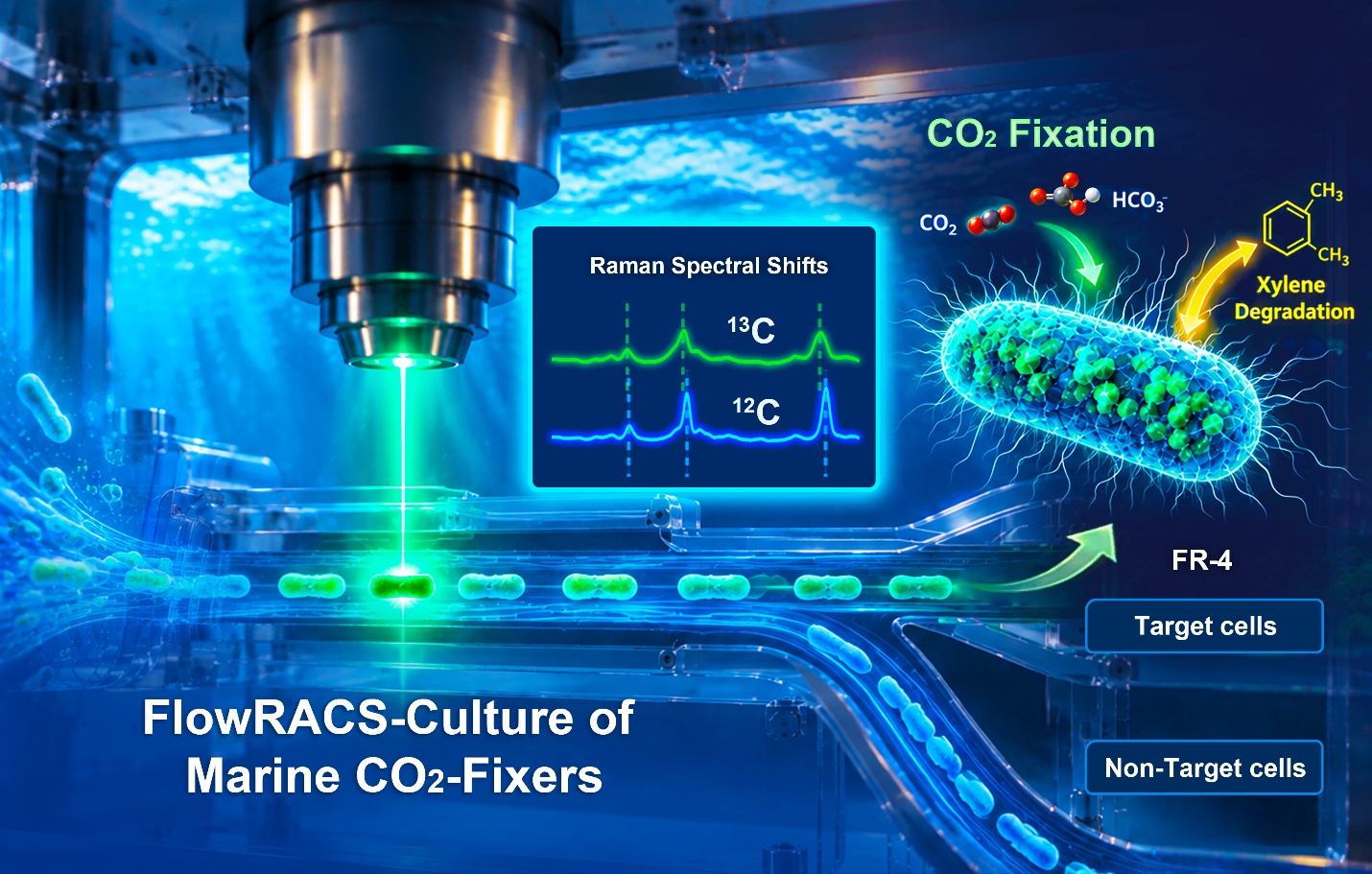
FlowRACS-based workflow for mining low-abundance functional marine microorganisms (Image by QIBEBT)
<関連情報>
- https://english.cas.cn/newsroom/research-news/202609/t20260929_1201569.shtml
- https://www.sciencedirect.com/science/article/abs/pii/S0960852426018572
フローモードラマン活性化細胞選別法による海洋性CO2固定細菌の機能スクリーニングおよび単細胞培養 Functional screening and single-cell cultivation of marine CO2-fixing bacteria via flow-mode Raman-activated cell sorting
Dong Cheng, Zhiguang Xu, Yishang Ren, Huihui Pan, Guangxia Ma, Zongze Shao, Emma Rocke, Xiaoyan Jing, Jian Xu
Bioresource Technology
Available online 9 September 2026
DOI:https://doi.org/10.1016/j.biortech.2026.135775
Highlights
- scRACS-Culture isolates active marine CO2-fixing bacteria within 7 days.
- Paraburkholderia aromaticivorans FR-4 couples nitrite oxidation with CO2 fixation.
- Strain FR-4 exhibits flexible metabolic autotrophy and xylene degradation.
Abstract
Most marine CO2-fixing microorganisms remain uncultivated due to strong culture bias and low throughput of conventional approaches, which fail to link in situ function with isolated strains and render slow-growing or low-abundance taxa virtually inaccessible. This study presents an integrated single-cell workflow that incorporates 13C-NaHCO3 labeling, high-throughput flow-mode Raman-activated cell sorting (RACS) and microwell cultivation for the isolation of active CO2-fixing bacteria from the Yellow Sea. Function-guided sorting was achieved by monitoring the 13C-induced Raman shifts of carotenoids (ν1 band: ∼1507 to ∼ 1503.78 cm−1 at 24 h). Genomic and physiological analyses identified Paraburkholderia aromaticivorans FR-4 as a novel facultative chemoautotrophic nitrite-oxidizing bacterium (NOB). Its genome encodes complete nitrite oxidation and Calvin cycle pathways, together with key carbon acquisition genes (carbonic anhydrase, bicarbonate transporter). FR-4 grows autotrophically using NO2− as the electron donor and CO2/HCO3− as the carbon source, confirming its ability to couple nitrite oxidation with carbon fixation, while retaining metabolic flexibility for heterotrophic growth. By directly linking in situ carbon-fixing activity, genotype, and phenotype, this workflow provides a targeted strategy for exploring elusive marine CO2-fixing bacteria and overcomes critical limitations of conventional cultivation.