2026-09-30 中国科学院(CAS)
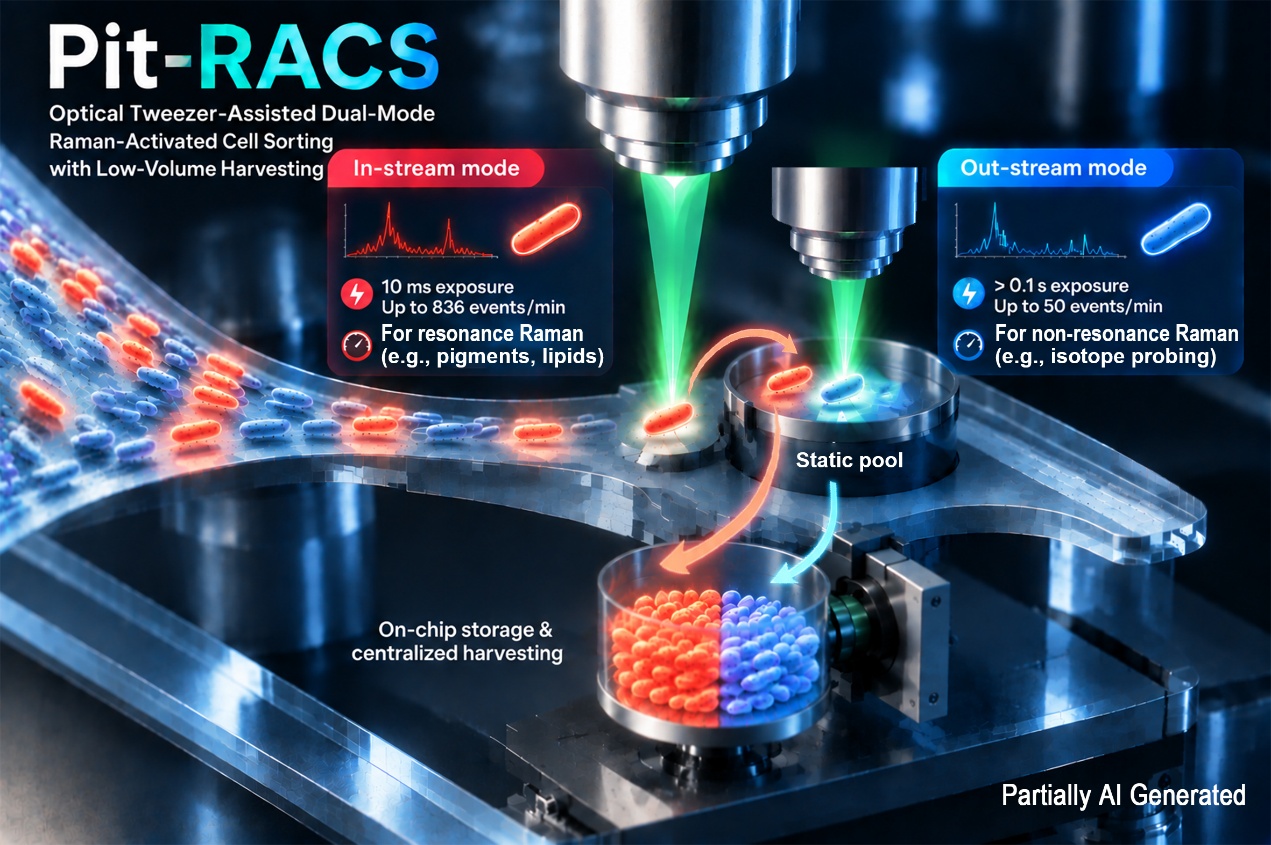
Pit-RACS combines two Raman-activated cell sorting modes on one microfluidic chip (Image by QIBEBT)
<関連情報>
- https://english.cas.cn/newsroom/research-news/202609/t20260930_1201619.shtml
- https://onlinelibrary.wiley.com/doi/10.1002/smtd.71037
高スループット二重共鳴モードおよび非共鳴モードラマン活性化細胞選別と少量回収 High-Throughput Dual Resonance and Non-Resonance Mode Raman-Activated Cell Sorting With Low-Volume Harvesting
Teng Xu, Pengfei Zhu, Yukuan Wang, Cuiyun Jia, Xibao Hou, Yang Zhang, Huijie Liu, Jingyun Song, Min He, Fangzhou Li, Dongfang Hao, Yilong Zhao, …
Small Methods Published: 12 September 2026
DOI:https://doi.org/10.1002/smtd.71037
ABSTRACT
Raman-activated cell sorting (RACS) platforms are limited by inflexibility in tackling different Raman signals and inability to export the sorted cells in a sufficiently low volume for downstream processing. Here, we present a generally applicable RACS platform that tackles these challenges. For adaptive dual-mode operation that supports diverse spontaneous Raman signals, microfluidic optical tweezers are designed with switchable capture strategies, with a high-throughput in-stream mode (up to 834 events/min) for resonance Raman signals with short exposures (<0.1 s) for resonance-Raman-based screening, and a high-precision out-stream mode (up to 50 events/min) for non-resonance Raman detection with extended exposures (>0.1 s). Moreover, to achieve low-volume concentrated harvesting, an on-chip storage and centralized harvesting mechanism delivers target cells in uniform 10 µL suspensions with >97% purity. Using the in-stream mode for resonance Raman screening, we isolated a Yarrowia lipolytica mutant with 77% increased β-carotene production in just one sorting round directly from a mutant library. Employing the out-stream mode for non-resonance Raman detection, we enriched phosphate-solubilizing bacteria from wastewater with nearly 100% recovery in concentrated 10 µL volumes, enabling direct function-targeted mini-metagenomics. This high-throughput dual-mode RACS platform with low-volume cell harvesting greatly expands the application of label-free live-cell sorting via metabolic phenome.