2026-10-16 東北医科薬科大学
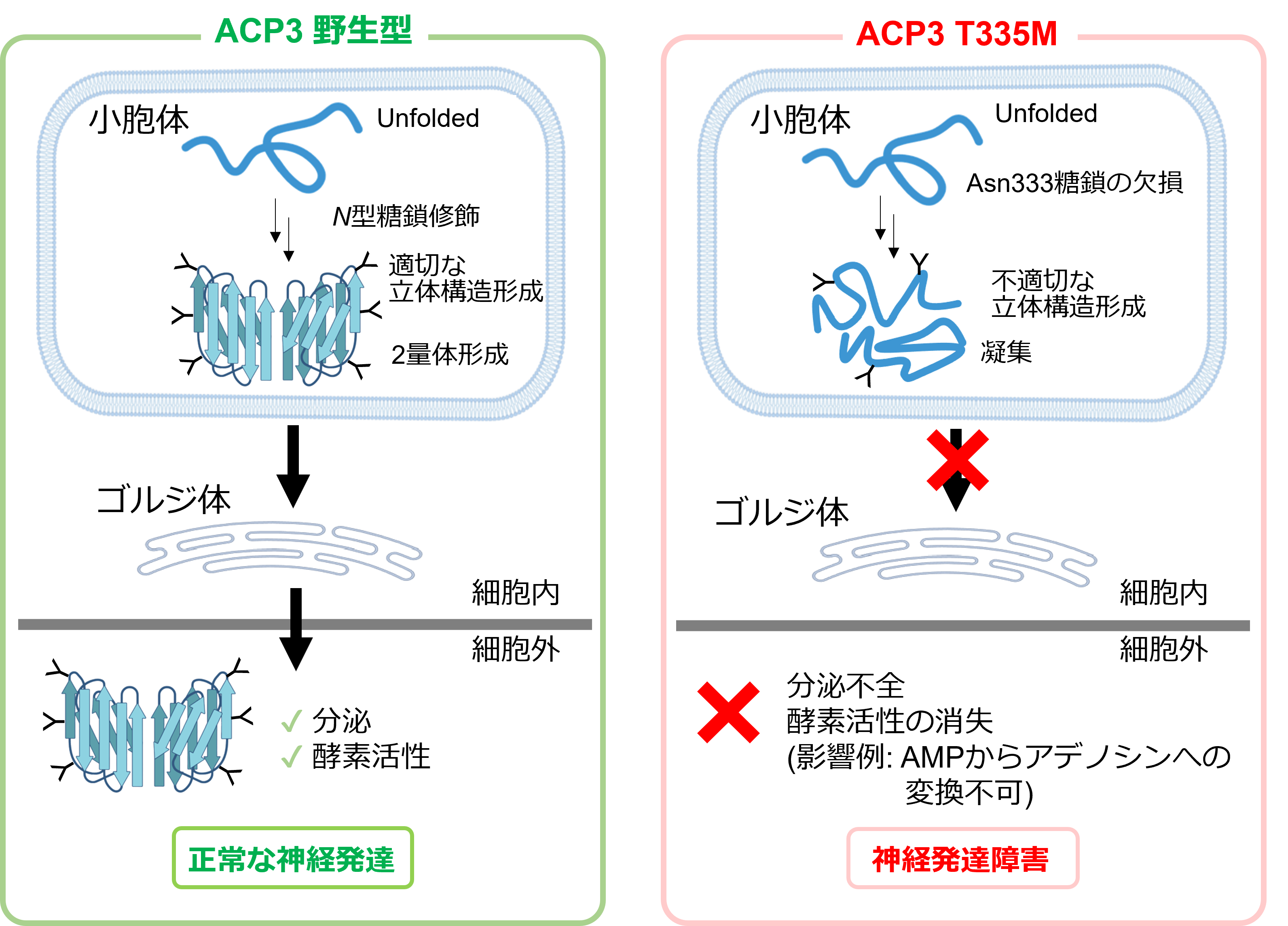
図 ACP3のT335Mバリアントが神経発達の障害につながる仕組み(推定)
<関連情報>
- https://www.tohoku-mpu.ac.jp/university/media-university/151027/
- https://www.cell.com/iscience/fulltext/S2589-0042(26)03127-5
ACP3の高マンノース型N-結合型糖鎖の喪失は、適切な立体構造形成を阻害し、疾患につながる機能障害を引き起こす Loss of the Asn333 high-mannose N-glycan impairs ACP3 folding and drives disease-associated dysfunction
Noriyoshi Manabe ∙ Kazuyoshi Itoh ∙ Shiho Ohno ∙ … ∙ Tadashi Kaname ∙ Shoko Nishihara ∙ Yoshiki Yamaguchi
iScience Published:October 7, 2026
DOI:https://doi.org/10.1016/j.isci.2026.117746
Highlights
- Site-specific glycoproteomics identifies Asn333 as a high-mannose N-glycosylation site
- The Asn333 N-glycan is required for efficient ER exit and secretion of ACP3
- Molecular dynamics simulations reveal structural stabilization by the Asn333 N-glycan
- Disease-associated T335M abolishes Asn333 glycosylation and impairs ACP3 folding
Summary
Missense mutations disrupting N-glycosylation motifs can perturb protein folding and trafficking, yet the site-specific contributions of individual N-glycans to proteostasis remain poorly defined. Here, we delineated the functional hierarchy of three N-glycosylation sites in human prostatic acid phosphatase (ACP3). Glycoproteomic analysis showed that Asn94 and Asn220 carry predominantly complex-type N-glycans, whereas Asn333 is enriched in high-mannose structures. Glycan-deficient N94Q and N220Q variants were efficiently secreted and retained phosphatase activity, whereas N333Q and T335M accumulated intracellularly, formed endoplasmic reticulum aggregates, and lacked enzymatic activity. Molecular dynamics simulations revealed that the Asn333 high-mannose glycan forms persistent hydrogen-bond networks with surrounding residues and exhibits markedly reduced conformational flexibility, supporting a non-redundant structural role. Individuals harboring a heterozygous p.T335M variant presented severe neurodevelopmental abnormalities, linking Asn333 glycan loss to proteostasis failure in vivo. These findings establish a site-specific glycan-protein stabilizing mechanism with broad implications in glycoprotein folding and human disease.