2026-11-04 東京大学病院
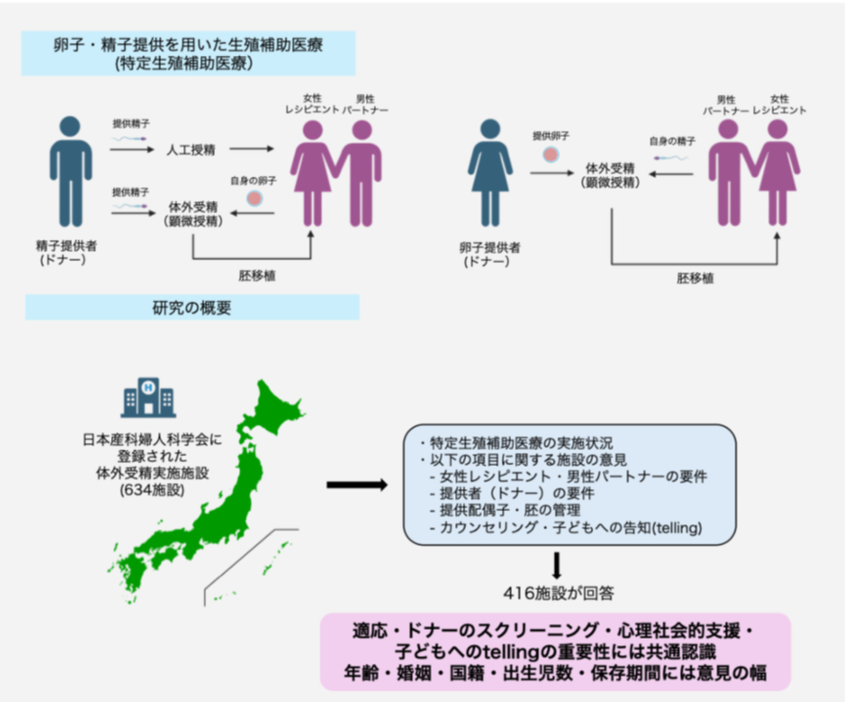
第三者から提供された配偶子を用いた生殖補助医療と全国調査の概要
<関連情報>
- https://www.h.u-tokyo.ac.jp/press/20261104.html
- https://www.h.u-tokyo.ac.jp/press/__icsFiles/afieldfile/2026/11/04/release_20261104.pdf
- https://onlinelibrary.wiley.com/doi/10.1002/rmb2.70108
日本における第三者配偶子を用いた生殖補助医療に関する機関の視点:生殖補助医療施設を対象とした全国調査 Institutional Perspectives on Assisted Reproductive Technology Using Third-Party Gametes in Japan: A Nationwide Survey of Assisted Reproductive Technology Facilities
Nozomi Takahashi, Miyuki Harada, Hiroshi Koike, Yuma Kawahara, Yasuji Kitabatake, Masayuki Kinutani, Tomoe Koizumi, Maki Suganuma, Norihiro Sugino, Nao Suzuki, …
Reproductive Medicine and Biology Published: 03 November 2026
DOI:https://doi.org/10.1002/rmb2.70108
Abstract
Objective
To clarify institutional perspectives on assisted reproductive technology (ART) using third-party gametes.
Methods
We surveyed 634 facilities registered with the Japan Society of Obstetrics and Gynecology, and 416 responses were included in a descriptive analysis.
Results
Psychosocial and economic stability of ART recipient couples were considered necessary in most facilities (94.6%). Japanese nationality and legal marriage were necessary recipient criteria in 36.8% and 54.3% facilities, respectively. Lower and upper age limits for female recipients were 20–25 and 43–45 years, respectively, whereas most male partners had no upper age limit (34.6%–36.6%). The most common upper age limit for oocyte donors was 35 years (67.9%). In contrast, upper age limits for sperm donors were more dispersed, with 40 years being the most common age at response to intrauterine insemination (35.6%) and in vitro fertilization (35.9%). The most accepted indications were hypergonadotropic hypogonadism for oocyte donation (87.5%) and failure to retrieve sperm via micro-testicular sperm extraction for donor sperm treatment (97.3%). Most facilities considered psychosocial support necessary.
Conclusions
This study provides a comprehensive overview of institutional perspectives on third-party ART in Japan. Although facilities showed substantial agreement on core principles, their views on specific eligibility and operational criteria varied.