2026-11-06 東京科学大学
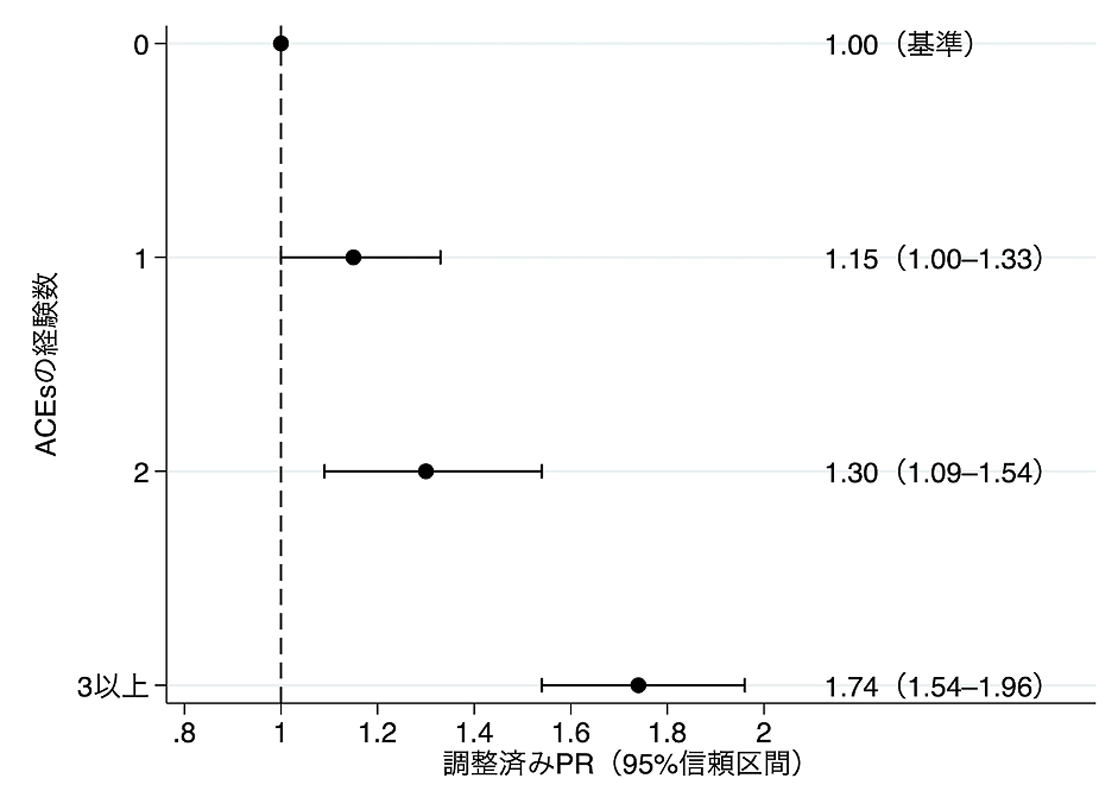
図1. ACEsの体験数と「子どもを持ちたくない」意向との関連(調整済みPR(Prevalence Ratio:有病割合比)
<関連情報>
- https://www.isct.ac.jp/ja/news/j89tshcp2qzx
- https://link.springer.com/article/10.1186/s12978-026-02447-1
幼少期の逆境体験と日本人若者の出生意気との関連性:全国横断研究 Association between adverse childhood experiences and fertility intention among Japanese youth: a nationwide cross-sectional study
Chiharu Ugajin, Shuhei Terada, Takahiro Tabuchi & Takeo Fujiwara
Reproductive Health Published:07 September 2026
DOI:https://doi.org/10.1186/s12978-026-02447-1 Early provide
Abstract
Background
Japan is experiencing a rapidly declining birthrate. Fertility intention predicts fertility behavior, and studies from South Korea and the United States have linked adverse childhood experiences (ACEs) to fertility intention, although findings have been inconsistent. The objective of this study was to examine the associations between ACEs and fertility intention among childless Japanese young adults aged 18–29.
Methods
Using data from the 2023 Japan COVID-19 and Society Internet Survey (JACSIS 2023), a nationwide, non-probability web panel, we analyzed a final sample of 4,222 childless individuals aged 18–29. Fertility intention was categorized as “wanted”, “unwanted”, or “uncertain”. ACEs were assessed using a Japanese instrument. Sex-stratified Poisson regression with robust variance assessed two contrasts: uncertain vs. definite fertility intentions (combining wanted and unwanted), and unwanted vs. wanted, adjusting for age and parental education.
Results
Among 4,222 participants, fertility intention was classified as wanted in 47.8%, unwanted in 23.0%, and uncertain in 29.2%. Compared with no ACEs, individuals with ≥ 3 ACEs were more likely to report an intention not to have children among participants with definite fertility intention (men: PR = 1.52, 95% CI: 1.26–1.84; women: PR = 1.93, 95% CI: 1.64–2.26), with a graded association across ACE-count categories (P for trend < 0.001). Emotional abuse was associated with an intention not to have children in both sexes; in exploratory item-specific analyses, parental overcontrol had the largest point estimate among women. ACEs were not clearly associated with uncertain versus definite fertility intention.
Conclusions
ACEs were associated with an intention not to have children among childless Japanese young adults. These findings suggest that ACEs may represent one life-course factor associated with fertility intention and highlight the potential relevance of early-life adversity to reproductive health policy and practice.
Trial registration
Not applicable.