2026-11-04 ロックフェラー大学
<関連情報>
- https://www.rockefeller.edu/news/40850-mating-food-odor-social-environment/
- https://www.nature.com/articles/s41586-026-11209-9
- https://www.nature.com/articles/s41586-024-08028-1
生態学的および社会的合図がショウジョウバエの協調的な求愛行動を統制する Ecological and social cues orchestrate concerted courtship in Drosophila
Philipp Brand, Katharine Keller, Rory T. Coleman, Noelle B. Eghbali, Sarah Zylka, Lucia L. Prieto-Godino & Vanessa Ruta
Nature Published:04 November 2026
DOI:https://doi.org/10.1038/s41586-026-11209-9
Abstract
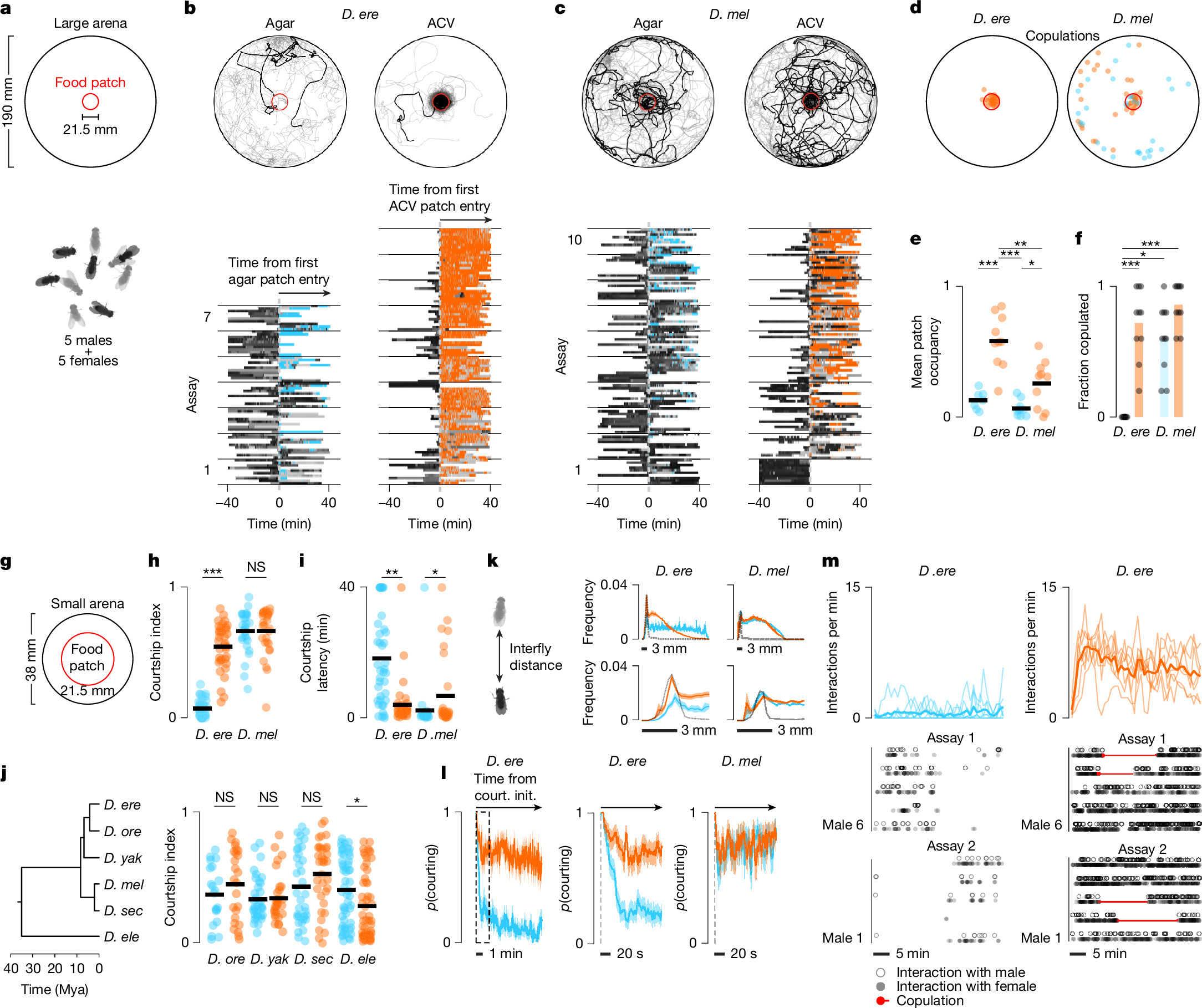
Mating decisions are often attributed to the sensory signalling between prospective sexual partners. Yet these interactions are also shaped by the broader environmental context in which they unfold, to appropriately align sexual arousal with reproductive opportunities1,2,3,4,5,6. Here we show that in Drosophila erecta mating is strictly contingent on the ecological and social environment generated as flies densely aggregate in groups on a food patch. We find that food volatiles directly promote male sexual arousal, triggering individuals to sample and pursue potential mates, giving rise to dynamic interactions across the group. The ensuing visual motion transforms each male’s visual field, which in turn further amplifies his arousal, generating a multisensory feedback loop that coordinately promotes courtship across individuals. D. erecta’s strict dependence on environmental cues appears latent in related species, such as Drosophila melanogaster, where food odour can promote arousal7 but is dispensable for vigorous courtship. Comparative circuit analyses show that species-specific thresholds for sexual arousal reflect variation in how olfactory input modulates conserved nodes controlling courtship drive, rendering food volatiles a strict sensory gate only in D. erecta. Together, our findings highlight how environmental cues not directly tied to sexual signalling can profoundly influence reproductive behaviour and reorganize the social landscape to ensure mating occurs in contexts where reproductive opportunities are abundant.
モジュール回路が求愛戦略の多様化を調整する A modular circuit coordinates the diversification of courtship strategies
Rory T. Coleman, Ianessa Morantte, Gabriel T. Koreman, Megan L. Cheng, Yun Ding & Vanessa Ruta
Nature Published:09 October 2024
DOI:https://doi.org/10.1038/s41586-024-08028-1
Abstract
Mate recognition systems evolve rapidly to reinforce the reproductive boundaries between species, but the underlying neural mechanisms remain enigmatic. Here we leveraged the rapid coevolution of female pheromone production and male pheromone perception in Drosophila1,2 to gain insight into how the architecture of mate recognition circuits facilitates their diversification. While in some Drosophila species females produce unique pheromones that act to arouse their conspecific males, the pheromones of most species are sexually monomorphic such that females possess no distinguishing chemosensory signatures that males can use for mate recognition3. We show that Drosophila yakuba males evolved the ability to use a sexually monomorphic pheromone, 7-tricosene, as an excitatory cue to promote courtship. By comparing key nodes in the pheromone circuits across multiple Drosophila species, we reveal that this sensory innovation arises from coordinated peripheral and central circuit adaptations: a distinct subpopulation of sensory neurons has acquired sensitivity to 7-tricosene and, in turn, selectively signals to a distinct subset of P1 neurons in the central brain to trigger courtship. Such a modular circuit organization, in which different sensory inputs can independently couple to parallel courtship control nodes, may facilitate the evolution of mate recognition systems by allowing novel sensory modalities to become linked to male arousal. Together, our findings suggest how peripheral and central circuit adaptations can be flexibly coordinated to underlie the rapid evolution of mate recognition strategies across species.