2026-10-15 愛媛大学
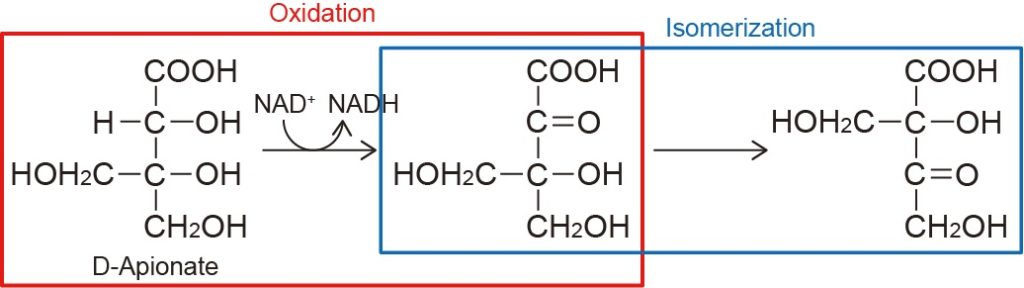
ApnOの触媒する反応
<関連情報>
- https://www.ehime-u.ac.jp/data_relese/pr_20261015_agr/
- https://www.sciencedirect.com/science/article/pii/S0021925826025007
ApnOによる酸化と共役した異性化反応の構造基盤 Structural basis for oxidation-coupled isomerization by ApnO
Seiya Watanabe, Yuzuki Aono, Shin-ichi Terawaki, Himika Sato, Taiyo Yokoi
Journal of Biological Chemistry Available online: 9 October 2026
DOI:https://doi.org/10.1016/j.jbc.2026.113628
Summary
D-Apionate oxidoisomerase (ApnO), involved in D-apiose metabolism from bacteria, is one of the few examples of the enzymes that catalyze two different reactions within a single active site, whereas there is no functional orthologue with significant sequence identity. Based on genome context, we found that ApnO additionally utilizes D-erythronate and D-ribonate as substrates, which made it possible to functionally characterize the enzyme. Crystallographic studies (using anomalous dispersion analysis) revealed that the overall folding of ApnO was similar to that of ketol-acid reductoisomerase (KARI), with two magnesium ions at sites II and I, and that the purified (inactive) enzyme contained one zinc ion at site II (and NAD+). Further crystallization in the presence of manganese ion led to the binding of manganese ions at both sites II and I. Among them, the coordination geometry at site II was uniquely tetrahedral, differed from the typical octahedral geometry observed at site I. Several crystal structures in complex with malonate and/or its derivative inhibitor, together with substrate docking simulations, showed a mechanism of oxidation-coupled isomerization similar to that of KARI via a cyclopropane transition state, whereas only four active site residues around the metal ion binding site I were conserved between ApnO and KARI, suggesting that they convergently acquired the second metal ion binding site (site II) in evolutional stage.