2026-11-05 中国科学院(CAS)
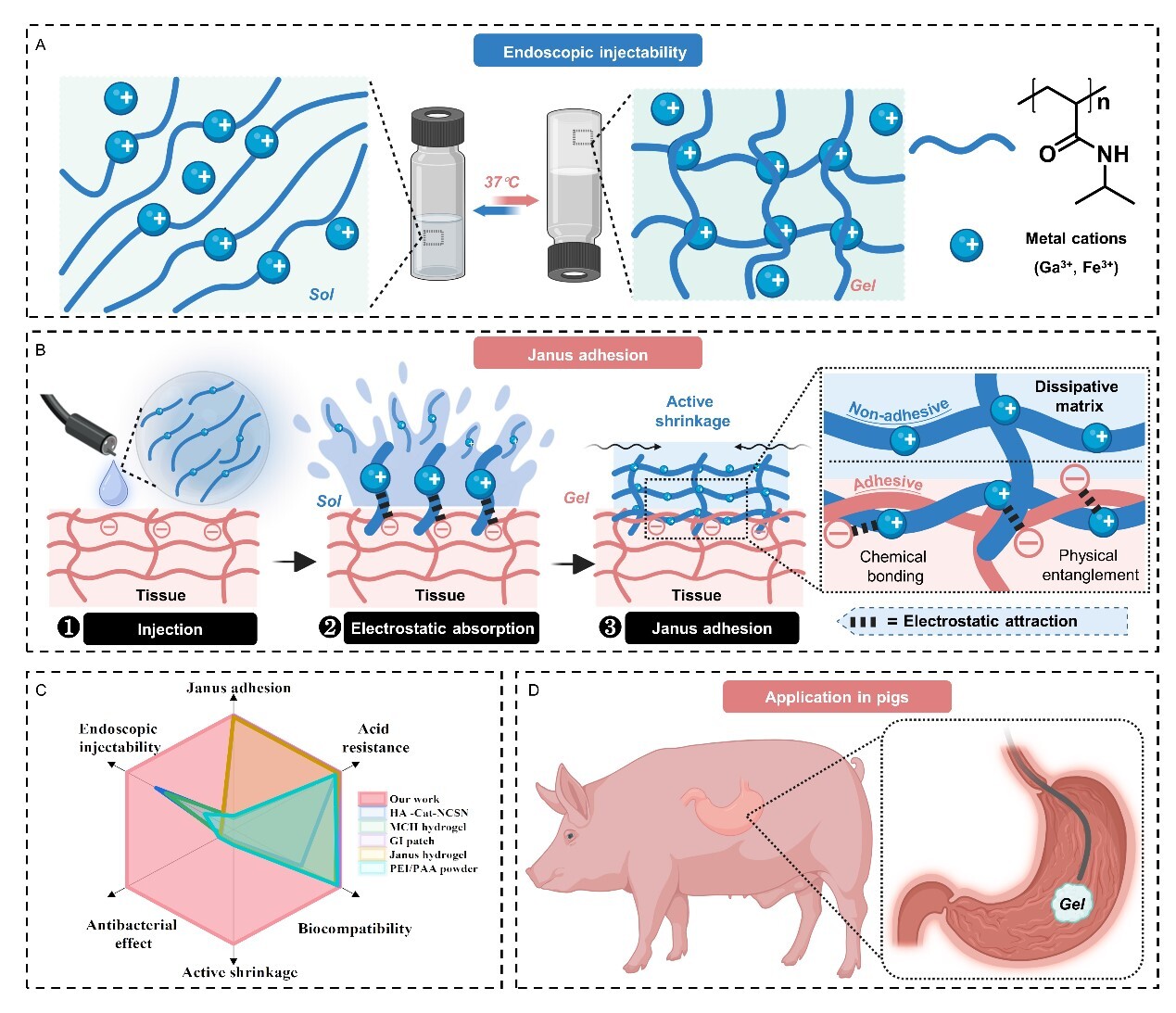
Schematic illustration of the mechanism and in vivo application of the injectable Janus adhesive hydrogel (Image by LIANG Sen)
<関連情報>
- https://english.cas.cn/newsroom/research-news/202611/t20261104_1213187.shtml
- https://www.nature.com/articles/s41551-026-01820-6
内視鏡的消化管瘻修復のための、単一ステップで注入可能なヤヌス接着性ハイドロゲル A single-step injectable Janus-adhesive hydrogel for endoscopic gastrointestinal fistula repair
Sen Liang (梁森), Jingtao Li (李靖涛), Qi Li (李琦), Tianhe Jiang (江天禾), Yajie Tian (田雅洁), Qingquan Han (韩青权), Yafeng Jing (荆雅峰), Shuai Wang (王帅), Jieling Li (李洁龄), Anhe Wang (王安河) & Shuo Bai (白硕)
Nature Biomedical Engineering Published:30 October 2026
DOI:https://doi.org/10.1038/s41551-026-01820-6
Abstract
Gastrointestinal fistulas (GFs) represent one of the main causes of morbidity and mortality. While endoscopic techniques provide a minimally invasive approach to GF repair, offering advantages over conventional surgical approaches, the integration of endoscopic delivery with hydrogel sealants in user-friendly and easy processes approaches remains a great challenge. Here we develop a thermoresponsive positively charged poly(N-isopropylacrylamide) (PNIPAM)/Ga3+ (PGaIII) hydrogel sealant, formed by slug-inspired biomimetic self-assembly. The PGaIII integrated injectability and single-step-formed Janus-type adhesion to tissues, simultaneously featuring excellent biocompatibility, water/acid resistance, active shrinkage and antibacterial properties, enabling its effective ready-to-use biological sealant for endoscopic repair of GFs and prevention of postoperative adhesions. To validate the efficacy of PGaIII in treating GFs, we demonstrate its effectiveness in repairing GFs and its convenience in non-invasive endoscopic surgery in living Sprague–Dawley rat and Bama miniature pig models. The proposed PGaIII holds potential for the repair of fistulas in other organs in vivo, thereby promoting the establishment of safer and more effective clinical treatment options for related diseases.