2026-11-06 東京大学,科学技術振興機構
<関連情報>
- https://www.rcast.u-tokyo.ac.jp/ja/news/release/20261102.html
- https://www.nature.com/articles/s44511-026-00004-w
微生物ロドプシンの汎用残基番号付けシステム A generic residue-numbering system for microbial rhodopsins
Flurin S. Hidber, Seiya Tajima, Koichiro E. Kishi, Yosuke Nishimura, Susumu Yoshizawa, Xavier Deupi & Hideaki E. Kato
npj Structural Biology Published:05 November 2026
DOI:https://doi.org/10.1038/s44511-026-00004-w
Abstract
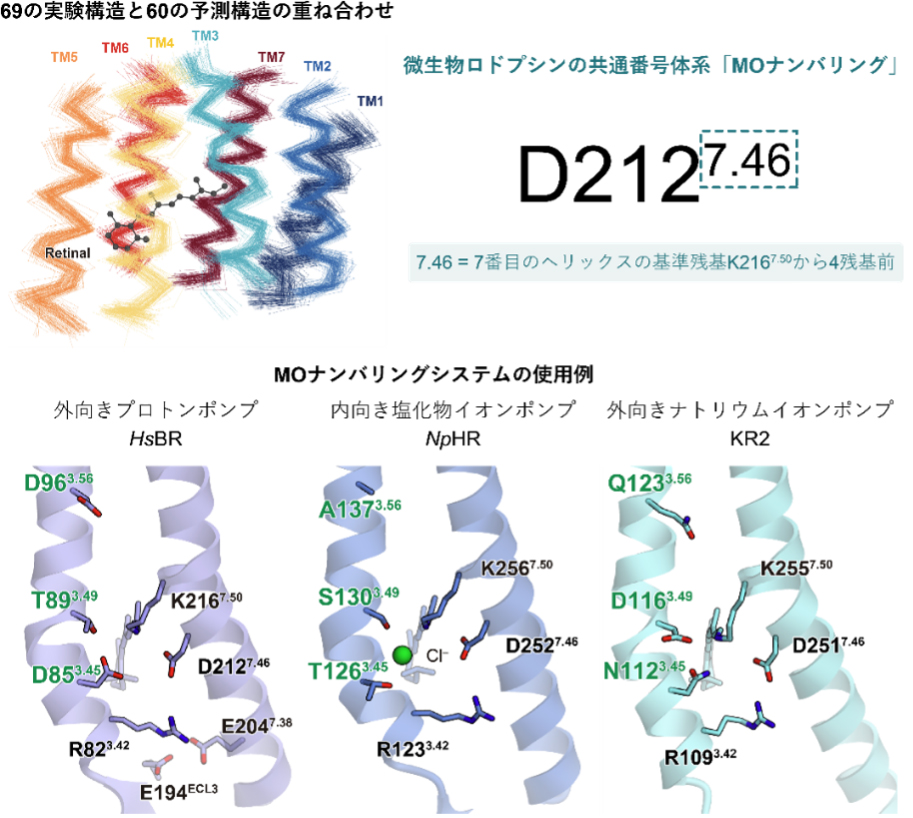
Microbial rhodopsins are photoreceptors with a conserved seven-transmembrane core architecture that use the chromophore retinal—a vitamin A derivative—to convert light absorption into ion transport, signaling, and enzymatic activity. Since their discovery half a century ago, genome sequencing has uncovered thousands of these proteins across archaea, bacteria, eukaryotes, and viruses, revealing a diverse functional repertoire that includes ion pumps and channels, transducer activators, and enzyme/channel regulators. Although the structure of the seven-transmembrane bundle core and the retinal-binding pocket is highly conserved, the sequence identity across major classes is low. This low sequence identity, combined with the rapidly expanding number of microbial rhodopsins identified by metagenomics, makes direct comparisons across the superfamily increasingly difficult. Here, we introduce a generic residue-numbering system for microbial rhodopsins (MO numbering system), a structure-guided framework anchored to the retinal-binding pocket that enables consistent residue comparison across even the most divergent family members. Analyzing 129 structures and approximately 40,000 sequences, we demonstrate its utility by analyzing sequence–structure–function relationships across the superfamily, including previously uncharacterized members. The MO numbering system provides a common language for organizing the growing repertoire of microbial rhodopsins, integrating structural, spectroscopic, and electrophysiological data, and engineering next-generation optogenetic tools.