2026-11-06 国立成育医療研究センター
<関連情報>
- https://www.ncchd.go.jp/press/2026/1106.html
- https://www.sciencedirect.com/science/article/pii/S0160412026004678
ネオニコチノイド系殺虫剤への出生前曝露と小児期のアレルギー疾患の経過:JECS出生コホートに基づく全国的なリスク評価 Prenatal exposure to neonicotinoid insecticides and childhood allergic disease trajectories: A nationwide risk assessment from the JECS birth cohort
Kiwako Yamamoto-Hanada,Limin Yang,Daisuke Harama,Miori Sato,Yumiko Miyaji,Kei Sakamoto,Minaho Nishizato,Aya Yoshikawa,Natsuhiko Kumasaka,Hidetoshi Mezawa,Maki Fukami,Yukihiro Ohya ,for the Japan Environment, Children’s Study JECS Group
Environment International Available online: 10 September 2026
DOI:https://doi.org/10.1016/j.envint.2026.110509
Highlights
- Prenatal neonicotinoid exposure and childhood AD/wheeze trajectories were evaluated.
- Four distinct AD and wheeze trajectories were identified.
- Several nominal associations were observed before multiple-testing correction.
- No robust associations remained after Benjamini-Hochberg correction.
- Low-level prenatal neonicotinoid exposure showed limited allergy risk.
Abstract
Background
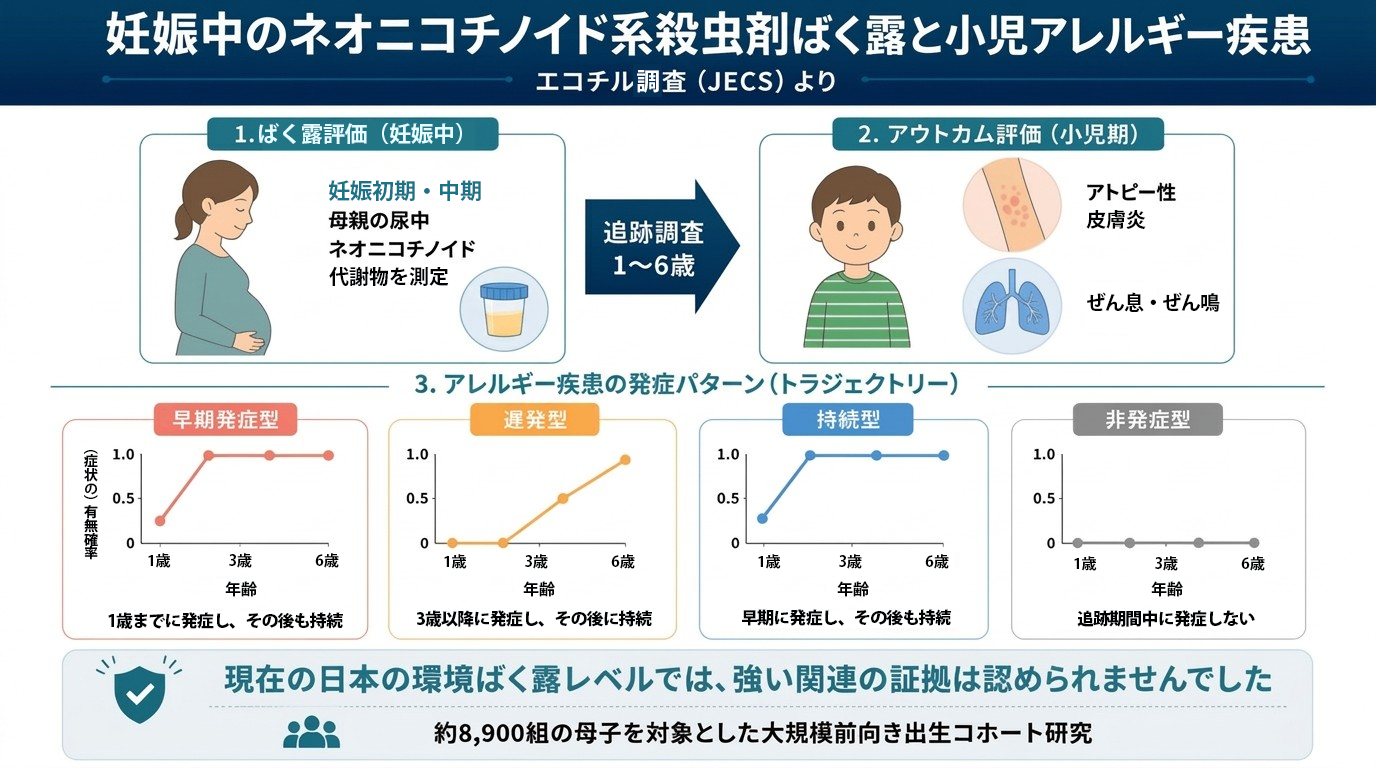
Neonicotinoid insecticides are widely used globally, raising concerns about their impact on human health, particularly during the vulnerable prenatal period. However, long-term epidemiological evidence regarding their role in childhood allergic disease development remains unclear. This study evaluated the association between prenatal neonicotinoid exposure and longitudinal trajectories of atopic dermatitis (AD) and wheeze in early childhood to provide data for environmental risk assessment.
Methods
Using data from the Japan Environment and Children’s Study (JECS), we analyzed a nationwide sub-cohort of approximately 8,900 mother–child pairs. Neonicotinoid concentrations were measured in maternal urine during early and mid-pregnancy. Disease trajectories (1–6 years) for AD and wheeze were identified using Latent Class Growth Analysis (LCGA). Multivariable logistic regression was used to estimate the association between exposure levels and trajectory phenotypes, focusing on the impact of background environmental exposure.
Results
Four distinct trajectories were identified for both AD and wheeze. In the multivariable analyses, several nominal associations were observed (e.g., ACE and late-onset AD: aOR 1.67, 95 % CI 1.09–2.54); however, none remained statistically significant after Benjamini–Hochberg correction. Overall, prenatal exposure to neonicotinoids at current environmental levels in Japan was not consistently associated with any specific trajectory of AD or wheeze.
Conclusion
We found no robust and consistent evidence of an association between prenatal neonicotinoid exposure and childhood atopic dermatitis or wheeze trajectories in this Japanese cohort under relatively low background exposure conditions. Further studies in populations with different exposure profiles are warranted.