2026-11-06 東京科学大学
東京科学大学の研究チームは、ヒトT細胞白血病ウイルス1型(HTLV-1)に関連する炎症に対し、エピジェネティクスを標的とするEZH1/2阻害薬が有効な治療戦略となる可能性を示した。HTLV-1は成人T細胞白血病やHTLV-1関連脊髄症、ぶどう膜炎などを引き起こすウイルスで、従来のぶどう膜炎治療は主にステロイドによる炎症抑制が中心だった。研究チームはHTLV-1感染T細胞と眼の細胞を組み合わせたモデルを用いて、EZH1/2阻害薬の作用を解析した。その結果、薬剤はヒストン修飾の一種であるH3K27me3を減少させ、感染T細胞ではウイルスのプロウイルス量と遺伝子発現を低下させた。また、眼細胞における炎症性サイトカインやケモカインの産生、炎症シグナルにも変化が認められた。感染細胞そのものと周囲の炎症環境の双方に作用するという、新しい治療アプローチにつながる成果である。
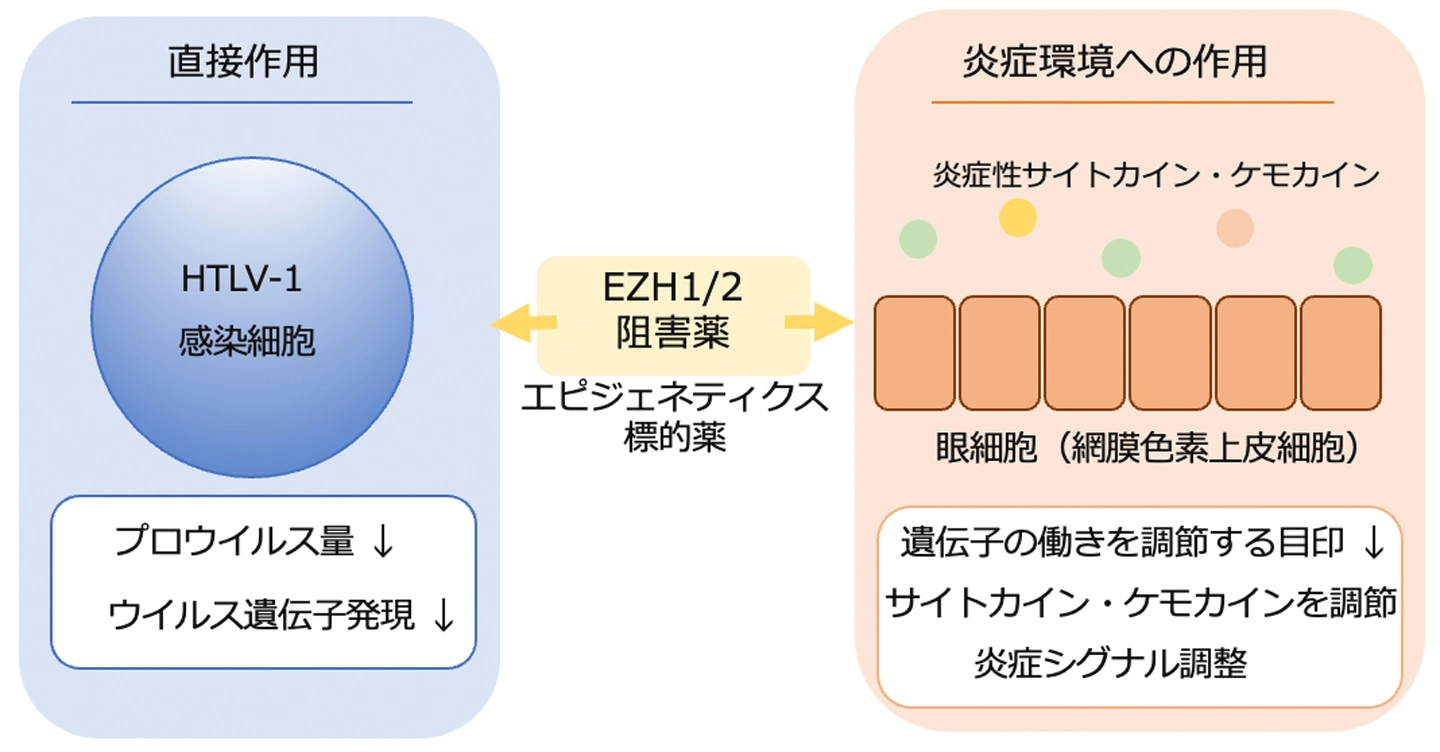
図1. エピジェネティクス標的薬が感染細胞と炎症環境に働きかける新たな治療戦略
<関連情報>
HTLV-1関連炎症におけるEZH1/2標的療法の二重効果:直接的および間接的メカニズム
Dual impact of EZH1/2-targeted therapy in HTLV-1-associated inflammation: Direct and indirect mechanisms
Yaru Zou ∙ Koju Kamoi ∙ Mingming Yang ∙ Yuan Zong ∙ Jing Zhang ∙ Kyoko Ohno-Matsui
iScience Published:October 8, 2026
DOI:https://doi.org/10.1016/j.isci.2026.117775
Highlights
•HTLV-1 exposure upregulates EZH1/2 and H3K27me3 in retinal pigment epithelial cells
•Valemetostat reduces H3K27me3 in HTLV-1-exposed ocular models
•Valemetostat directly lowers proviral load and transcription in infected T cells
•Valemetostat indirectly modulates inflammatory signaling in HTLV-1-associated models
Summary
Human T cell leukemia virus type 1 (HTLV-1)-associated inflammation, including uveitis, lacks effective targeted therapies. Here, we investigated whether epigenetic modulation through EZH1/2 inhibition could influence HTLV-1-related ocular inflammation using in vitro co-culture and infection models. HTLV-1 exposure increased EZH1 and EZH2 expression and the repressive histone mark H3K27me3 in retinal pigment epithelial cells. Treatment with the dual EZH1/2 inhibitor valemetostat reduced H3K27me3 levels. Valemetostat showed limited effects on cell viability and induced only modest, context-dependent apoptosis. Virological analyses showed model-dependent changes in proviral load, accompanied by reduced viral gene expression. Profiling of cytokines and chemokines revealed context-dependent modulation of inflammatory mediators. Functional assessment using p65 nuclear translocation assays indicated partial attenuation of NF-κB activation under inflammatory stimulation. Collectively, these findings suggest that EZH1/2-mediated epigenetic regulation is primarily involved in HTLV-1-related inflammatory responses, and that inhibiting EZH1/2 may be a potential approach to modulate inflammatory signaling.