2026-09-25 東京大学
NMR 測定に向けたヒト細胞を用いた重水素標識法の開発
<関連情報>
- https://www.u-tokyo.ac.jp/focus/ja/press/z0111_00102.html
- https://www.u-tokyo.ac.jp/content/400296640.pdf
- https://pubs.acs.org/jacsat/article-abstract/doi/10.1021/jacs.6c11086/5440195/High-Level-Deuteration-in-Mammalian-Cells-for-NMR
膜タンパク質のNMR研究のための哺乳類細胞における高レベル重水素化 High-Level Deuteration in Mammalian Cells for NMR Studies of Membrane Proteins
Taiga Yamamoto;Yutaka Kofuku;Yutaro Ogaeri;Qingci Zhao;Noritaka Nishida;Takumi Ueda;Yuki Toyama;Ichio Shimada;Koh Takeuchi
Journal American Chemical Society Published:September 28, 2026
DOI:https://doi.org/10.1021/jacs.6c11086
Abstract
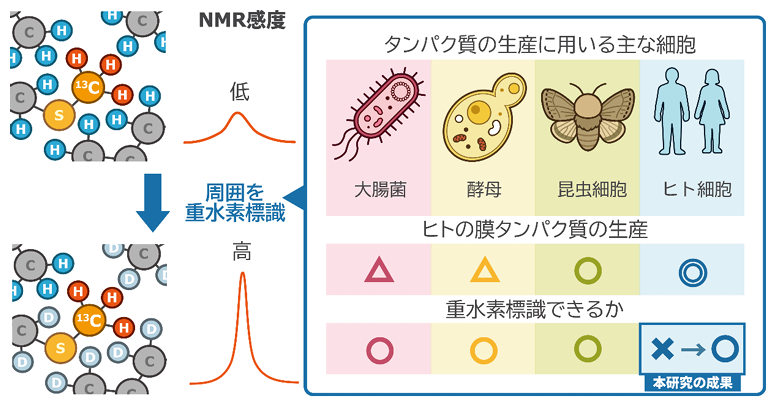
Membrane proteins and their complexes play essential roles in various biological processes and are, therefore, major targets in drug development. Although atomic-resolution structures of many membrane proteins are available, probing their function-associated dynamics remains essential to understand their molecular mechanisms. In this study, we developed an isotope-labeling method using mammalian cells for high-sensitivity NMR studies of membrane proteins and their complexes. Using Expi293F cells, we established a strategy to achieve high-level (>70%) deuteration and 13C-methyl selective labeling. An application to a human GPCR, β2-adrenergic receptor (β2AR), resulted in marked line narrowing and a three- to four-fold increase in the S/N ratio. We also found that the inverse agonist-bound β2AR adopted three distinct conformations, one of which has not been clearly identified without the extensive deuteration. Furthermore, the strategy enables the NMR detection of the human membrane protein complex CD19-CD81, an essential co-receptor in B-cell activation, validating their stable interaction. The strategy developed here substantially expands the utility of NMR for various biological and pharmacological studies that require mammalian cell systems.