2026-09-28 合肥物質科学研究院(HFIPS)
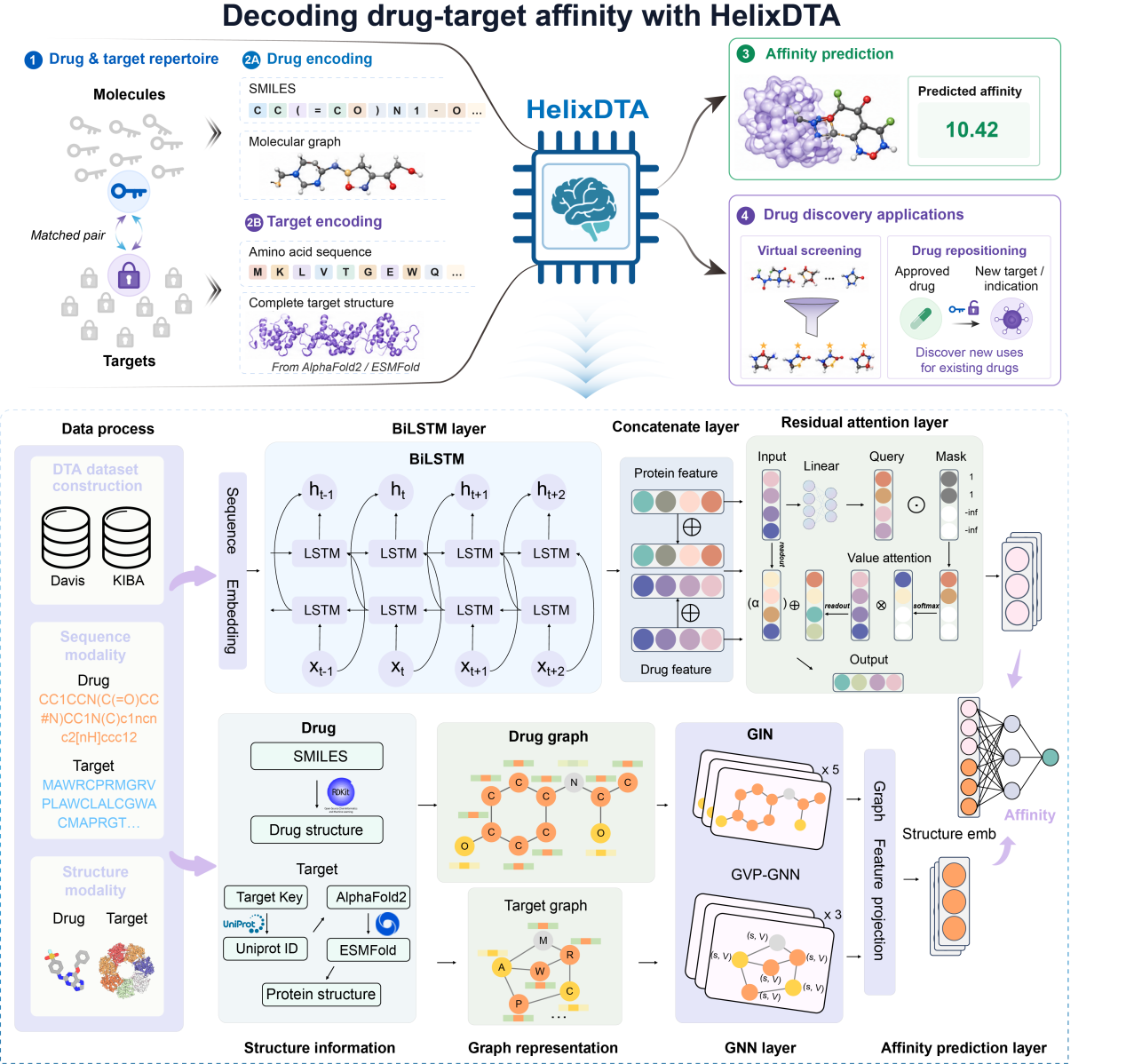
Framework of HelixDTA (Image by ZHANG Fan)
<関連情報>
- https://english.hf.cas.cn/nr/rn/202609/t20260928_1201550.html
- https://pubs.acs.org/jcisd8/article-abstract/doi/10.1021/acs.jcim.6c01759/5431446/HelixDTA-Dual-Branch-Sequence-Structure-Learning
HelixDTA:完全な標的構造を用いた二分岐配列構造学習による、堅牢かつ解釈可能な薬剤標的親和性予測 HelixDTA: Dual-Branch Sequence–Structure Learning with Complete Target Structures for Robust and Interpretable Drug–Target Affinity Prediction
Shang Lou;Xuhua Li;Yujie Peng;Yuan Yuan;Bo Peng;Yingyu Yi;Xuchao Zhang;Hailong Zhao;Beilei Wang;Kun Li;Hong Qian;Tao Ren;Hongcang Gu;Fan Zhang
Journal of Chemical Information and Modeling Published:September 16, 2026
DOI:https://doi.org/10.1021/acs.jcim.6c01759
Abstract
Accurate prediction of drug–target affinity (DTA) is crucial for accelerating the discovery of drug candidates. Despite recent advances in machine learning methods, existing models often rely solely on either sequence information or protein pocket structures. This limitation prevents these models from fully capturing the critical three-dimensional (3D) physical information that governs molecular recognition, thus failing to meet the high-precision demands of drug discovery. To address this, we introduce HelixDTA, a deep learning framework featuring a parallel dual-branch architecture that independently learns representations from two distinct but complementary modalities: sequence context and complete target structures. By integrating sequence-derived features with structure-derived features at the prediction layer, this architecture preserves modality-specific insights while characterizing drug–target interactions more comprehensively. HelixDTA achieved strong and competitive performance on the Davis and KIBA benchmarks and maintained clear advantages across most similarity-based cold-start settings, demonstrating robust generalization to compounds with unseen scaffolds and novel protein targets. Furthermore, its built-in attention mechanism enhances interpretability by highlighting molecular regions that contribute to affinity prediction. Finally, a WRN case study demonstrates the potential use of HelixDTA for structure-aware allosteric candidate prioritization by integrating complete target-level structural context with docking-based pose inspection. In conclusion, HelixDTA offers a highly accurate, interpretable, and robust solution for DTA prediction. It highlights the value of integrating structural context with sequence-derived information and demonstrates significant potential to empower precision drug design and accelerate the drug discovery pipeline.