2026-09-28 合肥物質科学研究院(HFIPS)
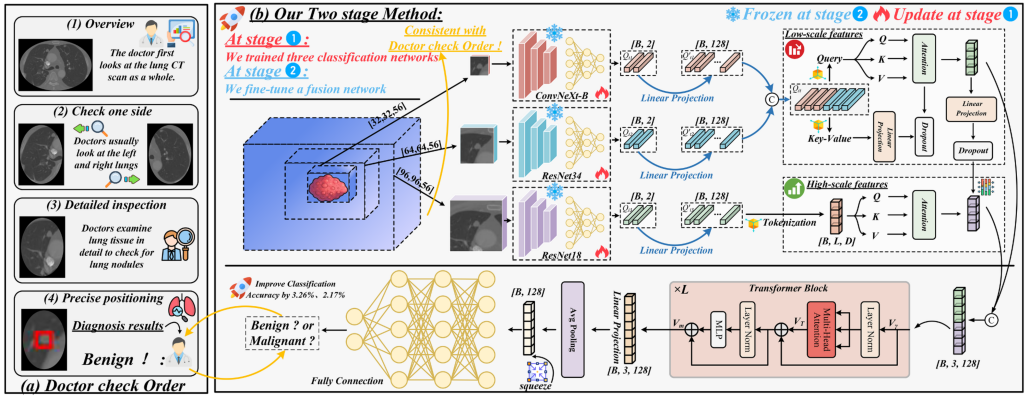
Workflow of the clinically inspired M3Net model for pulmonary nodule classification (Image by GE Dianlong)
<関連情報>
- https://english.hf.cas.cn/nr/rn/202609/t20260928_1201540.html
- https://www.sciencedirect.com/science/article/abs/pii/S1566253526002137
M3Net :肺結節分類のためのマクロ→メソ→ミクロの臨床的着想に基づく階層型3Dネットワーク M3Net: A macro → meso → micro clinical-inspired hierarchical 3D network for pulmonary nodule classification
Jinyue Li, Yuzhou Yu, Jingjing Yang, Meng Fu, Yani Zhang, Shuyao He, Dianlong Ge, Xin Ning, Yannan Chu, Qiankun Li
Information Fusion Available online: 29 March 2026
DOI:https://doi.org/10.1016/j.inffus.2026.104334
Highlights
- A clinically guided Macro-Meso-Micro (M3) 3D network enhances explainability in nodule classification.
- Progressive multi-scale fusion aligns model reasoning with radiologists’ hierarchical logic.
- Hierarchical cross-attention enables progressive reasoning across local and global cues.
- Experiments on LIDC-IDRI and clinical data show state-of-the-art performance and robustness.
Abstract
The accurate classification of benign and malignant pulmonary nodules in CT scans is critical for early lung cancer screening, yet remains challenging due to the multi-scale and heterogeneous nature of pulmonary nodules. While deep learning offers potential for auxiliary diagnosis, most existing models act as ”black boxes”, lacking the transparency and explainability required for trustworthy clinical integration. To address this issue, we propose M3Net, a novel 3D network for pulmonary nodule classification inspired by the hierarchical diagnostic workflow of radiologists, which integrates multi-scale contextual information from fine-grained structures to global anatomical relationships. Our framework constructs a progressive multi-scale input, from fine-grained nodule structures to local semantics and global spatial relationships. M3Net employs scale-specific encoders and ensures cross-scale semantic consistency through latent space projection and mutual information maximization. Extensive experiments on the public LIDC-IDRI dataset and a self-collected clinical dataset (USTC-FHLN) demonstrate that our method achieves state-of-the-art performance, with accuracies of 86.96% and 84.24% respectively, outperforming the best baseline by 3.26% and 2.17%. The results validate that M3Net provides a more robust and clinically relevant solution for pulmonary nodule classification. The code is available at https://github.com/jylEcho/M3-Net.