2026-09-28 スイス連邦工科大学ローザンヌ校(EPFL)
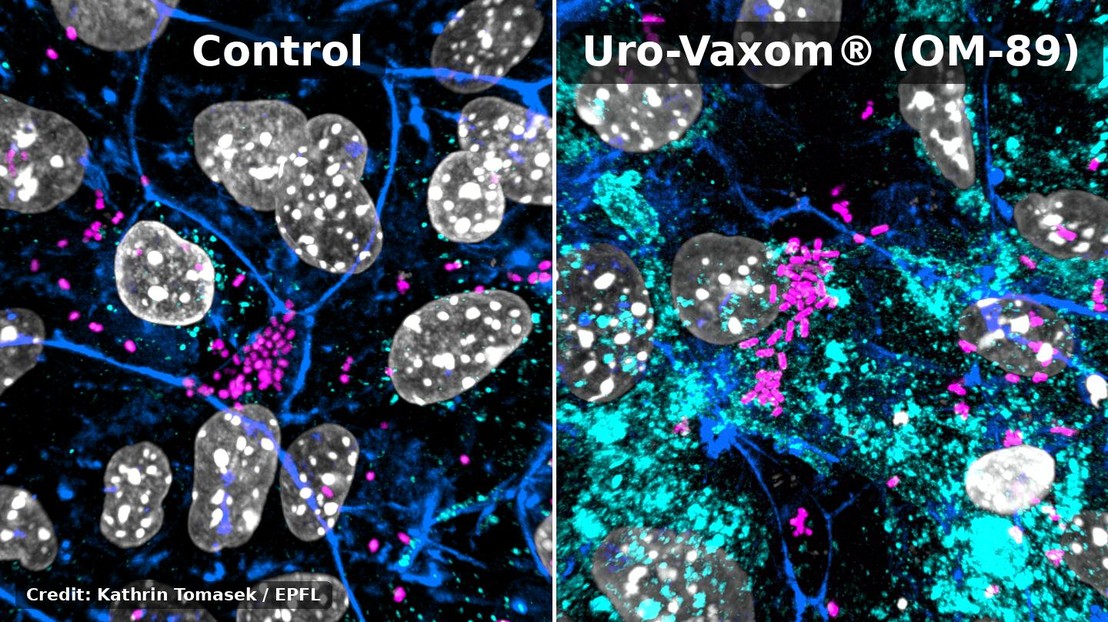
Image: Image of bladder epithelial cells infected with E. coli (magenta), untreated-control (left) or treated with Uro-Vaxom® (OM-89, right). Treatment strongly increases LAMP1-positive lysosomes (cyan). 2026 EPFL- Kathrin Tomasek- CC-BY-SA 4.0
<関連情報>
- https://actu.epfl.ch/news/helping-bladder-cells-to-clear-urinary-infections/
- https://journals.plos.org/plospathogens/article?id=10.1371/journal.ppat.1014448
膀胱上皮における標的リソソーム活性化は、細胞内尿路病原性大腸菌の除去を促進する Targeted lysosomal activation in bladder epithelium enhances clearance of intracellular uropathogenic Escherichia coli
Kathrin Tomasek,Kristina Skurvydaite,Gauri Paduthol,Allison M. Burns,Léa Schlunke,Valentin Borgeat,Christian Pasquali,Mario Romani,John D. McKinney
PLOS Pathogens Published: September 25, 2026
DOI:https://doi.org/10.1371/journal.ppat.1014448
Abstract
Recurrent urinary tract infections (UTIs) are a major clinical burden, driven in part by the ability of uropathogenic Escherichia coli (UPEC) to establish intracellular niches within the bladder epithelium, where bacteria withstand antibiotics and host defenses. The oral bacterial lysate OM-89 (Uro-Vaxom), a clinically approved and globally used therapy for the prevention and management of recurrent UTIs for several decades, reduces recurrence rates, but its cellular mechanisms of action remain incompletely understood. Here, we demonstrate that OM-89 strengthens antimicrobial defenses in bladder epithelial cells and, in combination with antibiotic therapy, limits post-antibiotic bacterial regrowth in epithelial infection models. OM-89 promotes lysosomal acidification and increases lysosomal protease activity in bladder organoids and differentiated epithelial monolayers, thereby directing intracellular UPEC toward degradative compartments. In parallel, OM-89 enhances intracellular accumulation of multiple antibiotic classes. These effects are conserved across distinct UPEC strains and in both murine and human epithelial models. Our findings demonstrate that bladder epithelial antimicrobial pathways can be pharmacologically reinforced to influence treatment outcomes by enhancing intracellular bacterial clearance.