2026-10-01 東北大学
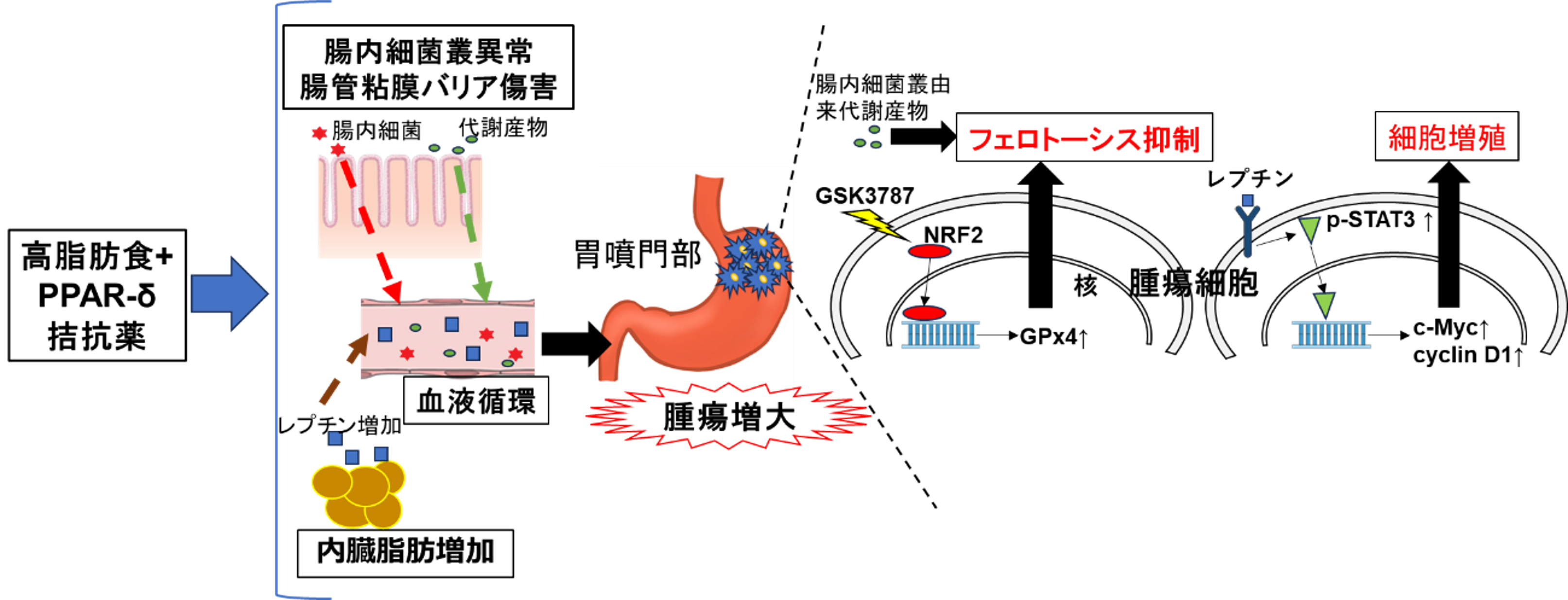
図1. 肥満症にともなう腸内環境異常が胃噴門部腺がんを進展させる
<関連情報>
- https://www.tohoku.ac.jp/japanese/2026/10/press20261001-04-tumorigenesis.html
- https://www.sciencedirect.com/science/article/pii/S2352345X26001785
フェロトーシスは肥満関連胃癌における代謝性炎症誘発性腫瘍形成を制御する Ferroptosis regulates metabolic inflammation-driven tumorigenesis in obesity-related gastric cancer
Mizuki Tanabe M.D., Kaname Uno M.D., Ph.D. , Toru Tamahara D.D.S., Naoki Asano M.D., Ph.D., Seizo Koshiba Ph.D., Keisuke Kusano M.D., Koya Ogasawara M.D., Yumiko Kaise M.D., Masahiro Saito M.D., Ph.D., Tomoyuki Koike M.D., Ph.D., Ritsuko Shimizu M.D., Ph.D., Atsushi Masamune M.D., Ph.D
Cellular and Molecular Gastroenterology and Hepatology Available online: 28 September 2026
DOI:https://doi.org/10.1016/j.jcmgh.2026.101900
Abstract
Background and Aims
The incidence of gastric cardia adenocarcinoma (GCA) has increased with increasing prevalence of metabolic syndrome (MetS). Peroxisome proliferator-activated receptor-delta (PPAR-δ) emerged as a key target in MetS and carcinogenesis. We aimed to elucidate its role in GCA progression.
Methods
Male K19-Wnt1/C2mE mice were fed a control or high-fat diet (HFD) with or without the PPAR-δ agonist GW-501516 or the PPAR-δ antagonist GSK-3787 (GSK). The involvement of nuclear factor erythroid 2–related factor 2 (Nrf2) in the PPAR-δ–regulated, metabolism–driven tumorigenesis was examined by comparing wild-type and Nrf2-deficient conditions.
Results
In HFD+GSK–treated K19-Wnt1/C2mE mice with metabolic endotoxemia, granular-nodular tumors at the squamocolumnar junction (SCJ) were greater than those in the other groups. Intratumor expression of the NAD(P)H quinone dehydrogenase 1 (NQO1) and glutathione peroxidase 4 (GPx4) proteins increased and the plasma levels of dysbiosis-related metabolites for tumor energy metabolism increased. In HFD+GSK–treated Nrf2-deficient mice, tumors shrank with decreases in NQO1 and GPx4 proteins expression and increases in the malondialdehyde level and GSSG/GSH ratio, and the plasma levels of metabolites for energy metabolism and ferroptosis resistance decreased. Suppression of PPAR-δ signaling in AGS cells treated with GSK or a small interfering RNA (siRNA) inhibited ferroptosis by increasing solute carrier family 7 member 11 (SLC7A11) expression and activating NRF2 signaling. Transfection with NRF2 siRNA decreased the GSK-induced upregulation of SLC7A11, and NRF2 directly regulates SLC7A11 transcription by binding to its promoter.
Conclusions
Cotreatment with HFD and GSK may promote SCJ tumor progression by suppressing ferroptosis through intratumoral NRF2 signaling and dysbiosis–related metabolites, indicating a negative role of PPAR-δ signaling on MetS-related SCJ tumorigenesis.