2026-09-30 東京科学大学
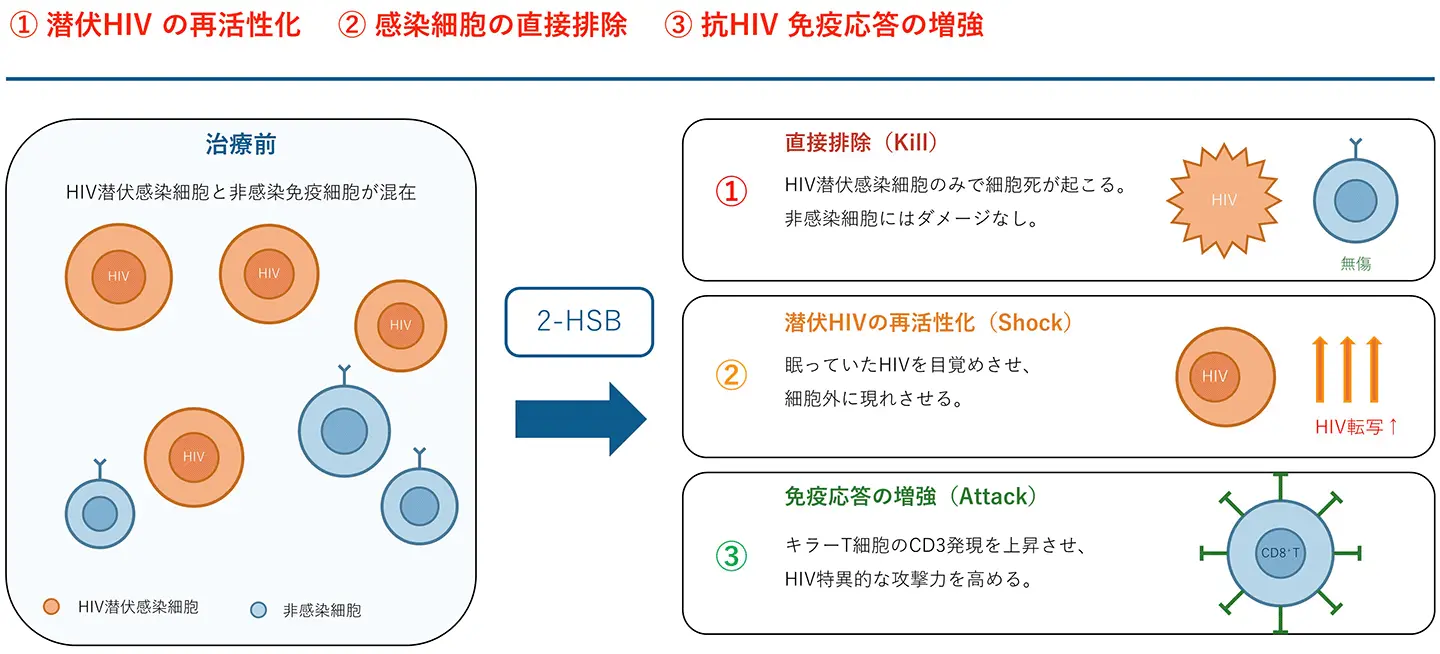
図. 2-HSB がもたらす「3本の矢」 ― (1)HIV潜伏感染細胞の直接排除、(2)潜伏HIVの再活性化、(3)抗HIV免疫応答の増強。単一の化合物が3つの効果を同時に発揮することで、HIV潜伏感染細胞を効率的に排除する可能性を示す。
<関連情報>
「ショック・アンド・キル」アプローチによるHIV排除を促進する新規低分子化合物の同定 Identification of a Novel Small Molecule Facilitating HIV Elimination by the “Shock-And-Kill” Approach
Yuichiro Hara, Haruki Kitamura, Kouki Matsuda, Chieko Fujisaki, Sayaka Sukegawa, Kosuke Tanimoto, Kenji Maeda, Hiroaki Takeuchi
Journal of Medical Virology Published: 31 August 2026
DOI:https://doi.org/10.1002/jmv.71131
ABSTRACT
Antiretroviral therapy (ART) has markedly improved the prognosis of people living with HIV (PLWH); however, latent viral reservoirs remain a major barrier to a cure. The “Shock and Kill” strategy aims to reactivate latent provirus with latency-reversing agents (LRAs) and subsequently eliminate the infected cells, yet most LRAs characterized to date provide only the “shock” component. Through screening a small-molecule library, we identified 2-hydrido-2,2′-spirobi(1,3,2-benzodioxaphosphole) (2-HSB) as a novel candidate that both reactivates latent HIV provirus and selectively induces cytopathic effects in latently infected reservoir cell lines, thereby exhibiting a dual “Shock and Kill” activity within a single compound. Mechanistically, the HIV-1 tat protein appears to contribute to this selectivity. At the single-cell level, the two effects appeared largely independent, indicating that, under the conditions tested, reactivation was not a consequence of cell death and vice versa. Importantly, 2-HSB induced viral transcription in ex vivo CD4+ T cells from ART-suppressed PLWH. Together, these findings identify 2-HSB as a dual-action candidate that reactivates latent HIV-1 and preferentially induces cytopathic effects in reservoir cell-line models, while supporting further mechanistic and ex vivo validation in primary reservoir-bearing cells.