2026-11-11 合肥物質科学研究院(HFIPS)
中国科学院合肥物質科学研究院の研究チームは、呼気に含まれる微量のジメチルスルフィド(DMS)を高感度に検出できる新型ガスセンサーを開発した。DMSは肝機能障害などに関連する呼気中の揮発性有機硫黄化合物であり、非侵襲的な肝疾患スクリーニングの指標として注目されている。しかし、呼気中のDMSは濃度が極めて低く、水蒸気や他のガス成分が共存するため、選択的な検出が難しい。今回の研究では、こうした干渉成分や高湿度環境下でもDMSを識別・検出できるセンサー技術を実現した。採血や侵襲的な検査を必要としない呼気分析への応用が期待され、肝疾患の早期発見や簡便な健康モニタリングに向けた新たな技術基盤となる。
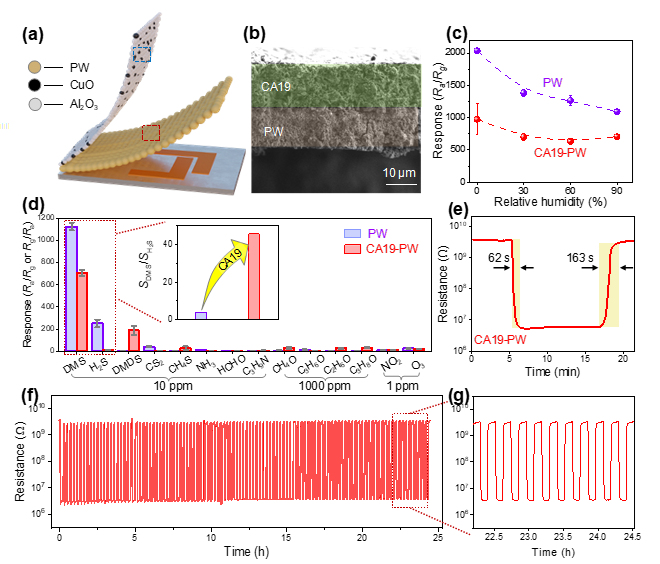
Schematic diagram, Scanning Electron Microscopy image, and gas sensing performances of the sensor (Image by DENG Zanhong)
<関連情報>
- https://english.hf.cas.cn/nr/rn/202611/t20261111_1213652.html
- https://pubs.acs.org/ancac3/article-abstract/20/42/28207/5451122/Exclusive-Detection-of-Dimethyl-Sulfide-by-a-Pd
CuO/Al₂O₃フィルター層を備えたPd–WO₃センサーによるジメチルスルフィド の 特異的検出 Exclusive Detection of Dimethyl Sulfide by a Pd–WO3 Sensor with the CuO/Al2O3 Filtering Overlayer
Ruofan Zhang; Xingxing Xie; Zanhong Deng; Jie Meng; Xiaohua Ji; Qi Zhang; Ruoqing Zhang; Siyuan Liu; Dandan Rong; Shimao Wang; Xiaodong Fang; Gang Meng
ACS Nano Published: October 14, 2026
DOI:https://doi.org/10.1021/acsnano.6c07624
Tii-summary
肝疾患の早期診断では、呼気中に含まれる微量のジメチルスルフィド(DMS)を高感度に検出することが重要である。しかし、呼気中には強い還元性を持つ硫化水素(H₂S)が共存し、金属酸化物半導体(MOS)センサーによるDMSの選択的検出を妨げる。本研究では、パラジウム担持酸化タングステン(Pd–WO₃)検知膜の上に、酸化銅(CuO)とアルミナ(Al₂O₃)からなるフィルター層を設けた二層構造のガスセンサーを開発した。CuOが室温付近でもH₂Sを触媒酸化できる性質を利用し、DMSを大きく消費することなくH₂Sを選択的に除去するとともに、Al₂O₃によってフィルター層自体の電気的応答が検知膜に干渉することを抑制した。CuO/Al₂O₃を1:9の割合で配合したフィルター層により、DMSとH₂Sに対する応答比は3.3から50.4に向上した。さらに、湿度90%の条件下で、10 ppmのDMSに対する応答値701.3、検出限界10 ppbを達成した。本技術は、呼気中の妨害ガスの影響を低減し、肝疾患の早期診断に向けた高選択性・高感度ガスセンサーの開発につながる成果である。
Early diagnosis of liver diseases requires sensitive detection of trace dimethyl sulfide (DMS) in exhaled breath. However, the presence of strongly reducing hydrogen sulfide (H₂S) interferes with the selective detection of DMS by metal oxide semiconductor (MOS) sensors. This study developed a bilayer gas sensor consisting of a palladium-modified tungsten trioxide (Pd–WO₃) sensing film and a copper oxide/alumina (CuO/Al₂O₃) filtering overlayer. The approach exploits the ability of CuO to catalytically oxidize H₂S even near room temperature, selectively removing the interfering gas without significantly consuming DMS. Dispersing CuO particles in an insulating Al₂O₃ matrix also prevents electrical interference from the filtering layer with the underlying sensing film. With a CuO/Al₂O₃ composition ratio of 1:9, the response ratio of DMS to H₂S increased from 3.3 to 50.4. The sensor additionally achieved a response value of 701.3 to 10 ppm DMS and a detection limit of 10 ppb under 90% relative humidity. These findings demonstrate a promising strategy for highly sensitive and selective breath analysis, potentially supporting the early diagnosis of liver diseases.
Early diagnosis of liver diseases requires sensitive detection of trace dimethyl sulfide (DMS) in exhaled breath. However, the presence of strongly reducing hydrogen sulfide (H₂S) interferes with the selective detection of DMS by metal oxide semiconductor (MOS) sensors. This study developed a bilayer gas sensor consisting of a palladium-modified tungsten trioxide (Pd–WO₃) sensing film and a copper oxide/alumina (CuO/Al₂O₃) filtering overlayer. The approach exploits the ability of CuO to catalytically oxidize H₂S even near room temperature, selectively removing the interfering gas without significantly consuming DMS. Dispersing CuO particles in an insulating Al₂O₃ matrix also prevents electrical interference from the filtering layer with the underlying sensing film. With a CuO/Al₂O₃ composition ratio of 1:9, the response ratio of DMS to H₂S increased from 3.3 to 50.4. The sensor additionally achieved a response value of 701.3 to 10 ppm DMS and a detection limit of 10 ppb under 90% relative humidity. These findings demonstrate a promising strategy for highly sensitive and selective breath analysis, potentially supporting the early diagnosis of liver diseases.
出典:ACS Nano, 20(42), 28207–28216 (2026)。出版社掲載のAbstractおよび書誌情報に基づく要約。