2026-10-07 国立循環器病研究センター
<関連情報>
- https://www.ncvc.go.jp/pr/release/pr_54637
- https://academic.oup.com/eurjpc/advance-article/doi/10.1093/eurjpc/zwag443/8869053
リポタンパク質(a)と頸動脈アテローム性動脈硬化症の連続性:プラーク形成から内腔狭窄まで:吹田研究 Lipoprotein(a) and the continuum of carotid atherosclerosis from plaque initiation to luminal stenosis: the Suita Study
Masayuki Teramoto, Yoshihiro Kokubo, Yuka Kato, Sakura Shinohara, Paramita Khairan, Yoko M Nakao, Jun Masui, Kanako Teramoto, Masatoshi Koga, Hiroharu Kataoka
European Journal of Preventive Cardiology Published:07 October 2026
DOI:https://doi.org/10.1093/eurjpc/zwag443
Abstract
Aims
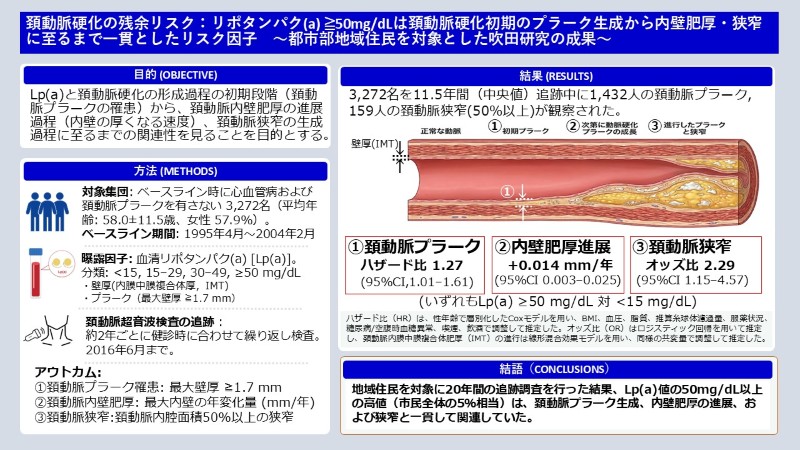
The aim of this study was to investigate the long-term association between lipoprotein(a) [Lp(a)] and the longitudinal continuum of carotid atherosclerosis, from initial plaque formation to progression to carotid stenosis, in a prospective study of a general Japanese population.
Methods and results
We studied 3272 participants in the Suita Study (mean age: 58.0 ± 11.5 years; 57.9% women) who were free of cardiovascular disease and carotid plaque at baseline (1995–2004). Follow-up carotid ultrasonography was performed biennially until June 2016. Incident carotid plaque was defined as a maximal intima–media thickness (IMT) ≥ 1.7 mm in the entire carotid artery. Progression from plaque to stenosis was defined as ≥50% stenosis in participants who developed plaques. We employed Cox proportional hazards models for incident plaques, linear mixed-effects models for annual IMT changes, and logistic regression for progression to stenosis. During a median follow-up of 11.5 years, 1432 participants developed carotid plaques. Compared with Lp(a) < 15 mg/dL, the multivariable-adjusted hazard ratio for incident plaque was 1.27 [95% confidence interval (CI), 1.01–1.61] for Lp(a) ≥ 50 mg/dL. Participants with Lp(a) ≥ 50 mg/dL had significantly accelerated annual progression of maximal IMT (β = 0.014 mm/year; 95% CI, 0.003–0.025) compared with those with Lp(a) < 15 mg/dL. Furthermore, high Lp(a) levels were associated with progression to ≥50% carotid stenosis (multivariable-adjusted odds ratio, 2.29; 95% CI, 1.15–4.57).
Conclusion
Elevated Lp(a) levels (≥ 50 mg/dL) were associated with the longitudinal continuum of carotid atherosclerosis, from plaque initiation to advanced stenosis. These findings suggest that high Lp(a) levels serve as a robust marker for long-term cardiovascular risk accumulation, highlighting the importance of screening and potential targeted interventions in individuals with Lp(a) ≥ 50 mg/dL.