2026-10-08 東京科学大学
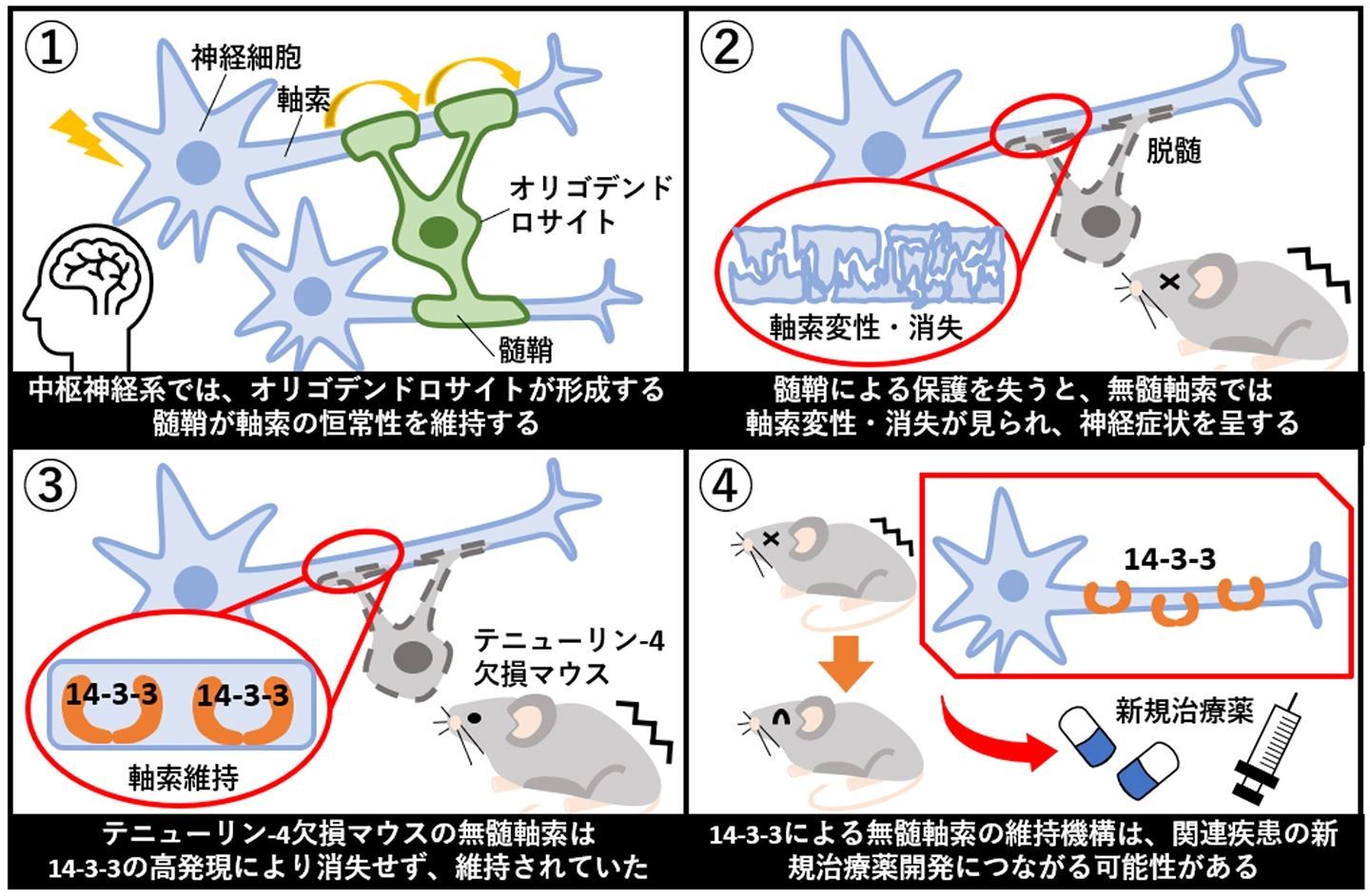
図1. 本研究成果の概要。
<関連情報>
中枢神経系における14-3-3タンパク質による脱髄小径軸索の維持 The Maintenance of Dysmyelinated Small-Diameter Axons by 14-3-3s in the Central Nervous System
Nanako Yamada, Hinako Saito, Riko Takahashi, Mio Fujisato, Yukina Hosoda, Binri Sasaki, Momona Yamada, Sakurako Abe, Chikako Hayashi, Akira Yoshimoto, …
GLIA Published: 09 September 2026
DOI:https://doi.org/10.1002/glia.70221
ABSTRACT
In the central nervous system, myelin formed around nerve axons by oligodendrocyte enables efficient conduction of action potentials and maintains axonal homeostasis. Therefore, in demyelinating diseases, such as multiple sclerosis (MS), axonal degeneration and loss, particularly in small-diameter axons, are observed. Teneurin-4 deficient (Ten-4 -/-) mice exhibit severe dysmyelination of small-diameter axons, but survive for over a year. Here, we aimed to elucidate the mechanism of the survival of small-diameter axons without myelin using Ten-4 -/- mice. An immunohistochemical analysis showed abnormally diffused and intense staining of neurofilament. Further, the immunohistochemical signal of nonphosphorylated neurofilament and amyloid precursor protein was higher in Ten-4 -/- mice. An electron microscopy analysis unexpectedly revealed that small-diameter axons in Ten-4 -/- mice survived at the age of 1 year, despite the absence of compact myelin. To elucidate the molecular mechanism, we performed a proteomics analysis in the Ten-4 -/- tissue by mass spectrometry. The result indicated that four of the seven 14-3-3 isoforms were highly expressed in Ten-4 -/- small-diameter axons. Finally, when the function of 14-3-3s in Ten-4 -/- mice was inhibited by 14-3-3 inhibitors, BV02 and difopein, the progression of small-diameter axon damage was observed. Altogether, 14-3-3s are among the pro-survival factors in dysmyelinated small-diameter axons. Our findings may be useful for better understanding the pathogenesis of demyelinating diseases, such as MS, as well as for the development of new treatments.