2026-10-08 東京科学大学
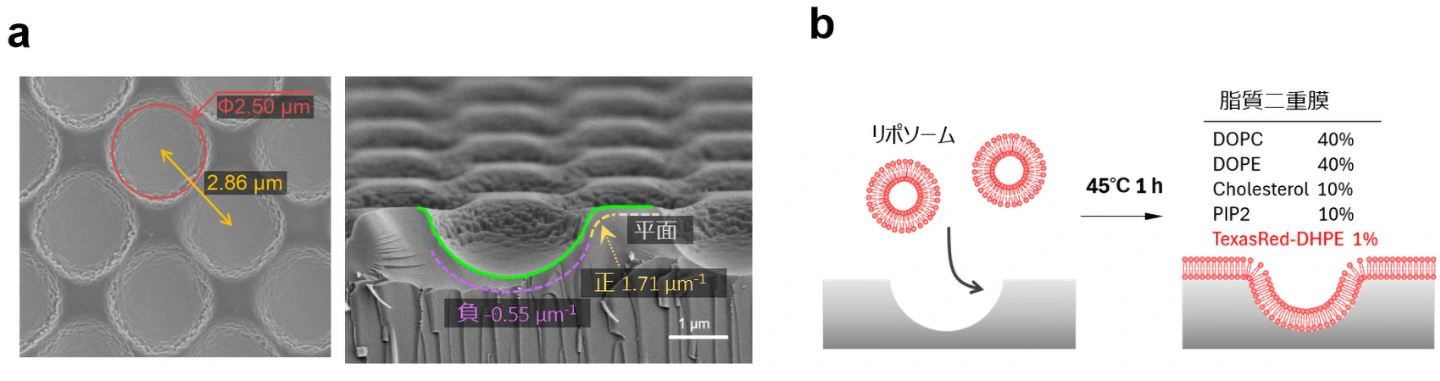
図1. 人工生体膜材料の作製
(a)作製した石英基板上のマイクロウェルアレイの一例。走査型電子顕微鏡による上面および断面像。
(b)蛍光標識脂質入りのリポソームをインキュベート(静置)することで、基板上に膜を修飾する。
<関連情報>
- https://www.isct.ac.jp/ja/news/qrv5qmg23fn7
- https://advanced.onlinelibrary.wiley.com/doi/10.1002/advs.77654
プロテオーム規模での膜曲率センサーの発見のための、バイアスのない幾何学的構造解析に基づく膜プラットフォーム An Unbiased Geometry-Resolved Membrane Platform for Proteome-Scale Discovery of Membrane Curvature Sensors
Takumi Komikawa, Rikuto Kawakami, Kunanon Chattrairat, Tatsuya Niwa, Taiga Ajiri, Takao Yasui, Masayoshi Tanaka
Advanced Science Published: 08 September 2026
DOI:https://doi.org/10.1002/advs.77654
ABSTRACT
Membrane curvature organizes protein-driven biochemistry on cellular membranes. Conventional membrane curvature assays are inherently limited by both candidate-based experimental designs and restricted membrane geometries, preventing proteome-scale discovery of curvature-sensing proteins. Here, we present a geometry-resolved membrane platform that enables hypothesis-agnostic identification of curvature-sensing proteins. A supported lipid bilayer on a hemispherical microwell array simultaneously presents convex rims, concave well interiors, and flat planar regions, while providing sufficient membrane surface area for shotgun proteomics. Following validation using canonical BAR domain proteins, we applied the platform to proteomic screening of a cell-derived peripheral membrane protein fraction. This analysis identified 671 proteins, including 71 curvature-responsive candidates spanning preferences for positively curved, negatively curved, and flat membranes. Subsequent candidate prioritization using a protein–protein interaction-guided workflow, followed by validation with purified proteins, demonstrated that the platform provides a comprehensive pipeline linking proteomics-based discovery to imaging-based evaluation. By interrogating membranes of positive, negative, and zero curvature in parallel, this platform eliminates geometric bias, expands the experimentally accessible landscape of membrane curvature sensing, and enables the discovery of previously overlooked modes of membrane curvature recognition.