
2026-09-30 チャルマース工科大学
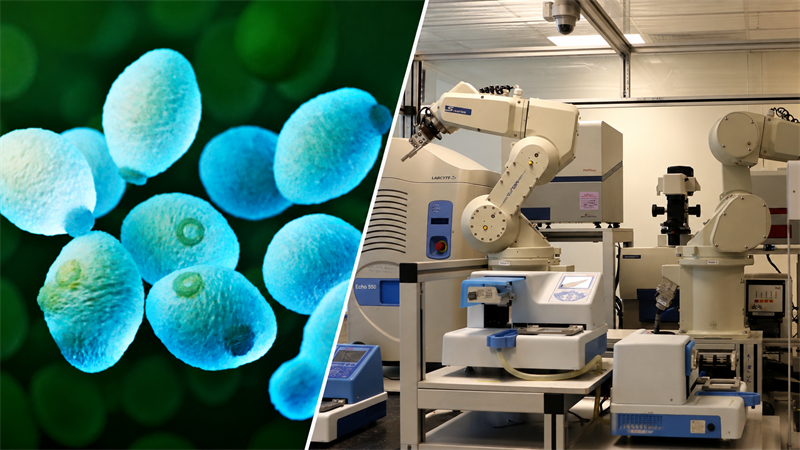
Researchers at Chalmers University of Technology in Sweden have developed an AI scientist capable of generating scientific hypotheses, designing experiments, and interpreting results. Making new biological discoveries with minimal human intervention is an important advance in self-driving laboratories.
<関連情報>
- https://news.cision.com/chalmers/r/ai-scientist-autonomously-generates-and-validates-new-biological-discoveries,c4400798
- https://royalsocietypublishing.org/rsif/article/23/240/20260043/482450/Agentic-AI-integrated-with-scientific-knowledge
科学的知識と統合されたエージェント型AI:システム生物学における実験室検証 Agentic AI integrated with scientific knowledge: laboratory validation in systems biology
Daniel Brunnsåker;Alexander Howard Gower;Prajakta Naval;Erik Yuusuke Bjurström;Filip Kronström;Ievgeniia Tiukova;Ross King
Journal of the Royal Society Interface Published:08 Jul 2026
DOI:https://doi.org/10.1098/rsif.2026.0043
Abstract
Automation is transforming scientific discovery by enabling systematic exploration of complex hypotheses. Large language models (LLMs) perform well across diverse tasks and promise to accelerate research, but often struggle with logical structures. Here, we present a framework for biological discovery integrating LLM-based agents with laboratory automation, guided by logical scaffolds incorporating symbolic relational learning, structured vocabularies and experimental constraints. This integration improves coherence and reliability in automated workflows. We couple this AI-driven approach to automated cell-culture and metabolomics platforms, enabling integrated hypothesis validation and refinement, yielding a flexible discovery system. The system identified novel interactions in Saccharomyces cerevisiae, including glutamate-induced growth inhibition in spermine-treated cells and aminoadipate’s partial rescue of formic-acid stress. All hypotheses, experiments and data are captured in a graph database employing controlled vocabularies. Existing ontologies are extended, and a novel representation of scientific hypotheses is presented using description logics. This work demonstrates the potential for a reliable machine-driven discovery process in systems biology.

