2026-10-30 神戸大学
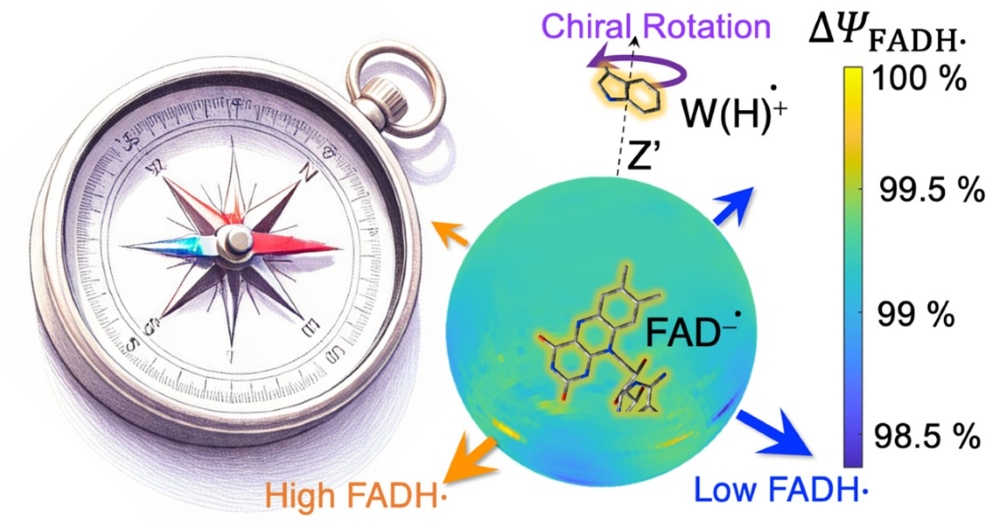
クリプトクロムのキラリティスピン選択性(CISS)による磁気コンパス
Yasuhiro Kobori, The Journal of Physical Chemistry Letters, 2026 (DOI:10.1021/acs.jpclett.6c02747) (CC BY)
<関連情報>
- https://www.kobe-u.ac.jp/ja/news/article/20261030-68376/
- https://pubs.acs.org/jpclcd/article/doi/10.1021/acs.jpclett.6c02747/5461333/Chirality-Induced-Spin-Selectivity-in-Photoinduced
クリプトクロムの光誘起電荷分離におけるキラリティ誘起スピン選択性:磁気受容における潜在的な役割 Chirality-Induced Spin Selectivity in Photoinduced Charge-Separations of Cryptochrome: Potential Role in Magnetoreception
Yasuhiro Kobori; Misato Hamada; Tatsuya Iwata; Hiroki Nagashima; Masaaki Fuki; Hideki Kandori; Stefan Weber
The Journal of Physical Chemistry Letters Published:October 30, 2026
DOI:https://doi.org/10.1021/acs.jpclett.6c02747
Abstract
Radical-pair-based magnetic compass mechanisms are believed to depend on spin-selective reaction pathways modulated by the Earth’s magnetic field. However, the influence of chirality-induced spin selectivity (CISS) on the magnetic compass function at the molecular level remains largely unknown. In this study, we address this question by monitoring the electron spin polarization of long-range charge-separated (CS) states in cryptochromes using time-resolved electron paramagnetic resonance spectroscopy. Our results reveal a measurable, albeit modest, 8% contribution of CISS to the observed spin polarization in the secondary CS state, while the CISS contribution is less than 6% in the tertiary CS state. We propose that the CISS polarization originates from the twisting rearrangement of an oxidized tryptophan residue. This is consistent with previously reported light-induced conformational changes between the inactive and active states of cryptochromes. Furthermore, model calculations predict that even a minor CISS can generate pronounced anisotropy in the signaling-state yield and impact a preferred yield directionality by breaking the magnetic-field inversion symmetry. Together, these findings suggest that CISS may provide an additional mechanism for directional sensitivity in radical pair-based chemical magnetoreception.