2026-09-03 京都大学iPS細胞研究所
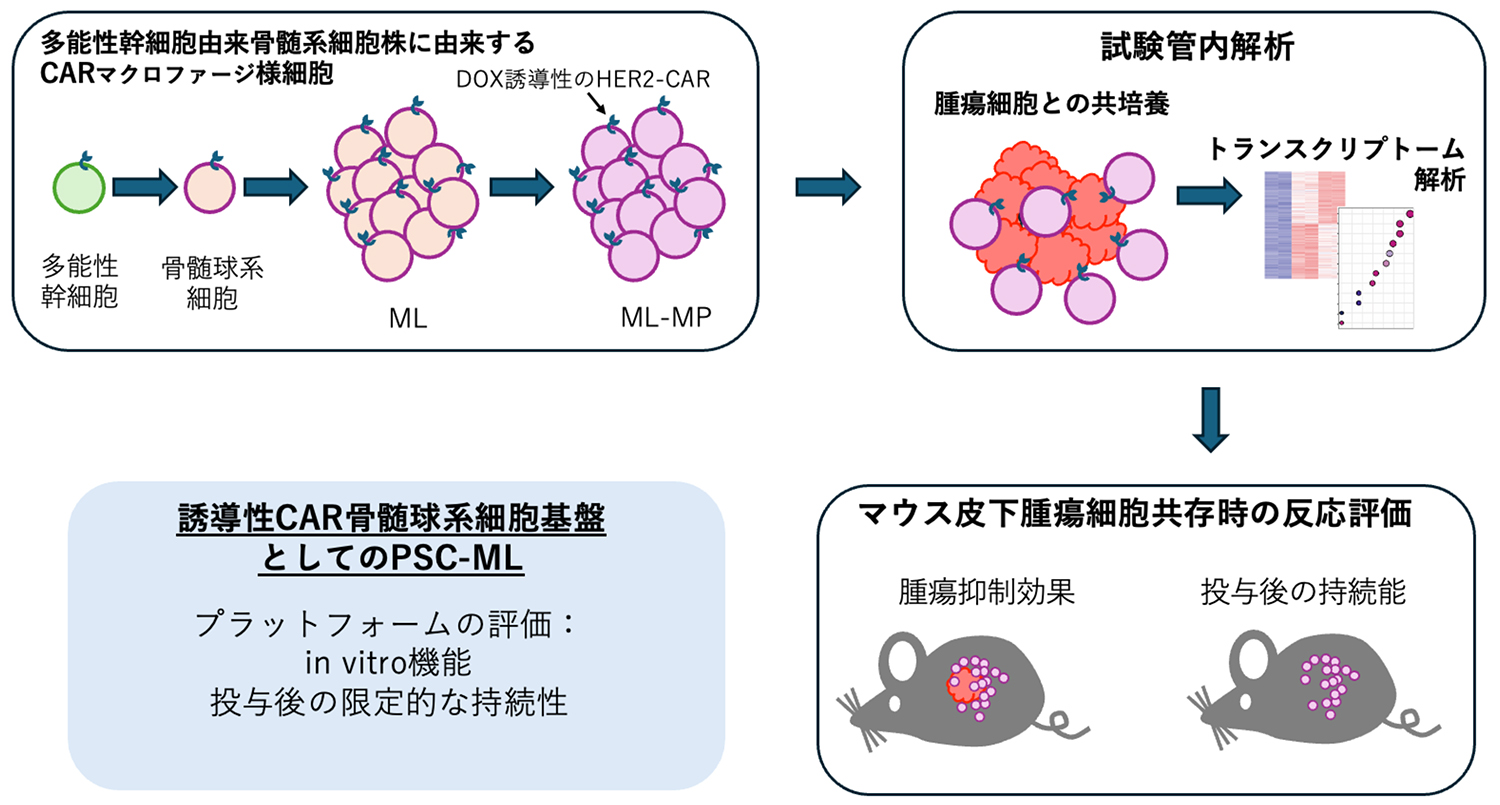
図1 研究の概要
<関連情報>
- https://www.cira.kyoto-u.ac.jp/j/pressrelease/news/260903-100000.html
- https://www.isct-cytotherapy.org/article/S1465-3249(26)00937-0/fulltext
PSC由来骨髄系細胞株ベースのCARマクロファージ様細胞の評価により、生体内での持続性が限られていることが明らかになった Evaluation of PSC-derived myeloid line-based CAR macrophage-like cells identifies limited in vivo persistence
Yuya Atsumi ∙ Akira Niwa ∙ Yohko Kitagawa ∙ … ∙ Shigeki Yagyu ∙ Yozo Nakazawa ∙ Megumu K. Saito
Cytotherapy Published:August 5, 2026
DOI:https://doi.org/10.1016/j.jcyt.2026.102976
Highlights
- Inducible anti-HER2 CAR engineering was coupled to PSC-ML-derived effectors
- PSC-ML-derived macrophage-like cells showed measurable activity in vitro
- Tumor contact was associated with inflammatory and uptake-related programs
- CAR induction was associated with vesicular and lysosomal programs
- Renewable cell production did not ensure durable in vivo persistence
Abstract
Macrophages are of interest as candidates for adoptive cell therapy for solid tumors because they can infiltrate tumor tissue, engage target cells, and influence the tumor microenvironment. However, macrophage products derived from primary monocytes remain difficult to standardize, expand, and genetically modify. Pluripotent stem cell-derived myeloid cell lines (PSC-MLs) provide a renewable and engineerable myeloid platform, but their use as direct tumor-targeting effectors has remained incompletely defined.
In this study, we generated macrophage-like cells from PSC-MLs carrying a doxycycline-inducible anti-HER2 chimeric antigen receptor (CAR) and evaluated three separable features of the platform: in vitro tumor-cell control, contact-associated and CAR-modified transcriptional responses, and post-administration persistence in vivo. Cells established from 2 human pluripotent stem cell backgrounds retained macrophage-associated phenotypes after differentiation. In co-culture with HER2-expressing tumor cells, the cells showed measurable antitumor activity relative to untreated controls. The DOX-treated condition was compatible with a CAR-associated contribution in some comparisons, but uniform CAR-dependent enhancement was not established across tumor models. Live imaging documented phagocytic events but did not quantify their frequency. Transcriptomic profiling associated tumor-cell contact with inflammatory, trafficking, and uptake-related programs, and the CAR-induced co-culture condition with a relative emphasis on vesicular, lysosomal, and proteostasis-related modules.
In a subcutaneous co-implantation assay, in which tumor and effector cells were introduced together, treated groups showed short-term tumor-control signals relative to untreated controls at later observation points. However, an incremental benefit of the CAR-induced (DOX) condition was not clearly resolved. Luciferase-based tracking of ML-MPs showed marked loss by day 3 and no detectable signal by day 7. Repeated dosing was feasible, but its incremental benefit over single dosing could not be established in the small exploratory experiment.