
2026-09-22 中国科学院(CAS)
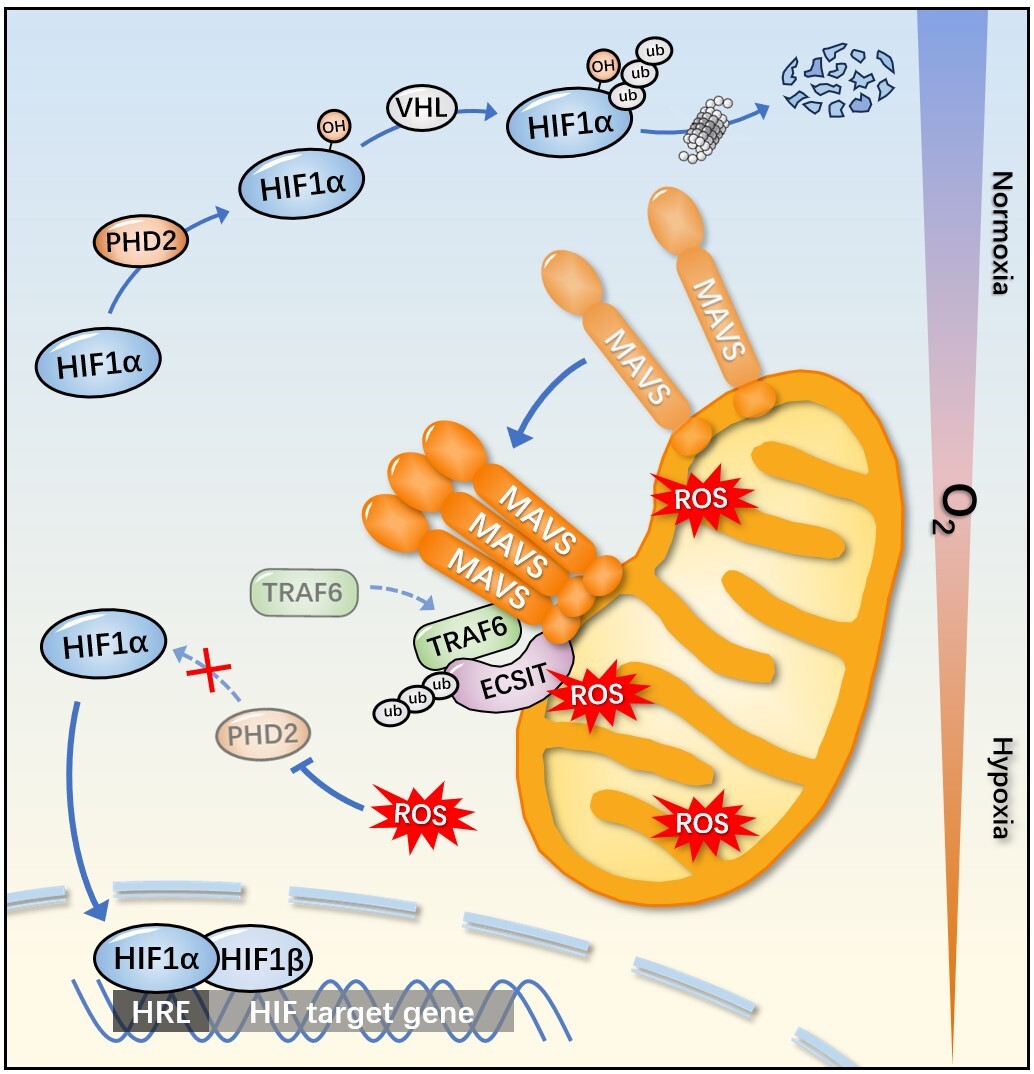
A working model for the role of MAVS under hypoxic conditions (Image by IHB)
<関連情報>
- https://english.cas.cn/newsroom/research-news/202609/t20260922_1201131.shtml
- https://www.pnas.org/doi/10.1073/pnas.2612849123
MAVSは低酸素状態下で凝集し、ミトコンドリアROSの生成を促進することで低酸素シグナル伝達経路を強化する MAVS undergoes aggregation under hypoxia to enhance the hypoxia signaling pathway by promoting the generation of mitochondrial ROS
Xueyi Sun, Chunchun Zhu, Wen Liu, +8 , and Wuhan Xiao
Proceedings of the National Academy of Sciences Published:September 9, 2026
DOI:https://doi.org/10.1073/pnas.2612849123
Abstract
The mitochondrial antiviral signaling protein (MAVS) is a key component of the innate immune response against RNA viruses. Its involvement in other cellular stresses is largely unknown. Here, we found that hypoxia induces MAVS aggregation, leading to the stabilization of HIF1/2α proteins and the enhancement of hypoxia signaling. Mechanistic studies revealed that MAVS enhances TRAF6 binding to ECSIT, which catalyzes ECSIT polyubiquitination. This promotes mitochondrial ROS generation and likely inhibits PHD2 enzymatic activity, thereby reducing HIF1/2α proteasomal degradation. Disrupting MAVS in both mice and zebrafish decreased the expression of hypoxia response genes and reduced the tolerance of zebrafish to hypoxia. This study reveals an unexpected role of MAVS in hypoxia signaling.

