2026-09-10 マウントサイナイ医療システム(MSHS)
<関連情報>
- https://www.mountsinai.org/about/newsroom/2026/pancreatic-cancer-uses-blood-clotting-system-to-evade-immune-attack-targeting-may-improve-immunotherapy
- https://www.nature.com/articles/s41586-026-11002-8
膵臓癌の不均一性と免疫回避におけるセルピン-骨髄系軸 A serpin–myeloid axis in pancreatic cancer heterogeneity and immune evasion
Chiara Falcomatà,Maximilian M. Schaefer,Bhavya Singh,Divya Chhamalwan,Alexander Tepper,Sebastian R. Nielsen,Hunter T. Potak,Maxime Dhainaut,Gurkan Mollaoglu,Matthew D. Park,Miriam Merad,Alessia Baccarini & Brian D. Brown
Nature Published:09 September 2026
DOI:https://doi.org/10.1038/s41586-026-11002-8
Abstract
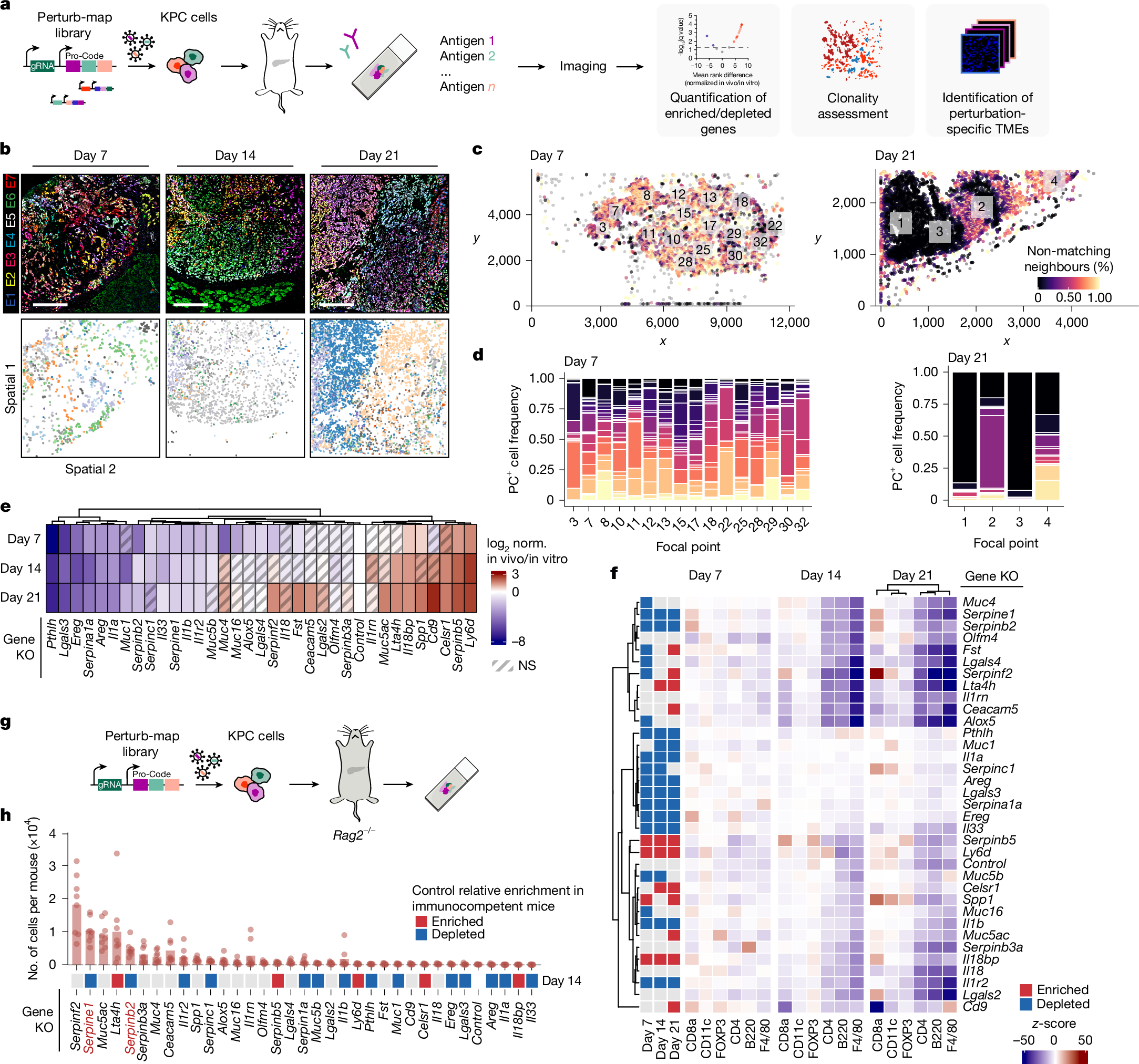
Pancreatic ductal carcinoma (PDAC) is characterized by a highly immunosuppressive, extracellular matrix-rich microenvironment, yet tumours display marked heterogeneity1,2,3,4. This raises the question of whether immune resistance is a global tumour property or is organized within spatially restricted niches. Here, using Perturb-map spatial functional genomics, we determine how different genes shape the growth and cellular environments of PDAC clones across space and time. This analysis revealed early gene-driven remodelling of local immune neighbourhoods preceding late-stage spatial clonal dominance. We identify SERPINE1 (encoding plasminogen activator inhibitor 1 (PAI1)) and SERPINB2 (encoding PAI2) as dominant regulators of tumour microenvironment control and immune evasion. These serpins promote stabilization of fibrin-rich extracellular matrix niches that spatially retain and programme macrophages towards immunosuppressive states while excluding cytotoxic T cells. Loss of Serpine1 or Serpinb2, or pharmacological inhibition of PAI1 or CD18, improves tumour control in mice and synergizes with anti-PD-1. Multimodal spatial analysis of patient tumours revealed that immunosuppressive niches form around rare SERPINB2– and SERPINE1-expressing PDAC subpopulations, dominated by SPP1+/MARCO+ macrophages. These findings identify cancer-derived SERPINE1 and SERPINB2 as local spatial organizers of immune suppression, linking tumour-intrinsic heterogeneity to local microenvironmental control and immunotherapy resistance in PDAC.