
2026-10-02 筑波大学
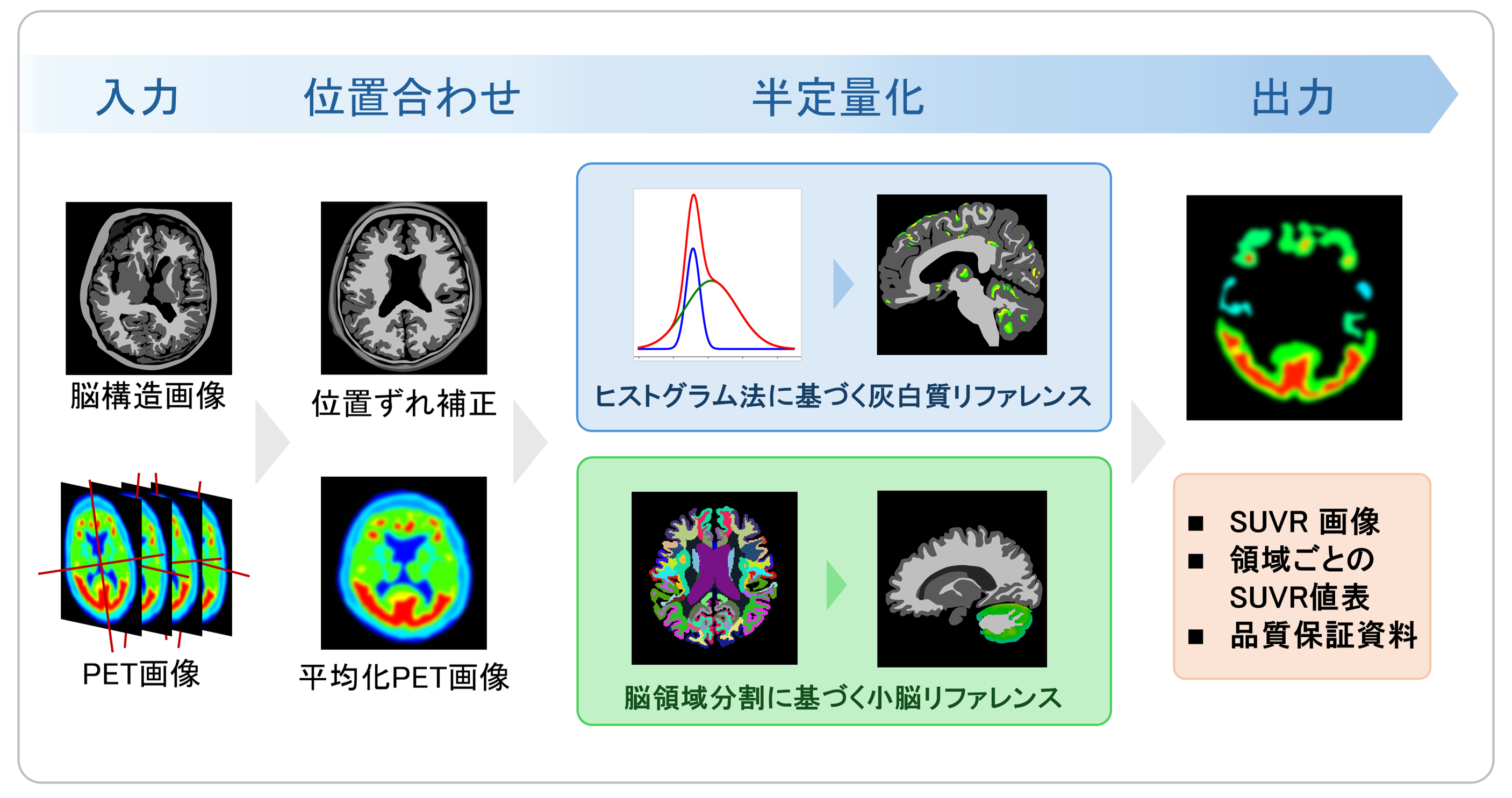
図1.TAME-Qが実行する処理パイプラインの概観
異常なタウ蓄積を調べるPET画像(左下図)と、脳の構造を示すMRI画像(左上図)を入力として与えると、2画像の位置合わせ、半定量化の基準値の推定、脳の各部位の定量的な指標の算出を自動で行う。図はNakayama et al., BMC Medical Imaging (2026)に基づき作成。
<関連情報>
- https://www.tsukuba.ac.jp/journal/medicine-health/20261002140000.html
- https://www.tsukuba.ac.jp/journal/pdf/p20261002140000.pdf
- https://link.springer.com/article/10.1186/s12880-026-02775-5
TAME-Q: florzolotau (18F) PETの再現可能な半定量化のためのオープンソース前処理パイプライン TAME-Q: an open-source preprocessing pipeline for reproducible semi-quantification of florzolotau (18 F) PET
Kenjiro Nakayama, Kiyotaka Nemoto, Hironobu Endo, Kenji Tagai, Asaka Oyama, Miyuki Nemoto, Masashi Tamura, Miho Ota, Takahiko Tokuda, Makoto Higuchi & Tetsuaki Arai
BMC Medical Imaging Published:09 September 2026
DOI:https://doi.org/10.1186/s12880-026-02775-5 Early provide
Abstract
Background
Florzolotau (18 F) PET can visualise tau aggregates in Alzheimer’s disease (AD) and non-AD tauopathies. A previously developed histogram-based grey-matter reference strategy enables semi-quantification without prespecifying a single anatomically spared reference region, but its reliance on in-house and proprietary tools has limited reproducibility. We developed TAME-Q, an automated, openly accessible pipeline implementing this strategy, and evaluated its technical performance and concordance with the previous workflow.
Methods
TAME-Q was applied to dynamic florzolotau PET and T1-weighted MRI from 37 participants on the AD continuum, 46 with progressive supranuclear palsy–Richardson syndrome (PSP-RS), and 50 healthy controls. The pipeline performs image alignment, tissue segmentation, Gaussian fitting of grey-matter intensity histograms, reference estimation, SUVR generation, FreeSurfer-based parcellation, extraction of 132 ROI-level SUVRs, and generation of quality-assurance outputs. Outputs were evaluated using quantitative screening and structured visual review. Disease-specific regional SUVRs and Elastic Net-derived AD-tau and PSP-tau scores were compared with a benchmark implementation. Held-out discrimination across ten 75%/25% shuffle-split iterations and post hoc reduced-feature and atlas-sensitivity analyses were also evaluated.
Results
TAME-Q completed automated preprocessing for all 133 participants, and all outputs were accepted after quality control. Bimodal and monomodal histogram fits were used in 121 and 12 participants, respectively. Age- and sex-adjusted SUVRs were higher in the inferior temporal gyrus in AD and in the globus pallidus in PSP-RS (Holm-adjusted p < 0.001). Histogram- and cerebellar-derived reference values showed broadly similar group-level scaling but differed in some individuals. TAME-Q-derived and benchmark tau scores were strongly correlated (AD-tau, r = 0.979; PSP-tau, r = 0.960). Full-cohort AUCs were 0.999 (95% CI: 0.998–1.000) for AD and 0.967 (95% CI: 0.941–0.992) for PSP; corresponding mean held-out AUCs were 0.996 ± 0.009 and 0.935 ± 0.010. Full-cohort AUCs were similar after coefficient truncation to the top 20 ROIs and after retraining with the unmerged FreeSurfer atlas.
Conclusions
TAME-Q provides an automated and inspectable implementation of histogram-based florzolotau PET semi-quantification and produced outputs concordant with the benchmark workflow in this single-center dataset. External multicenter validation is required to establish generalisability across acquisition settings and populations.

