2026-10-01 京都大学
<関連情報>
- https://www.kyoto-u.ac.jp/ja/research-news/2026-10-01
- https://www.sciencedirect.com/science/article/pii/S3050597626000552
CD19 標的CAR-T細胞療法後の低ガンマグロブリン⾎症の発症率とリスク因⼦ Incidence and risk factors for hypogammaglobulinemia after CD19-CAR-T cell therapy
Kotaro Suzuki, Tomoyasu Jo, Toshio Kitawaki, Noriyoshi Yoshinaga, Takashi Sakamoto, Junya Kanda, Momoko Nishikori, Kouhei Yamashita, Miki Nagao, Akifumi Takaori-Kondo, Yasuyuki Arai
Blood Immunology & Cellular Therapy Available online: 28 August 2026
DOI:https://doi.org/10.1016/j.bict.2026.100085
Key Points
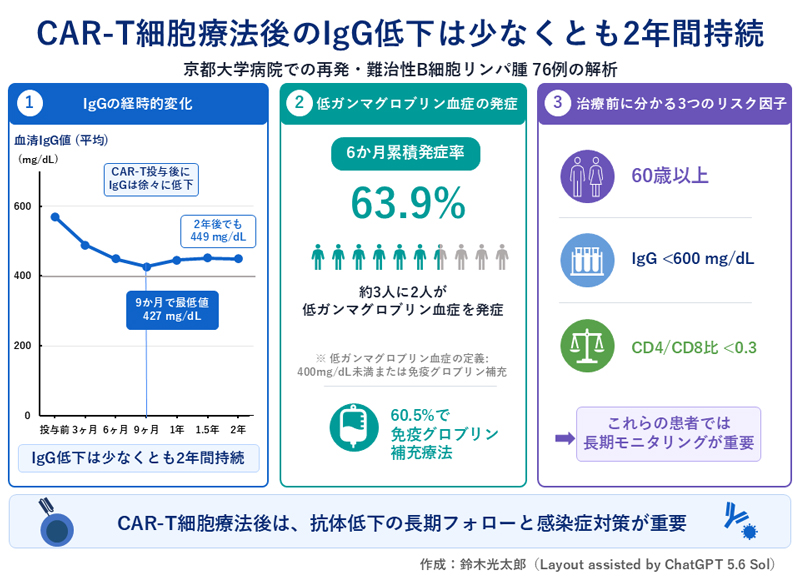
- Serum IgG levels declined after CAR-T infusion, reaching a nadir at 9 months, and remaining suppressed for more than 2 years after infusion.
- Older age, low pre-infusion IgG, and a low CD4/CD8 ratio independently predisposed patients to post-CAR-T hypogammaglobulinemia.
ABSTRACT
CD19-directed chimeric antigen receptor T-cell (CAR-T) therapy has transformed the treatment landscape of relapsed or refractory (r/r) B-cell lymphoma. Despite its remarkable efficacy, CAR-T therapy is associated with a spectrum of acute and late toxicities. Among these, hypogammaglobulinemia is a common complication; however, the long-term kinetics of serum immunoglobulin levels and clinical risk factors are not fully understood. We retrospectively analyzed adult patients with r/r B-cell lymphoma who underwent CD19-targeted CAR-T therapy at Kyoto University Hospital. Serum IgG levels were evaluated longitudinally from apheresis to up to two years after infusion. Hypogammaglobulinemia was defined as serum IgG <400 mg/dL or the necessity of immunoglobulin replacement therapy. Seventy-six patients were analyzed. Serum IgG levels declined significantly after infusion, reaching their nadir at 9 months, and remaining suppressed as long as 2 years. Cumulative incidence of hypogammaglobulinemia at six months was 63.9%. 60.5% of patients received immunoglobulin replacement therapy. Multivariable analysis identified the following three independent risk factors for hypogammaglobulinemia: age ≥60 years at infusion, pre-infusion IgG <600 mg/dL, and a pre-infusion CD4/CD8 ratio <0.3, reflecting impaired immune reserve. Hypogammaglobulinemia was not significantly associated with progression-free survival or overall survival in landmark analyses. These findings may help identify patients for whom careful monitoring of immunoglobulin levels and appropriate management of hypogammaglobulinemia and infectious complications are warranted.