2026-09-23 マウントサイナイ医療システム(MSHS)
<関連情報>
- https://www.mountsinai.org/about/newsroom/2026/nine-studies-led-by-mount-sinai-investigators-featured-in-coordinated-collection-of-papers-that-map-the-molecular-and-cellular-architecture-of-brain-disorders
- https://www.nature.com/articles/s41586-025-09573-z
- https://www.nature.com/articles/s41586-026-10271-7
- https://www.nature.com/articles/s41586-026-10836-6
- https://www.nature.com/articles/s41591-025-04128-1
- https://www.nature.com/articles/s41588-026-02733-5
- https://www.nature.com/articles/s41467-026-72310-1
- https://www.nature.com/articles/s41467-026-75681-7
- https://www.nature.com/articles/s41597-025-04687-5
脳疾患全体における転写産物脆弱性の単一細胞アトラス Single-cell atlas of transcriptomic vulnerability across brain disorders
Donghoon Lee, Mikaela Koutrouli, Nicolas Y. Masse, Gabriel E. Hoffman, Seon Kinrot, Xinyi Wang, Prashant N. M., Milos Pjanic, Tereza Clarence, Fotios Tsetsos, Deepika Mathur, David Burstein, Karen Therrien, Aram Hong, Clara Casey, Zhiping Shao, Marcela Alvia, Stathis Argyriou, Jennifer Monteiro Fortes, Sarah R. Murphy, Pavel Katsel, Pavan K. Auluck, Lisa L. Barnes, Stefano Marenco, PsychAD Consortium, … Panos Roussos
Nature Published:23 September 2026
DOI:https://doi.org/10.1038/s41586-025-09573-z
Abstract
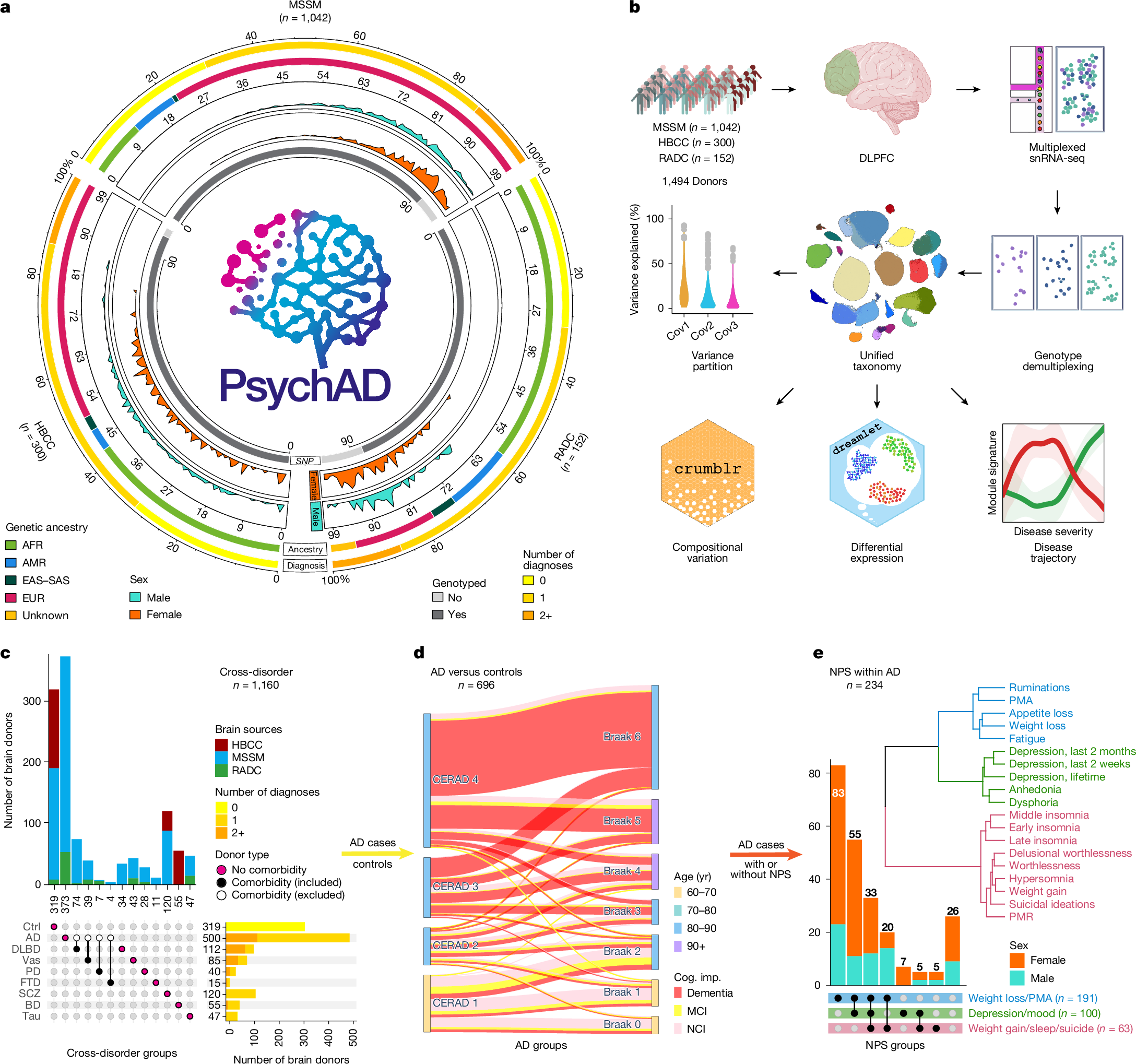
Neurodegenerative and neuropsychiatric diseases impose a considerable societal and public health burden. However, our understanding of the molecular mechanisms underlying these highly complex conditions remains limited1,2. Here, to gain deeper insights into the aetiology of different brain diseases, we used specimens from 1,494 unique donors to generate a population-scale single-cell transcriptomic atlas of the human dorsolateral prefrontal cortex, comprising over 6.3 million individual nuclei. The cohort includes neurotypical controls, as well as donors affected by eight common and complex brain disorders: Alzheimer’s disease (AD), diffuse Lewy body disease (DLBD), vascular dementia (Vas), Parkinson’s disease (PD), tauopathy, frontotemporal dementia, schizophrenia, and bipolar disorder. We show that interindividual variation accounts for a substantial portion of gene expression variation. By comparing transcriptomic variation across diseases, we reveal universal signatures enriched in basic cellular functions such as mRNA processing and protein localization. After discounting these cross-disease signatures, we show stronger genetic and transcriptomic concordance among AD, DLBD, Vas and PD. Furthermore, we characterize transcriptomic variation among different AD phenotypes, distinct from those observed in healthy ageing, revealing a reduction in neuronal abundance in individuals with more severe AD, coupled with an increase in immune and vascular cell populations. Exploring the neuropsychiatric symptoms (NPSs) that frequently accompany AD, we find an increased abundance of deep-layer excitatory neurons associated with a broad range of NPSs. By constructing transcriptome trajectories that capture AD progression, we implicate cell-type-specific responses in the early and late stages of AD. Our disease atlas provides a perspective of the transcriptomic landscape in neurodegenerative and neuropsychiatric disorders, shedding light on shared and distinct processes involving the neurological–immune–vascular systems, and identifying potential targets for therapeutic intervention.
ヒト前頭前皮質の生涯にわたる単一細胞トランスクリプトームアトラス Lifespan single-cell transcriptomic atlas of the human prefrontal cortex
Hui Yang, Tereza Clarence, Madeline R. Scott, Xinyi Wang, Prashant N. M., Milos Pjanic, Sanan Venkatesh, Aram Hong, Clara Casey, Sarah R. Murphy, Zhiping Shao, Marcela Alvia, Stathis Argyriou, Alexander Kawah Yu, PsychAD Consortium, Nadejda M. Tsankova, Pavan K. Auluck, Stefano Marenco, Vahram Haroutunian, Georgios Voloudakis, Jaroslav Bendl, Colleen A. McClung, Donghoon Lee, John F. Fullard, … Panos Roussos
Nature Published:23 September 2026
DOI:https://doi.org/10.1038/s41586-026-10271-7
Abstract
The human brain undergoes profound changes from early development through late adulthood, shaping cognition, behaviour and vulnerability to disease1,2. Understanding how these changes are organized within specific brain regions and cell types is essential for interpreting normal ageing and its relationship to psychiatric and neurodegenerative disorders. The dorsolateral prefrontal cortex has a central role in higher cognitive functions and is particularly sensitive to age-related decline3, yet its cellular and molecular programs across the human lifespan remain poorly defined. Most existing studies4,5,6,7 have focused on restricted age ranges or disease-affected brains, limiting the ability to distinguish normative developmental and ageing trajectories from pathological processes. Consequently, a comprehensive, lifespan-resolved reference of cellular states in the human prefrontal cortex has been lacking. Here, using a single-nucleus transcriptomic atlas spanning the human lifespan, we show that the dorsolateral prefrontal cortex exhibits non-linear, cell-type-specific transcriptional trajectories characterized by dynamic remodelling during development, relative stability in midlife and selective molecular reactivation in late adulthood. We identify distinct neuronal and glial programs, including early-life neuronal resilience pathways and late-life glial programs associated with immune activation, stress responses and circadian reorganization. These programs are anatomically organized across cortical layers and grey–white matter domains, revealing coordinated spatial and molecular changes. Together, these findings provide a framework for understanding how cellular programs transition from resilience to vulnerability in the human cortex and establish a foundation for interpreting age-related cognitive decline and disease risk.
ヒト脳疾患の単一核トランスクリプトームワイド関連解析 Single-nucleus transcriptome-wide association study of human brain disorders
Sanan Venkatesh, Roman Kosoy, Zhenyi Wu, Marios Anyfantakis, Christian Dillard, Prashant N. M., David Burstein, Deepika Mathur, Chris Chatzinakos, Bukola Ajanaku, Fotis Tsetsos, Biao Zeng, Sonali Gupta, Rachel Bercovitch, Aram Hong, Clara Casey, Marcela Alvia, Zhiping Shao, Stathis Argyriou, Karen Therrien, PsychAD Consortium, Tim Bigdeli, Pavan Auluck, David A. Bennett, … Panos Roussos
Nature Published:23 September 2026
DOI:https://doi.org/10.1038/s41586-026-10836-6
Abstract
Common brain disorders impose a substantial health burden, but localizing their genetic risk in the brain remains challenging1. Although genome-wide association studies have identified numerous loci associated with neuropsychiatric and neurodegenerative disorders, many of these loci lie in non-coding regions that influence gene expression in specific cell types2,3,4,5. Traditional bulk brain transcriptomic analyses, which often focus on European ancestry cohorts, average over cellular diversity, obscuring genetic risk-related changes in gene expression. Here we use single-nucleus gene expression profiles from the dorsolateral prefrontal cortex in the multi-ancestry PsychAD cohort to develop transcriptomic imputation models of genetically regulated expression across major brain cell types. Applying these models to neuropsychiatric and neurodegenerative disorders reveals thousands of gene–trait associations that are undetectable in bulk tissue analyses and resolves many signals to discrete neuronal, glial and immune cell populations. Cross-ancestry analyses in the Million Veteran Program confirm these associations, reveal pleiotropic effects of cell-type-specific predicted expression and demonstrate that trait-related dysregulation is conserved across ancestries, enabling mapping of causal genes and pathways. Together, these findings provide a cell-type-resolved and ancestry-aware atlas of genetically regulated expression in the human prefrontal cortex and illustrate how single-nucleus transcriptomics can sharpen gene discovery and therapeutic target prioritization for complex brain disorders.
集団規模の単一細胞データに基づくAIを用いたアルツハイマー病表現型の特徴付け AI-based characterization of Alzheimer’s disease phenotypes from population-scale single-cell data
Chenfeng He, Athan Z. Li, Kalpana Hanthanan Arachchilage, Chirag Gupta, Xiang Huang, Xinyu Zhao, Carissa L. Sirois, PsychAD Consortium, Kiran Girdhar, Georgios Voloudakis, Gabriel E. Hoffman, Jaroslav Bendl, John F. Fullard, Donghoon Lee, Panos Roussos & Daifeng Wang
Nature Medicine Published:23 September 2026
DOI:https://doi.org/10.1038/s41591-025-04128-1
Abstract
The complexity of Alzheimer’s disease (AD) manifests in diverse clinical phenotypes, including cognitive impairment and neuropsychiatric symptoms. However, the etiology of these phenotypes remains elusive. To address this, the PsychAD project generated a population-level single-nucleus RNA sequencing dataset comprising over 6 million nuclei from the prefrontal cortex of >1,000 individual brains, covering a variety of disease phenotypes. Here, leveraging this dataset, we developed a computational framework, called Phenotype Associated Single Cell encoder (PASCode), to score single-cell phenotype associations, and identified ∼1.5 million phenotype-associated cells (PACs) from 584 donors with AD-related phenotypes. PASCode ensembles multiple statistical methods into a graph neural model for robust scoring. Comparing PACs within 27 brain cell subclasses, we prioritized cell subpopulations and their expressed genes for various AD phenotypes. For instance, we identified microglia subpopulations implicated in AD pathology; reactive astrocyte subtypes with altered neuroprotective and neurotoxic gene expression that likely confer cognitive resilience; and enhanced excitatory/inhibitory imbalance and mitochondrial dysfunction in cognitively impaired AD donors. We also identified many PACs for multiple phenotypes, including the astrocytes between AD and depression showing specific gene expression patterns such as inflammation and endoplasmic reticulum stress pathways. These prioritized subpopulations, genes and pathways potentially offer valuable insights for precision diagnostic and therapeutic development. We also validated our findings in external population-scale datasets including AD and major depressive disorder, compiled an AD-phenotypic single-cell atlas and delivered the framework as an open-source tool with pre-trained models and a web application for community use.
ヒト脳における細胞型特異的遺伝子制御の単一核アトラス Single-nucleus atlas of cell-type specific genetic regulation in the human brain
Biao Zeng, Hui Yang, Prashant N. M, Sanan Venkatesh, Deepika Mathur, Pavan Auluck, David A. Bennett, Stefano Marenco, Vahram Haroutunian, PsychAD Consortium, Georgios Voloudakis, Donghoon Lee, John F. Fullard, Jaroslav Bendl, Kiran Girdhar, Gabriel E. Hoffman & Panos Roussos
Nature Genetics Published:23 September 2026
DOI:https://doi.org/10.1038/s41588-026-02733-5
Abstract
Genetic risk variants for common diseases are predominantly located in non-coding regulatory regions and modulate gene expression. Although bulk tissue studies have elucidated shared mechanisms of regulatory and disease-associated genetics, the cellular specificity of these mechanisms remains largely unexplored. Here we present a comprehensive, single-nucleus multi-ancestry atlas of genetic regulation of gene expression in the human prefrontal cortex, comprising 5.6 million nuclei from 1,384 donors of diverse ancestries. Through multi-resolution analyses spanning eight major cell classes and 27 subclasses, we identify genetic regulation for 14,258 genes, with 981 showing cell type-specific regulatory effects at the class level and 857 at the subclass level. Colocalization of genetic variants associated with gene regulation and disease traits uncovers novel cell type-specific genes implicated in Alzheimer’s disease, schizophrenia and other disorders that were not detectable in bulk tissue analyses. Analysis of dynamic genetic regulation at the single-nucleus level identifies 2,073 genes with regulatory effects that vary across developmental trajectories, inferred from a broad age range of donors. We also uncover 1,655 genes with trans-regulatory effects, revealing distal regulation of gene expression. This high-resolution atlas provides insight into the cell type-specific regulatory architecture of the human brain, and offers novel mechanistic targets for understanding the genetic basis of neuropsychiatric and neurodegenerative diseases.
個別化シングルセル転写解析により、アルツハイマー病における分子多様性が明らかになる Personalized single-cell transcriptomics reveals molecular diversity in Alzheimer’s disease
Pramod Bharadwaj Chandrashekar, Sayali Anil Alatkar, Noah Cohen Kalafut, Ting Jin, Chirag Gupta, Ryan Conway Burczak, Xiang Huang, Shuang Liu, Athan Z. Li, PsychAD Consortium, Kiran Girdhar, Georgios Voloudakis, Gabriel E. Hoffman, Jaroslav Bendl, John F. Fullard, Donghoon Lee, Panos Roussos & Daifeng Wang
Nature Communications Published:23 September 2026
DOI:https://doi.org/10.1038/s41467-026-72310-1
Abstract
Alzheimer’s disease (AD) is highly heterogeneous and driven by diverse molecular and cellular mechanisms. Functional genomics investigates these mechanisms from genetic variants to gene expression and regulation. We performed personalized functional genomics analysis on population-scale single-nucleus RNA-seq data, with cross-cohort validation across multiple cohorts comprising over 1900 individual brains, capturing donor-level cell type interactions and gene regulatory networks. Using a knowledge-guided graph neural network, we learned latent representations of each donor’s functional genomics that accurately classified AD phenotypes, identified molecularly defined subpopulations, and traced disease progression trajectories. Our importance scores, derived from graph attentions, identified significant inter-donor differences and prioritized personalized cell type genes and regulatory networks. Finally, we identified gene regulatory QTLs (grQTLs) linking genetic variants to donor-level regulatory changes, providing insights into gene regulatory relationships beyond traditional eQTLs. All results are summarized into a personalized functional genomics atlas for AD, including an open-source framework, iBrainMap, for general use.
crumblrによる細胞構成の違いの迅速かつ柔軟な分析 Fast, flexible analysis of differences in cellular composition with crumblr
Gabriel E. Hoffman & Panos Roussos
Nature Communications Published:23 September 2026
DOI:https://doi.org/10.1038/s41467-026-75681-7
Abstract
Changes in cell type composition play an important role in human health and disease. Recent advances in single-cell technology have enabled the measurement of cell type composition at increasing cell lineage resolution across large cohorts of individuals. Yet this raises new challenges for statistical analysis of these compositional data to identify changes in cell type frequency. We introduce crumblr (DiseaseNeurogenomics.github.io/crumblr), a scalable statistical method for analyzing count ratio data using precision-weighted linear mixed models incorporating random effects for complex study designs. Uniquely, crumblr performs statistical testing at multiple levels of the cell lineage hierarchy using a multivariate approach to increase power over tests of one cell type. In simulations, crumblr increases power compared to existing methods while controlling the false positive rate. We demonstrate the application of crumblr to published single-cell RNA-seq datasets for aging, tuberculosis infection in T cells, bone metastases from prostate cancer, and SARS-CoV-2 infection.
Dreamletを用いた大規模シングルセル転写産物データの効率的な差分発現解析 Efficient differential expression analysis of large-scale single-cell transcriptomics data using Dreamlet
Gabriel E. Hoffman, Donghoon Lee, Jaroslav Bendl, N. M. Prashant, Aram Hong, Clara Casey, Marcela Alvia, Zhiping Shao, Stathis Argyriou, Karen Therrien, Sanan Venkatesh, Georgios Voloudakis, Vahram Haroutunian, John F. Fullard & Panos Roussos
Nature Communications Published:23 September 2026
DOI:https://doi.org/10.1038/s41467-026-75680-8
Abstract
Advances in single-cell and -nucleus transcriptomics have enabled generation of increasingly large-scale datasets from hundreds of subjects and millions of cells. These studies promise to give unprecedented insight into the cell type specific biology of human disease. Yet performing differential expression analyses across subjects remains difficult due to challenges in statistical modeling of these complex studies and scaling analyses to large datasets. Our open-source R package dreamlet (DiseaseNeurogenomics.github.io/dreamlet) uses a pseudobulk approach based on precision-weighted linear mixed models to identify genes differentially expressed with traits across subjects for each cell cluster. Designed for data from large cohorts, dreamlet is substantially faster and uses less memory than existing workflows, while supporting complex statistical models and controlling the false positive rate. We demonstrate computational and statistical performance on published datasets, and a novel dataset of 1.4 M single nuclei from postmortem brains of 150 Alzheimer’s disease cases and 149 controls.
ヒト前頭前皮質の単一細胞解像度における集団規模の疾患横断的アトラス Population-scale cross-disorder atlas of the human prefrontal cortex at single-cell resolution
John F. Fullard, Prashant NM, Donghoon Lee, Deepika Mathur, Karen Therrien, Aram Hong, Clara Casey, Zhiping Shao, Marcela Alvia, Stathis Argyriou, Tereza Clarence, David Burstein, Sanan Venkatesh, Pavan K. Auluck, Lisa L. Barnes, David A. Bennett, Stefano Marenco, PsychAD Consortium, Kiran Girdhar, Vahram Haroutunian, Gabriel E. Hoffman, Georgios Voloudakis, Jaroslav Bendl & Panos Roussos
Scientific Data Published:06 June 2025
DOI:https://doi.org/10.1038/s41597-025-04687-5
Abstract
Neurodegenerative diseases and serious mental illnesses often exhibit overlapping characteristics, highlighting the potential for shared underlying mechanisms. To facilitate a deeper understanding of these diseases and pave the way for more effective treatments, we have generated a population-scale multi-omics dataset consisting of genotype and single-nucleus transcriptome data from the prefrontal cortex of frozen human brain specimens. Encompassing over 6.3 million nuclei from 1,494 donors, our dataset represents a diverse range of neurodegenerative and serious mental illnesses, including Alzheimer’s and Parkinson’s diseases, schizophrenia, bipolar disorder and diffuse Lewy body dementia, as well as neurotypical controls. Our dataset offers a unique opportunity to study disease interactions, as 21% of donors had comorbid diagnoses of two or more major brain disorders. Additionally, it includes detailed phenotypic information on neuropsychiatric symptoms, such as apathy and weight loss, which commonly accompany Alzheimer’s disease and related dementias. We have performed stringent preprocessing and quality controls, ensuring the reliability and usability of the data. As a commitment to fostering collaborative research, we provide this valuable resource as an online repository, enabling widespread analyses across the scientific community.