2026-09-23 ペンシルベニア州立大学(Penn State)
<関連情報>
- https://www.psu.edu/news/research/story/frogs-coat-bacterial-armor-helps-protect-it-fungal-disease
- https://link.springer.com/article/10.1186/s42523-026-00593-2
新熱帯に生息する2種のカエルにおける、皮膚細菌叢を介したツボカビ症に対する異なる防御機構 Differential skin-bacteriome-mediated defense against chytridiomycosis in two neotropical frog species
Laura K. Schuck, Julia R. Ernetti, Shannon Buttimer, Ananda B. de Assis, Renato A. Martins, Mariana R. Pontes, Ana C. Zanatta, Maria B. Tosta, Luís Felipe Toledo & C. Guilherme Becker
Animal Microbiome Published:04 August 2026
DOI:https://doi.org/10.1186/s42523-026-00593-2
Abstract
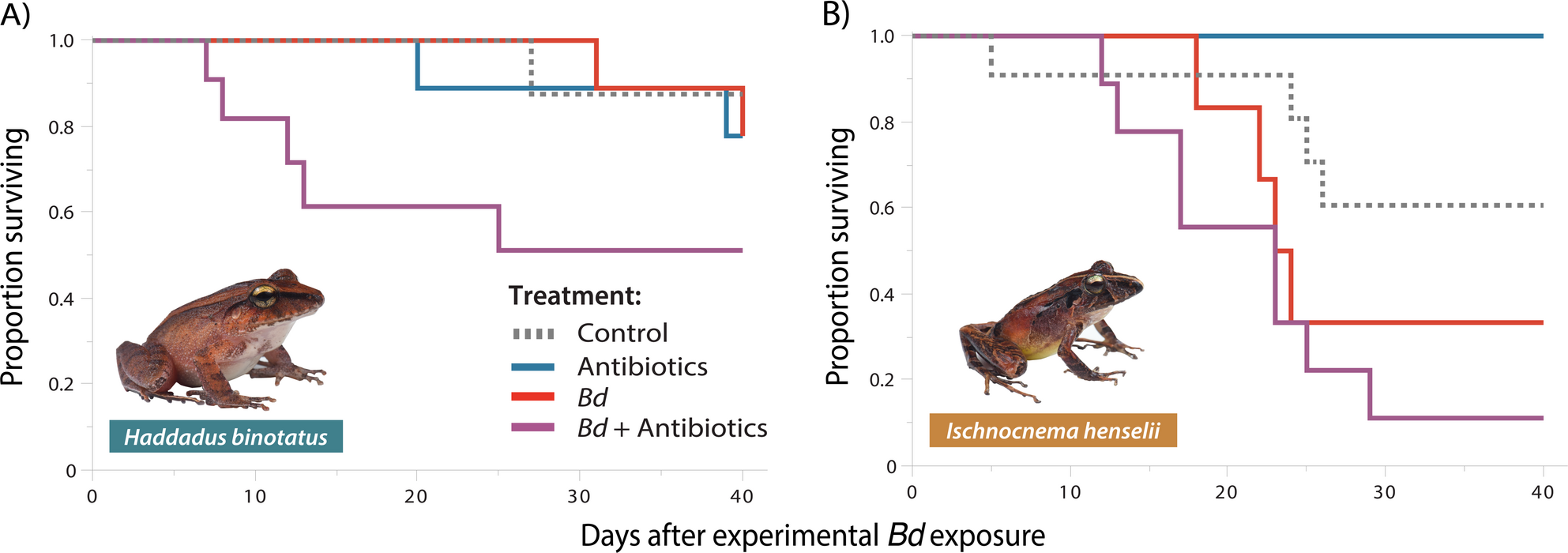
Symbiotic microbial communities have been implicated in host resistance to pathogens, but their effects are rarely demonstrated experimentally in wildlife. This study tested how skin-associated bacterial communities (i.e., bacteriomes) influence infection by the chytrid fungus Batrachochytrium dendrobatidis (Bd) in two tropical frog species, Haddadus binotatus and Ischnocnema henselii, which differ in susceptibility to Bd. Using a 2×2 factorial experimental design, frogs of both species were assigned to treatments crossing Bd exposure and antibiotic-mediated bacteriome suppression. In parallel, we cultured 786 bacterial isolates from frog skin and assayed their ability to inhibit Bd in vitro, generating a functional database of Bd-inhibitory symbionts. Haddadus binotatus with an unsuppressed skin bacteriome and exposed to Bd showed no reduction in survival relative to Bd-unexposed controls, consistent with the lack of Bd infection previously observed in wild populations. In contrast, bacteriome suppression increased mortality and infection intensity under Bd exposure. Bd infection intensity in H. binotatus also decreased with the proportion of Bd-inhibitory sequence reads in the bacteriome, and a significant interaction between antibiotic treatment and Bd exposure affecting survival was detected, consistent with bacteriome-mediated protection in this species. In contrast, I. henselii experienced lower survival under Bd exposure in general. Species-specific log-rank tests revealed that bacteriome suppression significantly increased mortality under Bd exposure in H. binotatus but not in I. henselii, where survival was reduced under Bd exposure regardless of bacteriome state, suggesting fundamentally different defense strategies between species. Functional attributes of microbial communities, rather than diversity alone, appear to be key to disease outcomes. This work advances understanding of host–microbe–pathogen interactions and highlights microbiome function as a critical axis of wildlife disease defense.