2026-09-21 ジョンズ・ホプキンス大学(JHU)
<関連情報>
- https://hub.jhu.edu/2026/09/21/dna-repair-research-johns-hopkins/
- https://www.nature.com/articles/s41467-026-77503-2
- https://www.nature.com/articles/s41467-026-77534-9
NHEJにおけるポリメラーゼλとPNKPによる末端処理は、短距離シナプス形成中に協調的に行われる End processing in NHEJ by Polymerase λ and PNKP is coordinated during short-range synapsis
Alex Vogt, Andrea M. Kaminski, Jason G. Williams, Tasmin Naila, Danny Laurent, Alan E. Tomkinson, Susan P. Lees-Miller, Lars C. Pedersen, Thomas A. Kunkel & Yuan He
Nature Communications Published:09 September 2026
DOI:https://doi.org/10.1038/s41467-026-77503-2 Early provide
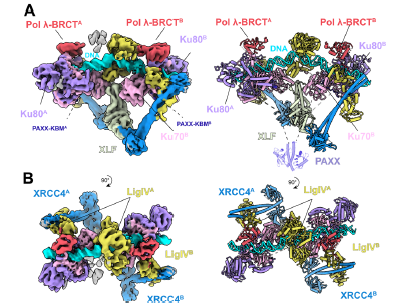
Fig. 1 | Structure of the SR-Pol λ NHEJ complex. A Composite cryo-EMmap (left) and structuralmodel (right) of the SR-Pol λ complex assembled on a DNA substrate containing symmetrical 1 nucleotide non-complementary 3′ overhangs. B Top views of the SR-Pol λ complex.
Abstract
Non-homologous end joining (NHEJ) is a major pathway of DNA double strand break (DSB) repair, capable of directly joining both damaged strands of DNA through the coordinated activities of repair factors that detect the termini, physically bridge them together, and perform the chemistry necessary to complete repair. NHEJ is capable of repairing a variety of damaged DNA, employing various accessory end-processing factors to resolve chemically blocked ends, trim overhangs, and fill gaps in order to achieve directly ligatable DNA ends. To investigate the molecular mechanisms underlying end-processing, we determine the cryo-EM structure of the NHEJ specific polymerase Pol λ bound to the short-range synaptic complex, detailing the mode of its recruitment to the complex as well as a putative model for its activity. Furthermore, the coordinated end-processing activities of the short-range (SR) synaptic complex simultaneously bound by both Pol λ and PNKP, another accessory factor, demonstrates the ability of NHEJ to form large, multifunctional repair complexes capable of processing a variety of different DNA end structures to effect repair.
DNA-PKによるヌクレオソームの巻き戻しはクロマチンにおけるNHEJを可能にする DNA-PK driven nucleosome unwrapping enables NHEJ in chromatin
Weifeng Lu, Alex Vogt, Susan P. Lees-Miller & Yuan He
Nature Communications Published:04 September 2026
DOI:https://doi.org/10.1038/s41467-026-77534-9 Early provide
Abstract
DNA double-strand breaks, one of the most cytotoxic forms of DNA damage, are primarily repaired by non-homologous end joining (NHEJ) in human cells. NHEJ is initiated by the Ku70/80 heterodimer (Ku) and DNA-dependent protein kinase catalytic subunit (DNA-PKcs), followed by factors that bridge and ligate DNA ends. Ku and DNA-PKcs require ~28 base pairs of free duplex DNA, which is often unavailable in chromatin with nucleosomes acting as barriers. The role of DNA-PKcs remains unclear, as previous in vitro studies mainly used naked DNA. Here, in vitro ligation assays show that DNA-PKcs promotes NHEJ on nucleosomes with limited DNA accessibility. Cryo-EM structures of nucleosome-bound Ku and DNA-PKcs reveal that Ku encounters nucleosomal barriers and overcomes them with DNA-PKcs. Distinct structural states support a stepwise model of DNA-PK progressive translocating along nucleosomal DNA, highlighting DNA-PKcs function in chromatin-associated NHEJ in vivo.