2026-10-09 東京大学
本研究の概要
<関連情報>
- https://www.u-tokyo.ac.jp/content/400297805.pdf
- https://www.jstage.jst.go.jp/article/jea/advpub/0/advpub_JE20250707/_article
3~6歳児を対象とした簡易型自己記入式食事歴質問票(BDHQ3y)から推定される栄養素および食品群摂取量の相対的妥当性 Relative Validity of Nutrient and Food Group Intakes Estimated From the Brief-type Self-administered Dietary History Questionnaire for Japanese Preschool Children Aged 3–6 Years (BDHQ3y)
Ryoko Tajima, Hitomi Okubo, Nana Shinozaki, Shizuko Masayasu, Satoshi Sasaki, Kentaro Murakami
Journal of Epidemiology Published:October 09, 2026
DOI:https://doi.org/10.2188/jea.JE20250707
Abstract
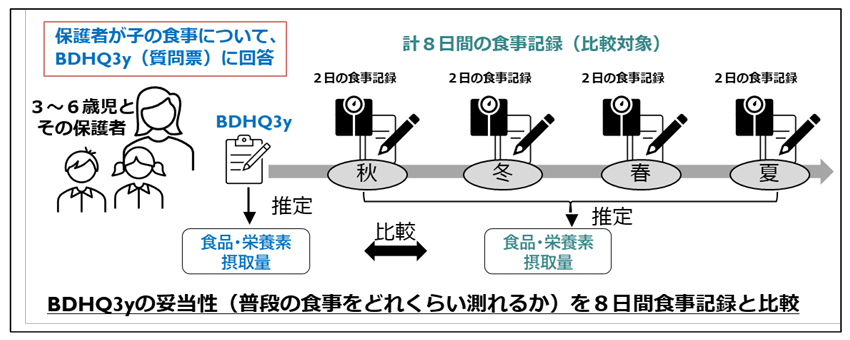
Background: To evaluate the relative validity of nutrient and food group intakes estimated using the brief-type self-administered Diet History Questionnaire for Japanese preschool children aged 3–6 years (BDHQ3y).
Methods: This study included 500 children (253 boys and 247 girls) aged 3–6 years recruited from 32 prefectures in Japan. Guardians completed the BDHQ3y to report their child’s dietary intake over the previous month and then 8-day weighed dietary records (DRs) over a year (2 days per season). From the BDHQ3y and DRs, energy-adjusted intakes of 44 nutrients and 26 food groups were estimated based on the density method.
Results: Percentage differences in median intakes were within 10% for 26 nutrients (most energy-providing nutrients and several vitamins and minerals) and three food groups (cereals, fish/shellfish and milk/dairy products). The median Spearman’s rank correlation coefficients were 0.31 (interquartile range [IQR], 0.23–0.40) for nutrients and 0.32 (IQR, 0.23–0.41) for food groups. Correlations exceeded 0.40 for 11 nutrients (eg, added sugar, dietary fiber and calcium) and nine food groups (eg, vegetables, fruits and milk/dairy products). Bland-Altman plots showed wide limits of agreement, with overestimation of intakes of protein, fats, carbohydrates, fruits, and milk/dairy products, as well as underestimation of intake of vegetables at higher intake levels. Similar findings were made when boys and girls were analyzed separately.
Conclusion: The BDHQ3y has the potential to monitor population-level intakes of a range of nutrients. However, its utility for ranking individuals and assessing individual-level intake remains limited, requiring cautious interpretation and application.