2026-11-02 東京科学大学
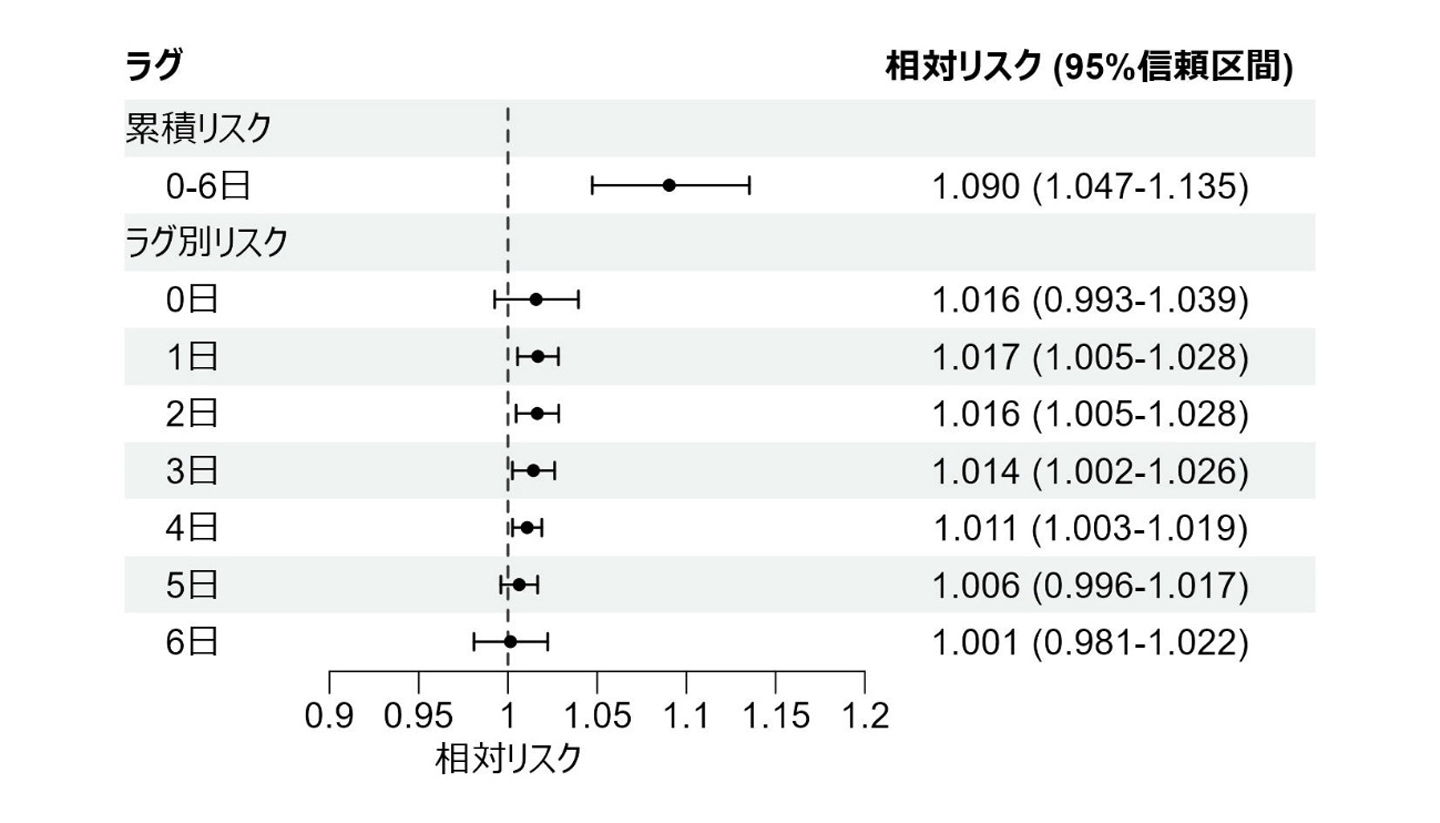
図1. 夜間の暑さにさらされたときの院外心停止による緊急入院のリスク。6日間のラグ期間を考慮し、ラグ0-6日における累積リスクと、ラグ別のリスクを示す。黒丸は相対リスクの推定値を、実線は95%信頼区間を示す。
<関連情報>
- https://www.isct.ac.jp/ja/news/wrpfvz56vvv8
- https://link.springer.com/article/10.1007/s00484-026-03342-x
夜間の熱曝露と院外心停止による緊急入院との関連性:日本における時間層別症例交差研究 Association between nighttime heat exposure and emergency hospitalization for out-of-hospital cardiac arrest: A time-stratified case-crossover study in Japan
Hisaaki Nishimura, Nobutoshi Nawa, Kiyohide Fushimi & Takeo Fujiwara
International Journal of Biometeorology Published:23 October 2026
DOI:https://doi.org/10.1007/s00484-026-03342-x
Abstract
Few studies have explored the adverse health effects of nighttime heat exposure. This study examined the association between nighttime heat exposure and emergency hospitalization for out-of-hospital cardiac arrest (OHCA) in Japan. Hospitalizations were identified from a nationwide administrative database covering the period from May to September between 2011 and 2021. Days with minimum temperatures higher than region-specific 92.5th percentile temperatures were considered as exposed to nighttime heat. Daily maximum temperature was adjusted for as a proxy for daytime heat exposure. First, a time-stratified case-crossover study using conditional quasi-Poisson regression analysis was conducted to estimate location-specific heat-related relative risks (RRs) of emergency hospitalization for OHCA over lag 0–6 days. Second, a random-effects meta-analysis was conducted to estimate pooled RRs. The analysis was further stratified by age, sex, and region. Third, in an attempt to account for the geographical heterogeneity in RRs, the location-specific penetration rate of air conditioners (ACs) was included as a meta-regressor. A total of 135,898 hospitalizations for OHCA were identified. Nighttime heat exposure was associated with increased emergency hospitalizations for OHCA (RR: 1.090 (95% confidence interval (CI): 1.047–1.135). Higher RRs were observed among people aged ≥ 75 years and females living in northern areas (1.295 (95%CI: 1.117-1.500) and 1.352 (95%CI: 1.145–1.596), respectively). In locations with a lower penetration rate of ACs, females and those aged ≥ 75 years were at higher RRs.