2026-11-01 インペリアル・カレッジ・ロンドン(ICL)
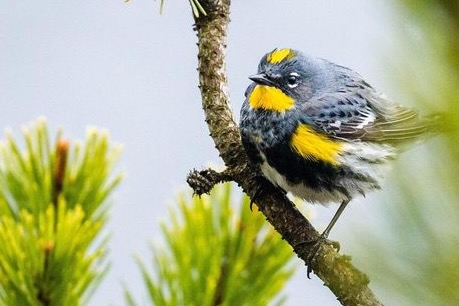
Yellow-rumped warbler. (Photo credit: Raina Fan)
<関連情報>
- https://www.imperial.ac.uk/news/articles/natural-sciences/life-sciences/2026/birds-and-humans-share-fundamental-song-and-speech-patterns/
- https://www.science.org/doi/10.1126/science.adr9983
鳥の歌に見られる普遍的なパターンは人間の話し言葉や歌のパターンと似ており、発声学習とは無関係である Pervasive patterns in bird songs resemble those in human speech and song and are independent of vocal learning
Logan S. James, Kendra Oudyk, Maria I. Pescaru, Erin M. Wall, Yining Chen, William D. Pearse, and Jon T. Sakata
Science Published:29 Oct 2026
DOI:https://doi.org/10.1126/science.adr9983
Abstract
Bird songs are often described as analogs to human speech and songs, but expansive comparisons are necessary to determine analogy and mechanistic substrates. By analyzing global corpora consisting of 367 bird species (>74,500 vocal elements from ~5900 songs) within two clades of vocal learners (oscines and hummingbirds) and related nonlearners (suboscines and nightjars) and 52 human languages (>15,000 elements in >800 speech or song phrases), we revealed common patterns in bird songs that resemble prevalent patterns in human speech and song with variation in resemblance to speech or song. Vocal learning did not systematically affect acoustic patterning or similarity to human vocalizations. These data underscore the deep analogies between bird and human vocalizations and convergent motor mechanisms shaping communication.