2026-11-02 東北大学
東北大学と中外製薬の研究グループは、酸化ストレスから細胞を守るKeap1-Nrf2システムにおいて、Keap1タンパク質が構造を変化させる仕組みを明らかにした。Keap1は通常、Nrf2と結合してその分解を促し、酸化ストレス防御に関わる遺伝子の働きを抑制している。研究チームは、クライオ電子顕微鏡による構造解析と独自の分子間距離解析を組み合わせ、Keap1二量体の2つのNrf2結合部位の距離を定量的に評価した。その結果、Nrf2が結合すると両結合部位の距離が近づき、Nrf2との結合を妨げる化合物を加えると再び広がることを確認した。また、Keap1の柔軟な構造変化に関わる領域も特定した。これにより、Keap1の構造変化を介した酸化ストレス応答の制御機構への理解が深まり、副作用の低減を目指した新しいNrf2活性化薬の開発につながる可能性がある。
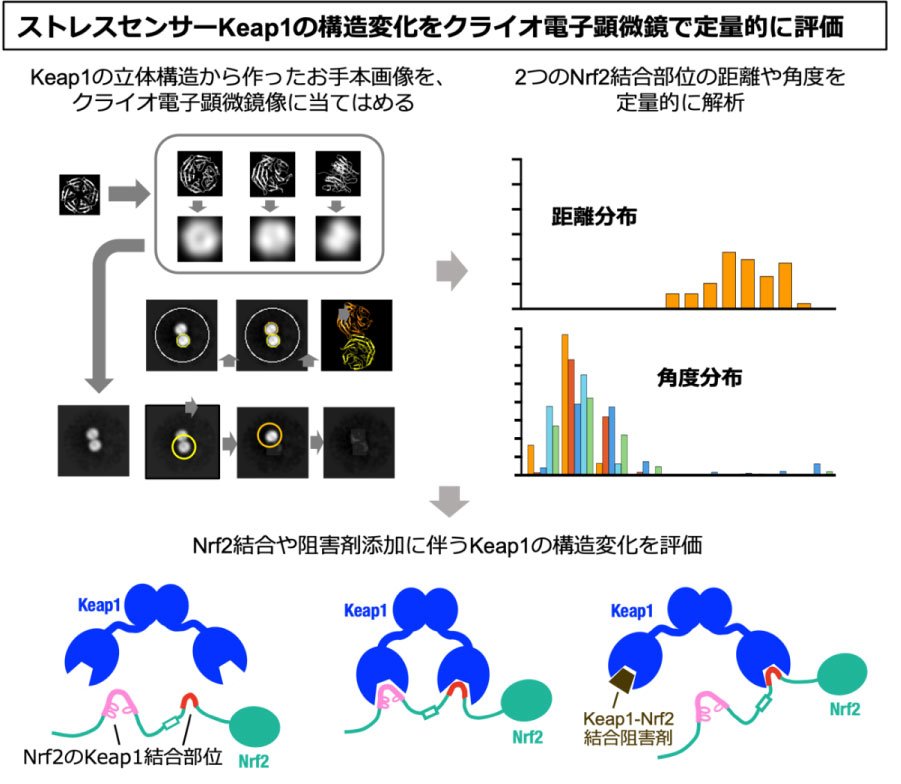
図1. 研究概要
<関連情報>
- https://www.tohoku.ac.jp/japanese/2026/11/press20261102-02-keap1.html
- https://www.sciencedirect.com/science/article/pii/S2213231726003782
ドメイン間距離解析により、Keap1-Nrf2ストレスセンサーシステムの構造変化が明らかになった Inter-domain distance analysis reveals conformational changes in the Keap1-Nrf2 stress sensor system
Ritsumi Saito,Takeshi Kawabata,Seisuke Yamashita,Keisuke Oki,Takashi Fujii,Hiroki Kawauchi,Yoshiaki Doi,Machiko Irie,Takuya Torizawa,Kengo Kinoshita,Masayuki Yamamoto,Seizo Koshiba
Redox Biology Available online: 1 September 2026
DOI:https://doi.org/10.1016/j.redox.2026.104379
Highlights
- Cryo-EM analysis indicates conformational diversity in full-length Keap1.
- A cryo-EM–based system quantitatively evaluates Keap1 domain-distance diversity.
- Nrf2 binding and a protein-protein interaction inhibitor alter Keap1 conformation.
- Three flexible regions contribute to Keap1 structural flexibility.
Abstract
The Keap1-Nrf2 system plays a central role in cellular defense against oxidative stress. Structural information on full-length Keap1 is essential for understanding the molecular basis of this regulation. However, its overall architecture has remained elusive due to pronounced conformational flexibility. In this study, we performed single-particle cryo-electron microscopy (cryo-EM) analysis of full-length Keap1 and found multiple particle conformations accompanied by severe preferred orientation in vitrified ice. To address these problems, we developed an analytical system that focuses on measuring the inter-domain distance between the two DC domains of the Keap1 homodimer. Using this approach, we identified the change of inter-domain distance distributions of Keap1 induced by Nrf2 binding or its inhibition, suggesting that these conformational changes are associated with Nrf2 regulation. Furthermore, through integration of this system with Keap1 deletion mutants, three flexible regions within Keap1 are found to contribute substantially to the conformational flexibility of the Keap1 homodimer. Together, these findings provide structural insights into the dynamic changes of the Keap1-Nrf2 system that would contribute to the development of Keap1-targeted therapeutics.