2026-10-30 沖縄科学技術大学院大学
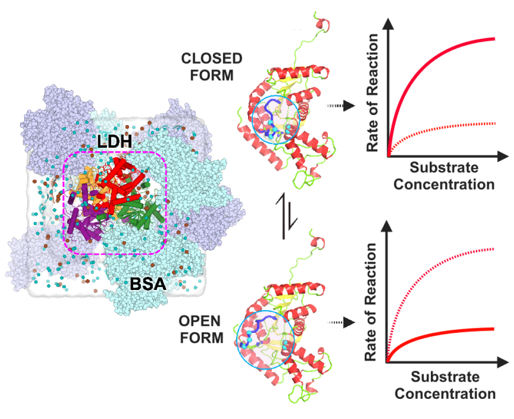
高密度環境は酵素活性を高める。シミュレーションの結果、BSAタンパク質に囲まれた乳酸脱水素酵素(LDH)は、開いた状態と閉じた状態の両方をとることが分かった。高密度環境では閉じた状態が優勢となり、その結果、酵素反応が起こりやすくなって活性が高まる。 © Dindo et al., 2026, 10.1038/s41467-026-77666-y
<関連情報>
- https://www.oist.jp/ja/news-center/news/2026/10/30/enzymes-get-flow-going-crowded-droplets
- https://www.nature.com/articles/s41467-026-77666-y
酵素は、様々なスケールで高密度の生体分子凝縮体を活性化および移動させることができる Enzymes can activate and mobilize dense biomolecular condensates across scales
Mirco Dindo, Jakob Metson, Weitong Ren, Michalis Chatzittofi, Kiyoshi Yagi, Alessandro Bevilacqua, Erika Fukuhara, Yuji Sugita, Ramin Golestanian & Paola Laurino
Nature Communications Published:30 October 2026
DOI:https://doi.org/10.1038/s41467-026-77666-y
Abstract
Biomolecular condensates have so far been studied in terms of their structural, compositional, and functional properties. However, condensate enzymatic activity – a key aspect of cellular metabolism – remains unexplored due to the complexity of the system. In this study, using a combination of experimental, computational and theoretical techniques, we have discovered that the non-equilibrium activity which originates from catalytic reactions couples with the environment through various feedback mechanisms across five orders of magnitude of length scales. We observe that condensed enzymes catalyze more rapidly in the presence of crowding proteins and show that the increased enzymatic activity within these droplets stems from the emergence of lower-energy protein conformations induced by the highly crowded environment. Despite the crowding in the environment of the droplet, which might suggest an effective increase in its overall viscosity, we find that it becomes more agile, as evidenced by the observation of enhanced diffusion and macroscopic flow, due to the enzymatic activity. These findings shed light on the dynamic interplay between enzymatic activity, composition and crowding in condensates, and their roles on the mobility and accessibility of various functional units in these environments, expanding our understanding of liquid-liquid phase separation in metabolically active conditions.