2026-10-30 オックスフォード大学
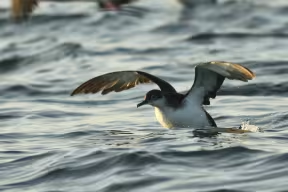
A Manx shearwater flying around Skomer Island, Pembrokeshire, Wales. Credit: Dr Joe Wynn.
<関連情報>
- https://www.ox.ac.uk/news/2026-10-26-study-finds-that-long-distance-flights-can-throw-seabirds-internal-clocks-out-of
- https://www.science.org/doi/10.1126/science.adz2542
急速な縦方向飛行は時間のずれと太陽コンパスの誤差を引き起こす Rapid longitudinal flights cause time shifts and Sun compass error
Patrick Lewin, Joe Wynn, Joe Morford, Oliver Padget, Lewis Lancaster-Reeves, Katrina Siddiqi-Davies, Hector Bailey, Sarah Bond, Madeline Davis, […] , and Tim Guilford
Science Published:29 Oct 2026
DOI:https://doi.org/10.1126/science.adz2542
Abstract
Many animals use the Sun compass to guide their movement, sometimes over thousands of kilometers. Consistent use of the Sun compass relies on the endogenous clock to track the Sun’s arc, yet animals traveling east-west experience time shifts, potentially causing mismatches between their internal clock and local time. Using GPS, we reveal that Manx shearwaters (Puffinus puffinus) experience such shifts during homing flights, generating predictable errors in Sun compass orientation. Use of the Sun compass persists even when shearwaters have access to compass-independent cues during coast following. Our findings provide a new avenue for chronobiology research in the wild, suggesting that rapid longitudinal movements may affect other processes governed by the endogenous clock and that conserved chronobiological mechanisms impose substantial constraints on navigation.