2026-10-30 マサチューセッツ工科大学(MIT)
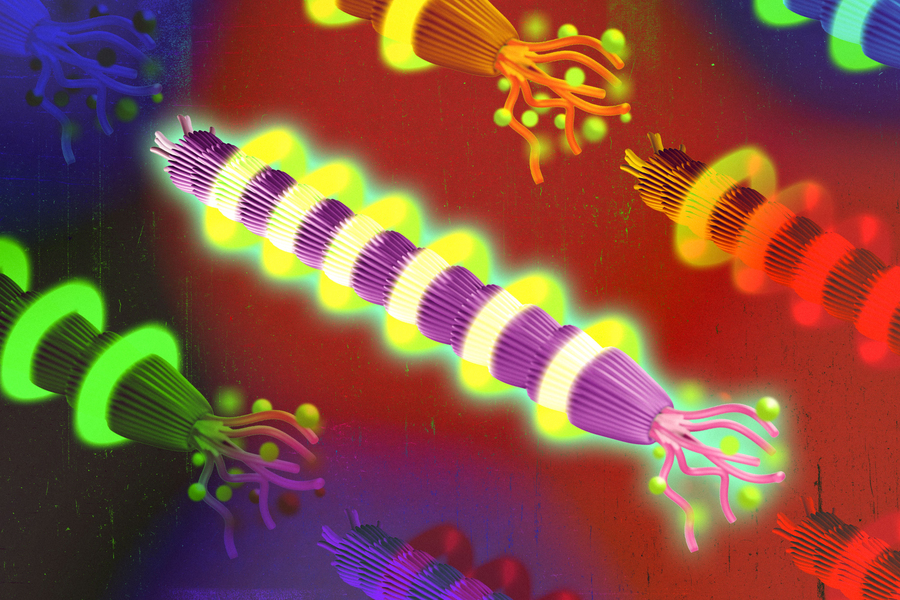
The backbone of the vaccine is a modified, harmless bacteriophage called M13, which forms a nanofiber that can be coated with cancer antigens. Credits: Jose-Luis Olivares, MIT
<関連情報>
- https://news.mit.edu/2026/mit-engineers-create-nanoparticles-delivering-personalized-cancer-vaccines-1030
- https://advanced.onlinelibrary.wiley.com/doi/10.1002/adhm.71811
個別化ナノワクチンのためのM13バクテリオファージ上の抗原密度のエンジニアリング Engineering Antigen Density on M13 Bacteriophage for Personalized Nanovaccine
Shengnan Huang, Allison Madow, Jack Rudrum, Huaiyao Peng, Hao Nghi Luu, Peiyan Dong, Jifa Qi, Angela M. Belcher
Advanced Healthcare Materials Published: 29 October 2026
DOI:https://doi.org/10.1002/adhm.71811
Abstract
Nanovaccines have been engineered to co-deliver antigens and adjuvants for robust immune responses. While extensive studies have examined the effect of nanovaccine size, shape, surface charge, and targeting on vaccine efficacy, the impact of antigen density remains underexplored. Here, we systematically optimize the anti-tumor CD8+ T cell response by modulating the antigen density on an M13 phage-based nanovaccine. By fine-tuning the antigen ratio from ∼6.0% to ∼70.4% on the phage capsid, the anti-tumor CD8+ T cell response was enhanced. Further investigation demonstrated that the antigen density affected not only antigen presentation efficacy but also dendritic cell uptake. Applying this strategy to a neoantigen in the MC-38 colorectal cancer model, we achieved up to a ∼7-fold increase in the neoantigen-specific CD8+ T cell frequency, resulting in significant tumor suppression. These findings underscore the critical role of antigen density in nanovaccine design and establish M13 bacteriophage as a universal platform for personalized cancer vaccine applications.