2026-10-05 岡山大学,東京大学,岐阜大学,香川大学
<関連情報>
- https://www.okayama-u.ac.jp/tp/release/release_id1619.html
- https://link.springer.com/article/10.1007/s10164-026-00902-x
コクヌストモドキにおける不妊雄に対する雌の交尾反応の実験的進化 Experimental evolution of female mating responses to infertile males in Tribolium castaneum
Yui Fujii, Yui Asano, Kenta Kori, Kentarou Matsumura, Yukio Yasui, Chihiro Himuro, Yutaka Nakamoto, Yoshitaka Sokei & Takahisa Miyatake
Journal of Ethology Published:05 October 2026
DOI:https://doi.org/10.1007/s10164-026-00902-x
Abstract
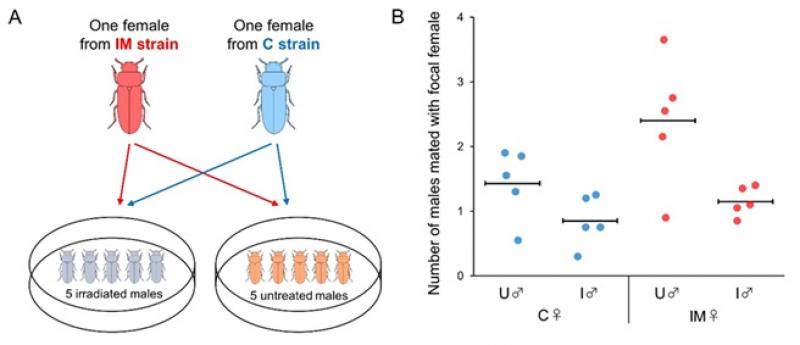
In many animal populations, infertile males—those unable to reproduce—are commonly present. If females mate exclusively with such males, they fail to produce offspring. How, then, do females deal with this situation? Distinguishing infertile from fertile males both before and after copulation is difficult for females. Here, we tested the hypothesis of bet-hedging polyandry, in which females mitigate the risk of reproductive failure by mating with multiple males, using experimental evolution in the red flour beetle (Tribolium castaneum). Females were cohabited with males artificially sterilized by sublethal radiation and with untreated males at a 1:1 ratio (sterile:untreated). After more than 15 generations, females from the treatment strains did not avoid mating with infertile males, leading to reduced reproductive success. However, compared with the control strains, females from the treated strains tended to mate with a greater number of males. The results raise the possibility that increased polyandry (mating with multiple males) may evolve rather than relying on pre- or post-copulatory discrimination to mitigate the risk posed by infertile males. Bet-hedging is a strategy that spreads or minimizes risk under uncertainty, and these results are consistent with the hypothesis that polyandry can function as a bet-hedging strategy against uncertain male fertility.