2026-11-18 東北大学
<関連情報>
- https://www.tohoku.ac.jp/japanese/2026/11/press20261118-03-podocalyxin.html
- https://www.mdpi.com/1422-0067/27/22/10317
がん特異的抗ポドカリキシンモノクローナル抗体薬物複合体が膵がん異種移植モデルで抗腫瘍活性を発揮
A Cancer-Specific Anti-Podocalyxin Monoclonal Antibody-Drug Conjugate Exerted Antitumor Activity in a Pancreatic Cancer Xenograft Model
Takuro Nakamura, Tomokazu Ohishi, Mika K. Kaneko, Hiroyuki Suzuki, Yukinari Kato
International Journal of Molecular Sciences, 27(22), 10317 (2026)公開日:2026-11-17
DOI:10.3390/ijms272210317
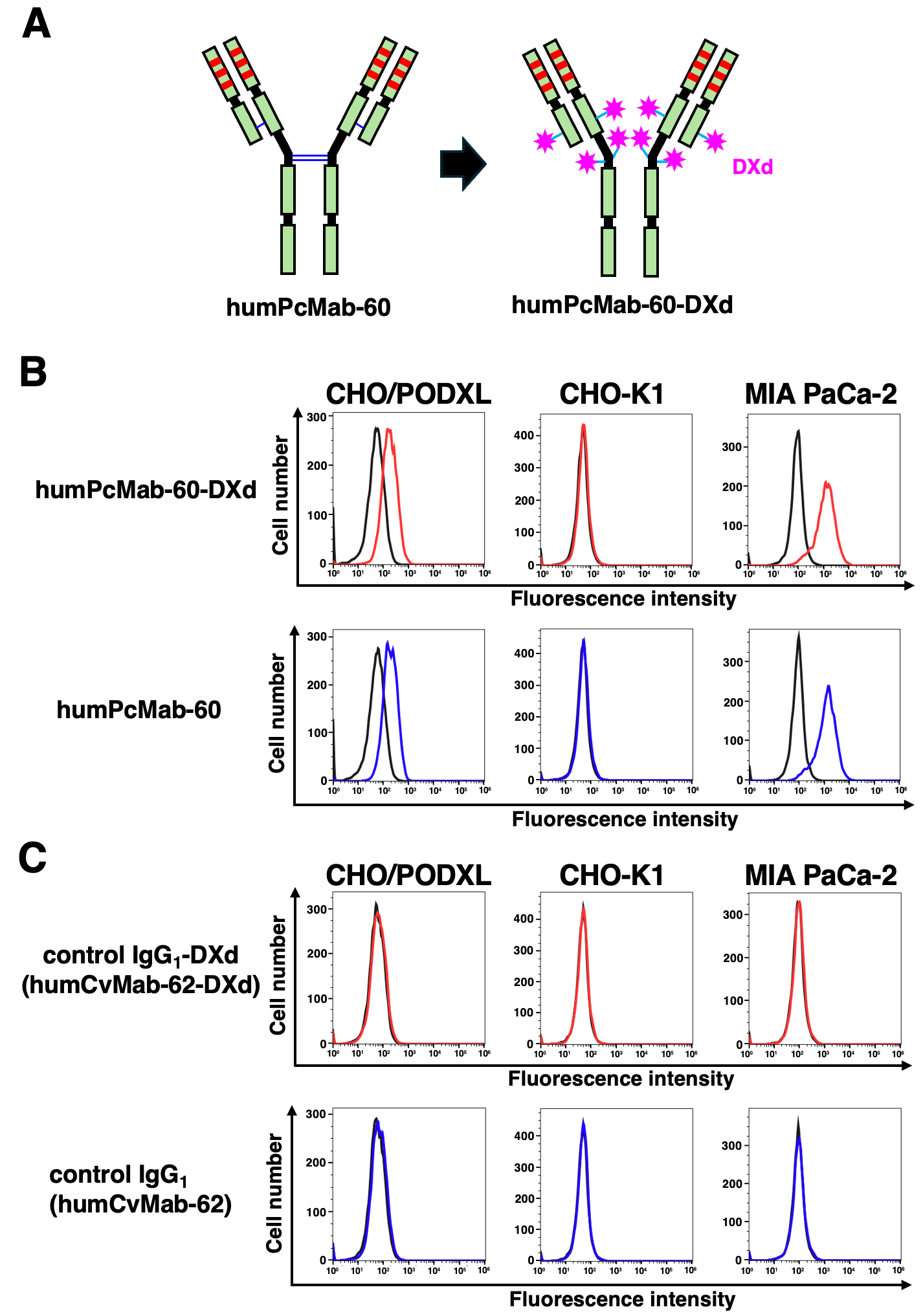
Figure 1. Flow cytometric analysis of humPcMab-60 and humPcMab-60-DXd in CHO/PODXL and MIA PaCa-2 cell lines. (A) Production of humPcMab-60-DXd (DAR7.8) from humPcMab-60. (B) CHO/PODXL, CHO-K1, and MIA PaCa-2 were treated with 6.25 μg/mL of humPcMab-60-DXd (DAR7.8, red line), humPcMab-60 (blue line), or blocking buffer (black line, negative control). (C) CHO/PODXL, CHO-K1, and MIA PaCa-2 were treated with 6.25 μg/mL of control IgG1-DXd (humCvMab-62-DXd, DAR7.7, red line)) or control IgG1 (humCvMab-62, blue line) at 6.25 μg/mL (red line) or blocking buffer (black line, negative control). We treated these cells with fluorescein isothiocyanate (FITC)-conjugated anti-human IgG. We collected fluorescence data using the SA3800 Cell Analyzer and analyzed them in FlowJo software (version 10.8.1). The experiments were conducted twice.© Nakamura et al., 2026. Licensed under CC BY 4.0.
本研究は、膵がん細胞に特異的に結合する抗ポドカリキシン(PODXL)抗体を利用した抗体薬物複合体(ADC)の開発と、その抗腫瘍効果を検証したものである。研究チームは、がん細胞特有のPODXLを認識するヒト化モノクローナル抗体humPcMab-60に、トポイソメラーゼI阻害剤エキサテカンの誘導体DXdを結合させたhumPcMab-60-DXdを作製した。このADCは、膵管腺がん細胞株MIA PaCa-2に結合して細胞内に取り込まれ、正常リンパ管内皮細胞には反応しないがん特異性を維持した。また、培養細胞に対して濃度依存的な細胞障害活性を示し、IC50は0.68 μg/mLであった。さらに、MIA PaCa-2を移植したヌードマウスモデルでは、対照群と比較して投与14日後の腫瘍重量を56%減少させ、100~300 μgの投与量に応じた抗腫瘍効果が確認された。マウスの体重減少は認められなかった。本研究は、がん特異的抗体と抗がん剤を組み合わせた新しい膵がん治療戦略を提示する成果である。ただし、評価は単一のヒト膵がん細胞株を用いた動物モデルに限られ、ヒト正常細胞に対する毒性評価や多様な腫瘍モデルでの検証が今後の課題である。
This study developed and evaluated an antibody-drug conjugate (ADC) targeting podocalyxin (PODXL) in pancreatic cancer. The researchers conjugated DXd, an exatecan-derived topoisomerase I inhibitor, to the humanized cancer-specific monoclonal antibody humPcMab-60, which recognizes tumor-associated PODXL. The resulting ADC, humPcMab-60-DXd, retained selective binding to the pancreatic ductal adenocarcinoma cell line MIA PaCa-2 while showing no reactivity toward normal lymphatic endothelial cells. The ADC was internalized into cancer cells and exhibited dose-dependent cytotoxicity in vitro, with an IC50 of 0.68 μg/mL. In a mouse xenograft model implanted with MIA PaCa-2 cells, treatment reduced tumor weight by 56% compared with the control group 14 days after administration. Dose-dependent antitumor activity was also observed at doses ranging from 100 to 300 μg, without detectable body-weight reduction in the treated mice. These findings demonstrate the preclinical potential of combining cancer-specific antibodies with cytotoxic drugs for pancreatic cancer treatment. However, the study was limited to a single human pancreatic cancer cell line xenograft model, and further investigations using additional tumor models and human normal cells are required to establish therapeutic efficacy and safety.