2026-11-18 神戸大学
<関連情報>
- https://www.kobe-u.ac.jp/ja/news/article/20261118-68439/
- https://www.nature.com/articles/s41467-026-79248-4
RasによるGTP加水分解は、安定化された求核性水分子を必要とせずに進行する
GTP hydrolysis by Ras proceeds without a stabilized nucleophilic water molecule
Takashi Kawamura, Wakako Fujimoto-Sakisaka, Yoshiteru Makino, Shigeyuki Matsumoto, Tatsuya Ohyama, Yoko Yoshikawa, Chiduru Watanabe, Fangjia Luo, Taisuke Horikawa, Yuto Nagoshi, Kyohei Soga, Tomoyuki Tanaka, Rie Tanaka, Shigeki Owada, Kensuke Tono, Kazuya Hasegawa, Hitomi Yuki, Morihito Okada, Ryosuke Matsubara, Atsuo Tamura, Teruki Honma, Shigeki Kiyonaka, So Iwata, Eriko Nango, Takashi Kumasaka, Fumi Shima
Nature Communications, 17, Article number 11533 (2026)公開日:2026-11-18
DOI:10.1038/s41467-026-79248-4
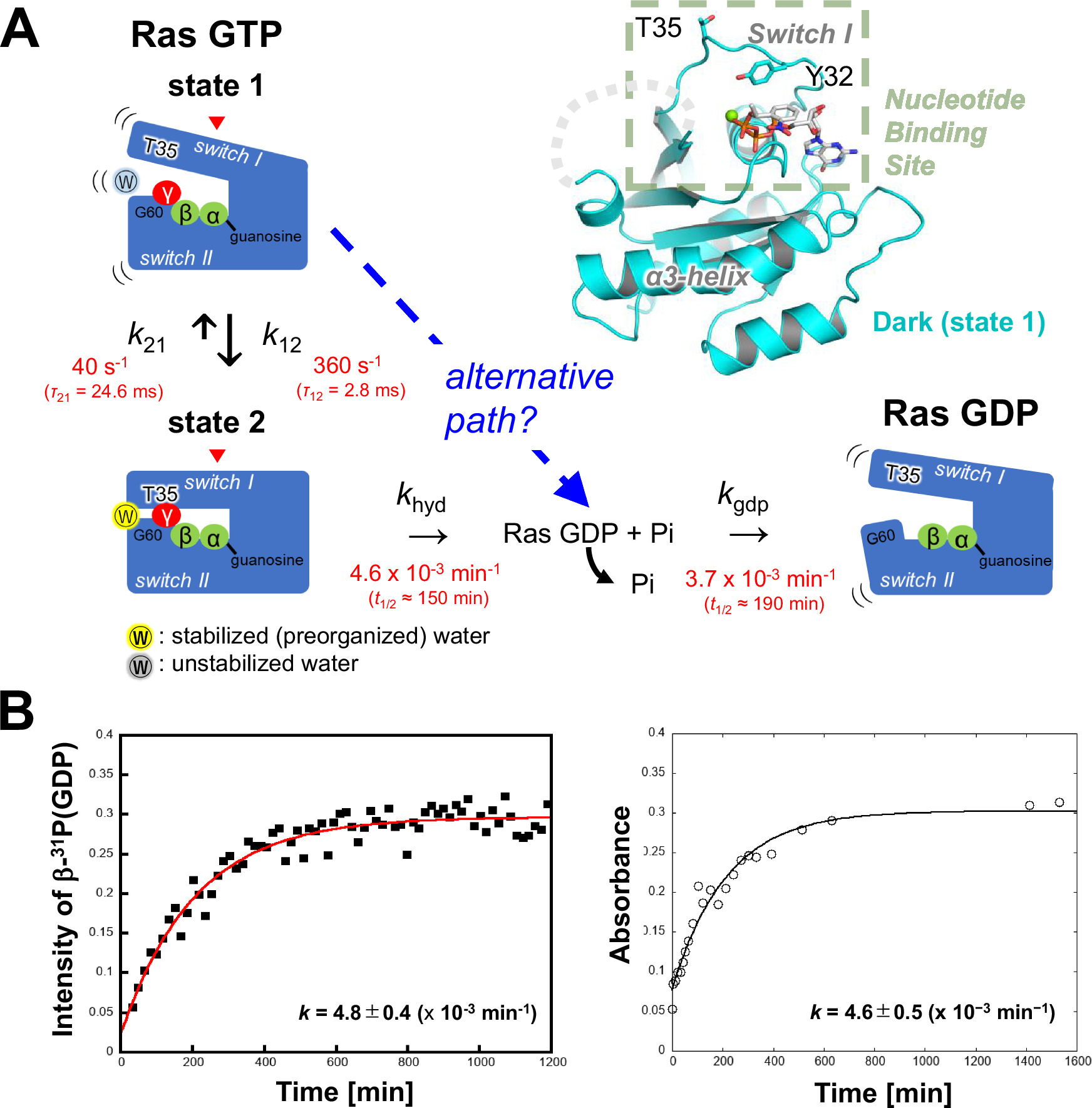
Fig. 1: Ras-mediated GTP hydrolysis scheme and kinetics. From: GTP hydrolysis by Ras proceeds without a stabilized nucleophilic water molecule Source: Kawamura et al., Nature Communications (2026), Fig. 1. CC BY-NC-ND 4.0.
This study elucidates the intrinsic GTP hydrolysis mechanism of Ras, a small GTP-binding protein critically involved in cancer development and progression. Ras terminates signaling by converting from its active GTP-bound form to its inactive GDP-bound form. Conventional models propose that Ras interconverts between an inactive state 1 and a catalytically competent state 2, in which a nucleophilic water molecule is stabilized, with hydrolysis proceeding through state 2. The researchers introduced photoactivatable caged GTP into Ras crystals and used time-resolved serial femtosecond and synchrotron crystallography to monitor structural changes over timescales ranging from milliseconds to hours. Following photolysis, Ras adopted state 1, which lacks a stabilized nucleophilic water molecule. Surprisingly, this conformation persisted for hours before converting directly into the GDP-bound state without passing through state 2. These findings challenge the prevailing model that state 2 is essential for GTP hydrolysis and demonstrate an alternative pathway in which state 1 can directly support catalysis. This revised understanding of Ras inactivation may provide a new conceptual foundation for developing therapeutic strategies targeting clinically relevant Ras mutants that preferentially adopt state 1.