2026-10-22 名古屋大学,科学技術振興機構,JSR株式会社
<関連情報>
- https://www.jst.go.jp/pr/announce/20261021-3/index.html
- https://link.springer.com/article/10.1186/s12951-026-05148-w
蛍光/磁気共鳴二重モードイメージング誘導近赤外線光免疫化学動的熱標的療法のための相乗的ナノセラノスティクスプラットフォーム Synergistic nanotheranostic platform for fluorescence/magnetic resonance bimodal imaging-guided near infrared photoimmuno-chemodynamic thermal targeting therapy
Kohei Matsuoka, Mizuki Yamada, Ryu Okada, Mibuko Shimada, Mikina Yoshida, Rika Fukushima, Kanna Umeda, Ayano Ohashi, Chiemi Oka, Ayako Kato, Misae Shimizu, Chiaki Koike, Akira Ito, Mitsuo Sato & Kazuhide Sato
Journal of Nanobiotechnology Published:14 October 2026
DOI:https://doi.org/10.1186/s12951-026-05148-w
Abstract
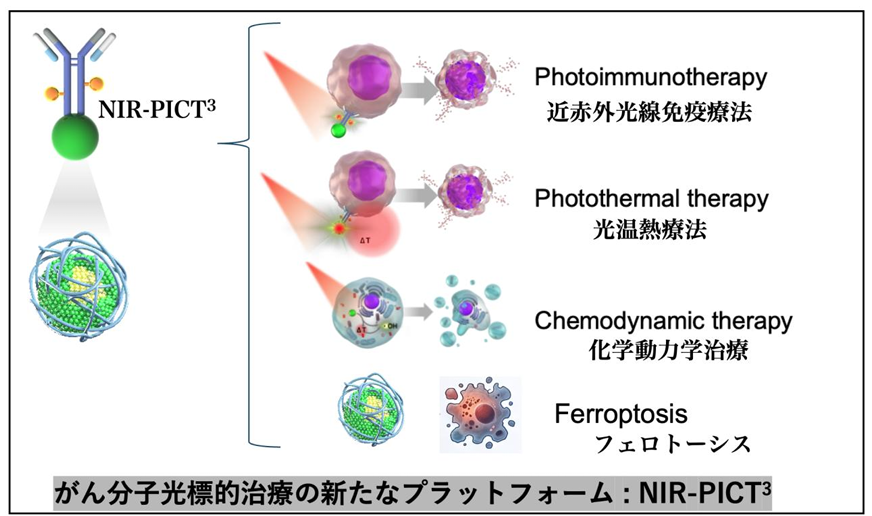
Near-infrared (NIR) photoimmunotherapy (PIT) is a promising cancer treatment strategy involving antibody–photoabsorber conjugates. However, the imaging depth and photobleaching susceptibility of the IR700 fluorescence used for treatment monitoring are limited, and antigen heterogeneity within tumors compromises the efficacy of strictly antigen-restricted therapies. We developed a synergistic nanotheranostic platform that integrates NIR-PIT, photothermal therapy, and chemodynamic therapy (CDT) into a single MRI-visible agent (NIR-PICT3). To achieve NIR-PICT3, conjugation of mAb–IRDye700DX (mAb-IR700) to dextran-coated superparamagnetic iron oxide nanoparticles (nanomag-D-spio) yielded nanomag-D-spio-mAb-IR700, enabling dual imaging (IR700 fluorescence/MRI) and targeted cytotoxicity upon 690-nm irradiation. The conjugate retained antigen selectivity, exhibited activatable NIR fluorescence after cellular uptake, generated negative T1- and T2-weighted MRI contrast, and demonstrated robust, cycle-enhanced photothermal performance. Iron-mediated redox catalysis promoted ·OH generation, supporting CDT. In vivo, systemic administration led to marked tumor accumulation, as confirmed by multimodal analyses. Repeated light dosing exploited the NIR-PIT–induced super-enhanced permeability and retention (SUPR) effect, enhancing nanoparticle retention, tumor heating, and therapeutic efficacy. In EGFR+ xenografts, NIR-PICT3 achieved superior tumor regression and survival while inducing photothermal bystander effects in antigen-heterogeneous models. These results establish a modular, image-guided strategy for platform therapy to overcome monitoring depth limitations and antigen heterogeneity in solid tumor NIR-PIT.