2026-11-11 ペンシルベニア州立大学(Penn State)
<関連情報>
- https://www.psu.edu/news/research/story/when-rain-finally-does-come-drylands-only-some-microbes-soil-awaken
- https://academic.oup.com/ismej/article/20/1/wrag231/8785853
降雨による微生物の蘇生は、生物地殻の遷移全体にわたる機能的分離を明らかにする Rainfall-induced microbial resuscitation reveals functional decoupling across biocrust succession
Raúl Román, Fernando T Maestre , Estelle Couradeau
The ISME Journal Published: 04 September 2026
DOI:https://doi.org/10.1093/ismejo/wrag231
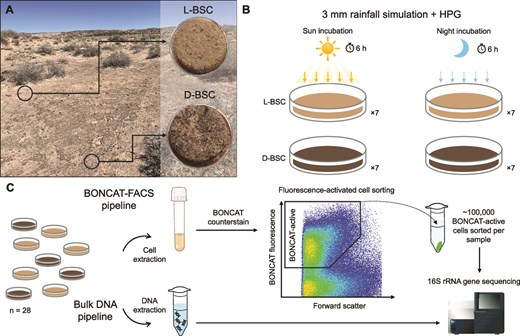
Figure 1Experimental workflow. (A) Cyanobacteria-dominated biocrusts representing early (L-BSC) and late (D-BSC) successional stages were collected at the Green Butte Site (Moab, UT, USA). (B) Intact biocrust microcosms received a 3 mm simulated rainfall event containing HPG (total n = 28). Samples were incubated for 6 h under either illuminated (Sun incubation) or dark (Night incubation) conditions. (C) Following incubation, samples were split and harvested for parallel analyses: one underwent the BONCAT-FACS pipeline, which included cell extraction in saline buffer, HPG click reaction, and fluorescence-activated cell sorting, and the other part was used for bulk DNA extraction. Both fractions were analysed by 16S rRNA gene amplicon sequencing (see below) to determine the composition of Bulk DNA and BONCAT-active bacterial communities.
Tii-summary
English
Dryland ecosystems depend on intermittent rainfall pulses to reactivate soil microbial communities, but the identity of microbes that resume activity and how this process varies across biological soil crust (BSC) succession remain poorly understood. This study investigated cyanobacteria-dominated biocrusts at early and late successional stages by applying simulated rainfall of 3 mm and incubating samples under light and dark conditions for six hours. Bioorthogonal non-canonical amino acid tagging combined with fluorescence-activated cell sorting (BONCAT-FACS) and 16S rRNA gene sequencing was used to identify translationally active bacteria. The results showed that only approximately 4–8% of the microbial community resumed detectable activity within six hours, with mature biocrusts exhibiting higher proportions of active cells than early-stage crusts. Light exposure had no significant effect on microbial activity patterns, while microbial presence and actual activity were found to be partially decoupled. Nevertheless, a shared group of rapidly responding microorganisms was identified across different successional stages. These findings reveal important aspects of microbial dormancy and resuscitation in dryland ecosystems and provide insights into predicting how changing precipitation patterns may affect soil nutrient cycling and ecosystem functioning.
出典:The ISME Journal, 20(1), wrag231 (2026)。出版社掲載の論文本文・抄録およびPubMed収録情報に基づく要約。