2026-11-03 カリフォルニア大学リバーサイド校(UCR)
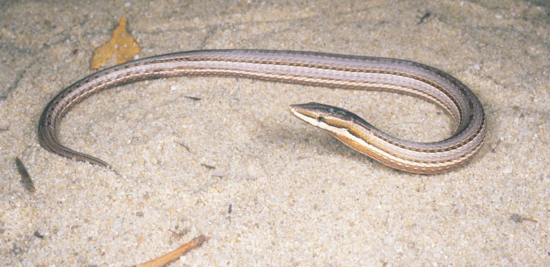
Photo shows Lialis burtonis. The enigmatic Pygopodid lizards adaptively radiated into at least 50 species of lizards that are endemic to Australia and New Guinea. Unlike conventional limbed-lizards, their locomotor abilities are mainly determined by their relative tail lengths and body girths. (UCR/Bryan Jennings)
<関連情報>
- https://news.ucr.edu/articles/2026/11/03/body-size-not-competition-may-kickstart-evolution
- https://academic.oup.com/evolinnean/advance-article/doi/10.1093/evolinnean/kzag030/9010907
形質進化のスケーリング理論 A scaling theory of trait evolution
W Bryan Jennings
Evolutionary Journal of the Linnean Society Published: 03 November 2026
DOI:https://doi.org/10.1093/evolinnean/kzag030
Abstract
I developed the ‘geometric-scaling-first model’ to test whether allometric trait divergence begins with a Geometric Scaling Step followed by a Re-adaptation Step. This framework hypothesizes that geometric similarity is preserved in populations that undergo changes in body size, after which directional natural selection restores functionality lost during the geometric scaling phase. I tested this model using morphological data for three locomotor-relevant traits based on 1,755 museum specimens representing 31 species of pygopodid lizards. The results demonstrated that initial trait divergence involves size-shape dissociations far more extreme than geometric scaling predicts, revealing that the Geometric Scaling Step provides an incomplete picture of early trait divergence. Initial divergence generally produced reversed evolutionary allometric slopes relative to ontogenetic slopes (i.e. ‘reverse evolutionary allometry’). Although the trait data supported the subsequent Re-adaptation Step, the overall results led to the rejection of the model. Consequently, I propose a new ‘dissociative-scaling-first model’, which posits that trait divergence typically begins with a reverse evolutionary allometry step, followed by later trait re-adaptation. This study suggests that dissociative scaling, driven by natural or sexual selection, may facilitate peak shifts on adaptive landscapes. Because body size variation is widespread in nature, this hypothetical mechanism, termed ‘niche scaling’, may play an important role in ecological diversification. Applications of the model to Darwin’s finches and the Irish elk are also discussed.