2026-10-28 名古屋大学
<関連情報>
- https://www.nagoya-u.ac.jp/researchinfo/result/2026/10/-fruitless.html
- https://journals.plos.org/plosbiology/article?id=10.1371/journal.pbio.3004041
雄のネッタイシマカが雌の飛行音に誘引されるには、実りがないことが不可欠である fruitless is essential for male Aedes aegypti mosquito attraction to female flight sounds
YuMin M. Loh,Alberto J. Thornton,WenWei Loh,Tai-Ting Lee,Wan-Tze Chen,Yifeng Y. J. Xu,Jia Xin Yap,Yuichiro Tsuchiya,Daniel F. Eberl,Matthew P. Su ,Azusa Kamikouchi
PLOS Biology Published: October 27, 2026
DOI:https://doi.org/10.1371/journal.pbio.3004041
Abstract
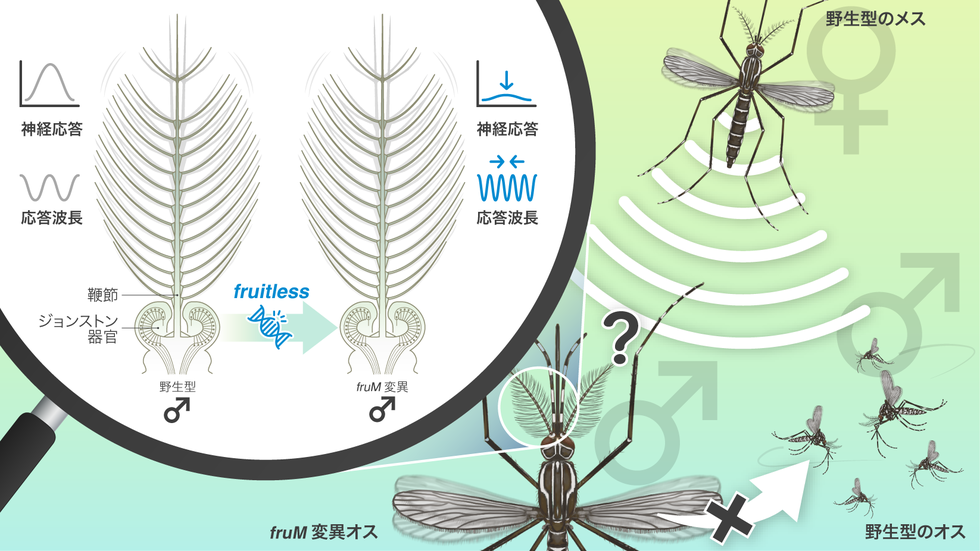
Male mosquitoes locate females through strong and innate attraction to female flight sounds, the basis of mating in the world’s deadliest animal. In contrast, females do not show any sound attraction behaviors. Despite being documented for almost a century, the molecular underpinnings of these behavioral dimorphisms remain unknown. Here, we found that by disrupting the male-specific isoform of fruitless (referred to as fruM) in Aedes aegypti, fruM mutant males show complete abolition of sound attraction behaviors, resulting in failure of mutant males to locate females for mating. We identified strong fruitless expression in control male ears, with the loss of FruM severely disrupting mutant male ability to amplify female flight sounds. fruM mutant male ears also propagate frequency-specific, sound-evoked electrical signals at about one-sixth the magnitude of control males, significantly reducing the amount of auditory information relayed to the brain. fruitless thus plays a significant role in determining proper male peripheral hearing function underlying mating. Transcriptomic analyses of mosquito ears identified essential hearing genes under the transcriptional influence of FruM via direct or indirect actions, thus shaping male-specific hearing cellular machineries that support male attraction to female flight sounds. Our work demonstrates that FruM commands male-specific hearing behaviors involved in mating by directly controlling the earliest stages of auditory organ performance, sound amplification and acoustic signal detection. Our findings show that FruM is essential for male-specific reproductive behaviors in mosquitoes.