2026-11-17 東北大学
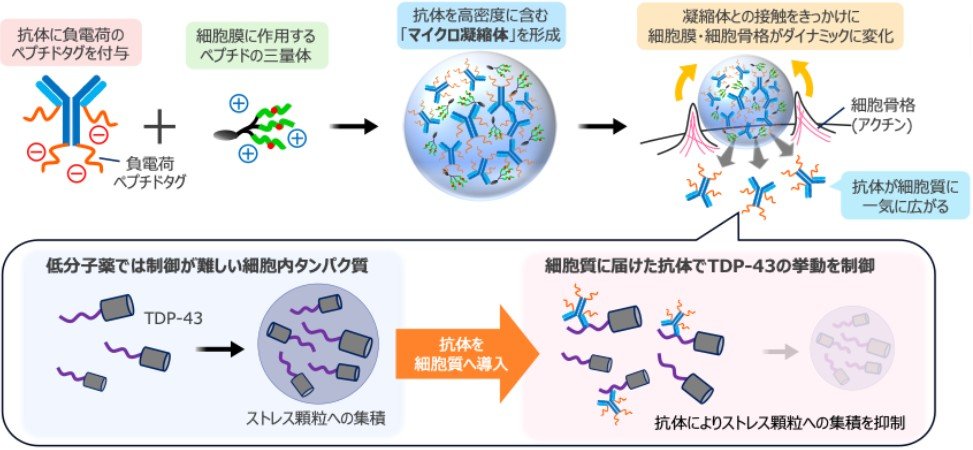
負電荷ペプチドタグを付加した抗体は、細胞膜に作用するペプチドとマイクロ凝縮体を形成し、細胞膜や細胞骨格の変化を伴って抗体を細胞質へ送り届ける。細胞内へ導入された抗体はTDP-43を認識し、ストレス顆粒への集積を抑制する。(イラスト作成者:川口祥正)
<関連情報>
- https://www.tohoku.ac.jp/japanese/2026/11/press20261117-01-infusion.html
- https://www.nature.com/articles/s41467-026-78720-5
膜透過性ペプチドのマイクロ凝縮体による、抗体の細胞内へのバースト状送達(Burst-like intracellular antibody infusion via membrane-permeabilizing peptide microcondensates)
Yoshimasa Kawaguchi, Megumi Kiyokawa, Daisuke Yamasaki, Mai Watabe, Shohei Shiomoto, Yuko Mimori-Kiyosue, Satoko Arakawa, Masaru Tanaka, Masaki Okumura, Shiroh Futaki
Nature Communications (2026):2026-11-16
DOI:10.1038/s41467-026-78720-5
抗体は標的タンパク質を高い選択性で認識できる一方、分子サイズが大きく細胞膜を通過しにくいため、細胞内タンパク質への応用が制限されている。本研究では、抗体の軽鎖・重鎖にグルタミン酸とチロシンを含む負電荷ペプチドタグを付加した改変抗体(LHAT-IgG)を設計し、細胞膜透過性ペプチドの三量体FcB(L17E)₃と混合することで、抗体を高密度に含むマイクロ凝縮体を形成させた。この凝縮体は生理的塩濃度や血清を含む培養条件でも形成され、最適条件では50%以上の細胞への抗体送達を達成した。共焦点顕微鏡や格子光シート顕微鏡による観察から、凝縮体が細胞表面に接触するとアクチンを含む細胞骨格と細胞膜が変化し、取り込まれた抗体が数分で細胞質全体に広がることが示された。さらに、ALSや前頭側頭型認知症との関連が知られるTDP-43を標的とする抗体を導入したところ、ストレス条件下でのTDP-43のストレス顆粒への集積が抑制された。本技術は、従来の低分子薬では制御が難しい細胞内タンパク質を抗体で操作するための新たな研究基盤となることが期待される。
Antibodies can recognize target proteins with high specificity, but their large molecular size generally prevents them from crossing cell membranes, limiting their use against intracellular targets. In this study, the researchers designed modified antibodies (LHAT-IgG) bearing negatively charged peptide tags containing glutamic acid and tyrosine residues on their light and heavy chains. Mixing these antibodies with the trimeric membrane-permeabilizing peptide FcB(L17E)₃ generated microcondensates containing high concentrations of antibodies. The condensates formed under physiological salt conditions and in serum-containing culture media, and the optimized formulation delivered antibodies into more than 50% of cells. Confocal and lattice light-sheet microscopy revealed that contact with the condensates induced changes in the cell membrane and actin cytoskeleton, followed by antibody release and rapid distribution throughout the cytoplasm within minutes. Furthermore, intracellular delivery of an antibody targeting TDP-43, a protein associated with amyotrophic lateral sclerosis and frontotemporal dementia, suppressed its accumulation in stress granules under stress conditions. This approach offers a potential new research platform for manipulating intracellular proteins that are difficult to control using conventional small-molecule drugs.