2026-11-16 理化学研究所
<関連情報>
- https://www.riken.jp/press/2026/20261116_1/index.html
- https://www.nature.com/articles/s42003-026-11152-5
新たに遭遇したプリズム偏位環境への能動的推論の転移(Transferring active inference to newly encountered prism-shifted environments)
Megumi Yoshihara, Takuya Isomura
Communications Biology, Volume 9, Article 1498 (2026)2026-11-16
DOI:10.1038/s42003-026-11152-5
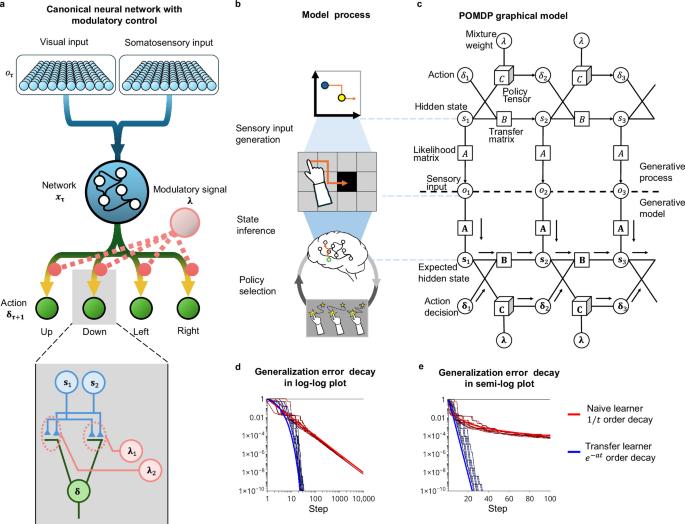
Fig. 1: Schematic of canonical neural networks performing active inference.DOI:10.1038/s42003-026-11152-5 https://creativecommons.org/licenses/by/4.0/
脳が新しい環境に素早く適応する仕組みを解明するため、プリズム眼鏡によって視界がずれた状態で行う到達運動(プリズム適応)を対象に、能動的推論(Active Inference)に基づく神経回路モデルを開発した。提案モデルは、異なる目標位置に対して事前学習した複数の行動規則を保持し、環境から得られる感覚情報に応じて、注意の働きを模した「注意スイッチ」により適切な規則を選択する。シミュレーションでは、プリズム眼鏡を装着した直後に生じる到達誤差の減少と、眼鏡を外した後に反対方向へ生じる誤差(後効果)の両方を再現した。一方、シナプス重みを逐次更新して行動規則を再学習する従来モデルでは、後効果を十分に再現できなかった。数理解析では、提案モデルの誤差が試行回数に対して指数関数的に減少するのに対し、従来モデルではべき乗則に従うことを示した。これらの結果は、脳が過去に獲得した知識を保持し、注意によって適切な行動規則を選び直すことで、新しい環境に迅速に適応する可能性を示している。ただし、本研究は数理モデルとシミュレーションによる検証であり、実際の脳内で同じ機構が働くことを直接実証したものではない。
To investigate how the brain rapidly adapts to unfamiliar environments, this study developed an active-inference-based neural circuit model of prism adaptation, a visuomotor phenomenon in which prism glasses shift the visual field during reaching movements. The proposed model retains multiple previously learned action policies for different target positions and selects the most appropriate policy according to sensory information through an attention-like mechanism termed an attention switch. Simulations reproduced both the reduction in reaching errors after prism exposure and the after-effects observed when the prism glasses were removed. In contrast, conventional models that gradually relearn action policies by updating synaptic weights failed to adequately reproduce the after-effects. Mathematical analysis showed that errors in the proposed model decrease exponentially with the number of trials, whereas those in conventional models follow a power-law relationship. These findings suggest that the brain may adapt rapidly to unfamiliar environments by retaining previously acquired knowledge and selecting appropriate action policies through attentional regulation rather than relearning all behavioral rules from scratch. However, the findings are based on computational modeling and simulations and do not directly demonstrate that the same mechanism operates in the biological brain.