2026-11-13 国立健康危機管理研究機構,産業技術総合研究所,京都大学,北里大学
<関連情報>
- https://www.jihs.go.jp/content4/pressrelease/2026/20261111114932.html
- https://www.jihs.go.jp/content4/pressrelease/2026/2026020/20261113_1400.pdf
- https://www.pnas.org/doi/10.1073/pnas.2603986123
B型肝炎ウイルスおよびD型肝炎ウイルスの細胞侵入を選択的に阻害するためのNTCP–EGFR受容体複合体の解離
Disruption of the NTCP–EGFR receptor complex as a strategy for selective inhibition of hepatitis B and D virus entry
Atsuto Kusunoki, Kaho Shionoya, Frank Stappenbeck, Takeshi Morita, Hirofumi Ohashi, Noritaka Kagaya, Makoto Nagano, Junki Mifune, Ryo Morishita, Feng Wang, Tetsuya Toyoda, Norimichi Nomura, Kazuo Shin-Ya, Kazuhiko Katayama, Farhad Parhami, Koichi Watashi
Proceedings of the National Academy of Sciences, 2026; 123(46):e2603986123
DOI:10.1073/pnas.2603986123
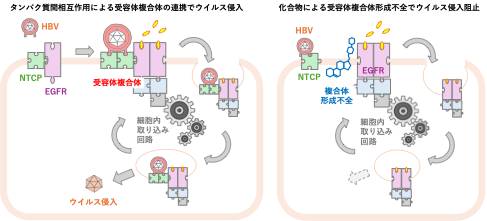
B型肝炎ウイルス(HBV)およびD型肝炎ウイルス(HDV)は、肝細胞表面の胆汁酸輸送体NTCPと、その補助因子である上皮成長因子受容体(EGFR)から構成される受容体複合体を利用して細胞内に侵入する。本研究では、このNTCP–EGFR間の相互作用を標的とする新たな抗ウイルス化合物の探索を行った。NTCPとEGFRの結合を評価する試験系を構築し、約1,000種類の化合物をスクリーニングした結果、オキシステロール誘導体Oxy229を同定した。細胞感染実験では、Oxy229がHBVとHDVの感染を抑制し、ウイルスと結合したNTCP複合体の細胞内への取り込みを阻害することが確認された。一方、NTCP本来の胆汁酸輸送機能やEGFRの下流シグナル伝達には顕著な影響を与えなかった。さらに、Oxy229の誘導体Oxy283を開発し、NTCP–EGFR間の結合とNTCPの多量体形成を同時に阻害することで、抗HBV活性を大幅に高めることに成功した。初代ヒト肝細胞を用いた実験では、Oxy283のHBV感染阻害に対するIC50は3.23 µMであった。本研究は、宿主細胞の受容体複合体を標的とする新しい抗ウイルス薬開発の可能性を示すものである。ただし、化合物の抗ウイルス活性や薬物動態、毒性には改善の余地があり、臨床応用にはさらなる研究が必要である。
Hepatitis B virus (HBV) and hepatitis D virus (HDV) enter hepatocytes through a receptor complex involving sodium taurocholate cotransporting polypeptide (NTCP), a bile acid transporter, and epidermal growth factor receptor (EGFR), an entry cofactor. This study investigated novel antiviral compounds targeting the interaction between NTCP and EGFR. The researchers established an assay to measure this interaction and screened approximately 1,000 compounds, identifying Oxy229, a semisynthetic oxysterol derivative. Cell-based infection experiments demonstrated that Oxy229 inhibited both HBV and HDV infection by preventing the internalization of virus-associated NTCP complexes into hepatocytes. Importantly, Oxy229 did not significantly impair the physiological bile acid transport activity of NTCP or downstream EGFR signalling pathways. The researchers subsequently developed Oxy283, a derivative that simultaneously inhibits NTCP–EGFR interaction and NTCP multimerization, resulting in substantially enhanced antiviral activity. In experiments using primary human hepatocytes, Oxy283 exhibited an IC50 of 3.23 µM against HBV infection. These findings demonstrate the potential of targeting host-cell receptor complexes as an alternative strategy for developing antiviral agents against HBV and HDV. However, further optimization of antiviral potency, pharmacokinetic properties, and safety is required before clinical application can be considered.