2026-11-13 鳴門教育大学,基礎生物学研究所,総合研究大学院大学,愛知教育大学
<関連情報>
食虫植物は獲物の知覚バイアスを利用しているのか? 黄緑色の捕虫葉を持つナガバノイシモチソウ(Drosera finlaysonii)の事例研究
Do carnivorous plants exploit prey perceptual bias? A case study in Drosera finlaysonii with yellow-green
Kazuki Tagawa, Aoi Watanabe, Shu-Miaw Chaw, Mitsuyasu Hasebe, Mikio Watanabe
Royal Society Open Science, 2026; 13(10):261740
DOI:10.1098/rsos.261740
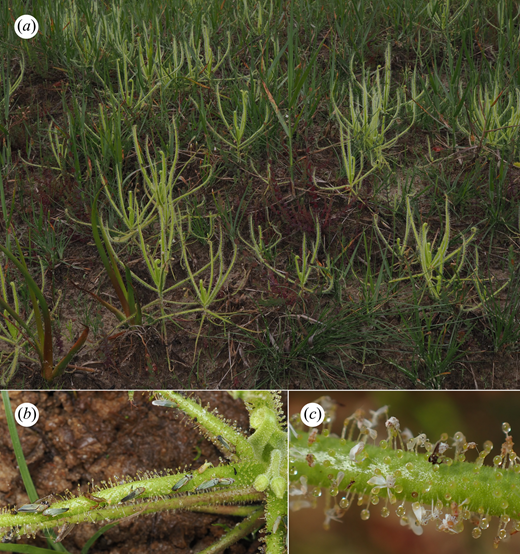
Figure 1. Drosera finlaysonii and trapped prey. (a) D. finlaysonii possesses bright yellow-green trap leaves that are visually conspicuous compared with the leaves of sympatric graminoid species. (b) Leafhoppers (Hemiptera: Auchenorrhyncha) trapped by D. finlaysonii. (c) Whiteflies (Hemiptera: Sternorrhyncha) trapped by D. finlaysonii.
Image: Tagawa et al., Royal Society Open Science (2026), CC BY 4.0.
食虫植物が獲物を捕獲する際、昆虫が特定の色に示す視覚的な反応(知覚バイアス)を利用している可能性が指摘されている。本研究では、黄緑色の捕虫葉を持つ食虫植物ナガバノイシモチソウ(Drosera finlaysonii)を対象に、昆虫の視覚特性を利用した捕獲メカニズムを検証した。マルチスペクトル画像解析により、捕虫葉は周囲のイネ科植物の葉より明るく、昆虫の緑色・青色光受容体の刺激比(G/B比)が高いことを確認した。また、2024年と2025年の野外調査で捕獲された節足動物を分析した結果、カメムシ目昆虫が主要な獲物群の一つであることが分かった。さらに、色とG/B比の異なる粘着式人工捕虫モデルを用いた実験では、G/B比が最も高い黄色モデルが、他の色のモデルより多くのカメムシ目昆虫を捕獲した。一方、実際の植物では人工黄色モデルと異なる獲物構成が観察され、双翅目昆虫の割合が高かった。これらの結果は、黄緑色の捕虫葉が昆虫の色彩知覚バイアスを利用してカメムシ目昆虫を誘引する可能性を支持する一方、色彩だけでは全体の捕獲パターンを説明できないことを示している。
Carnivorous plants may exploit the visual perceptual biases of insects to attract and capture prey. This study investigated this possibility in Drosera finlaysonii, a sundew characterized by bright yellow-green trap leaves. Multispectral imaging revealed that its traps were brighter than sympatric graminoid leaves and exhibited higher green-to-blue photoreceptor activation ratios (G/B ratios) when modelled using the visual system of hemipteran insects. Field surveys conducted in 2024 and 2025 identified Hemiptera as one of the major prey groups captured by the plants. In additional field experiments, adhesive artificial trap models with different colours and G/B ratios were deployed to examine visual attraction. Yellow models, which had the highest G/B ratio, captured more hemipterans than models of other colours. However, the prey assemblages captured by the actual plants differed from those captured by yellow models, with a higher proportion of Diptera and fewer Hemiptera. These findings support the hypothesis that the yellow-green traps of D. finlaysonii exploit the visual perceptual bias of hemipterans to enhance prey attraction and capture. Nevertheless, colour alone cannot fully explain the overall prey composition, suggesting that additional visual, chemical or ecological factors may contribute to prey capture.
原論文:The Royal Society Publishing