2026-08-24 ハーバード大学
<関連情報>
- https://seas.harvard.edu/news/smartphone-navigation-app-people-blindness-and-low-vision
- https://www.nature.com/articles/s41551-026-01772-x
AIを活用したスマートフォンアプリとパーソナライズされた音声ガイダンスを用いて、視覚障害者の屋外ナビゲーションを改善する Improving outdoor navigation for people with blindness using an AI-driven smartphone application and personalized audio guidance
Raymond Liu & Patrick Slade
Nature Medical Engineering Published:24 August 2026
DOI:https://doi.org/10.1038/s41551-026-01772-x
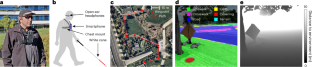
Abstract
Globally, 340 million people have blindness or moderate-to-severe visual impairment (BVI), which limits independent outdoor navigation and negatively affects their health and quality of life. We surveyed 112 people with BVI and found that an ideal outdoor navigation aid must be able to perform turn-by-turn directions, path guidance and obstacle detection and avoidance. Existing navigation tools such as white canes, guide dogs and electronic travel aids often lack one or more of these criteria and may be expensive or inaccessible. Here we introduce Mobilio, a smartphone application that incorporates machine learning, sensor fusion algorithms and personalized audio feedback to meet all of the outdoor navigation criteria. We assessed the reliability of the smartphone sensors and models used for navigation with engineering tests in representative navigation scenarios. We performed a series of experiments in which Mobilio personalized audio feedback for participants with BVI (n = 14), guided them along an outdoor community path and helped them to navigate an obstacle course. Participants walking with Mobilio and a white cane navigated a community path in 13 ± 3% less time and reduced environmental contacts by 41 ± 5% compared with using Google Maps and a white cane. Mobilio achieved similar outdoor navigation reliability to a human guide. Participant surveys reported that Mobilio was easy to use, had a low perceived workload and provided intuitive audio feedback. This work provides an accessible and personalized tool that may be an effective outdoor navigation aid to increase independence for people with BVI.